Three Delights from Earth
Eggplant, potato and green pepper stir-fried in a savoury-sweet sauce — a Northeastern home-style classic.
← Home · Shandong home-style egg
Silky pork slices, soft-scrambled egg, wood ear and daylily flowers, each cooked separately and combined in a thirty-second final toss — the Shandong home-style classic whose name nods to osmanthus blossom. Adapted for a home kitchen from the original ClouChef R&D report — 木须肉, report 94.
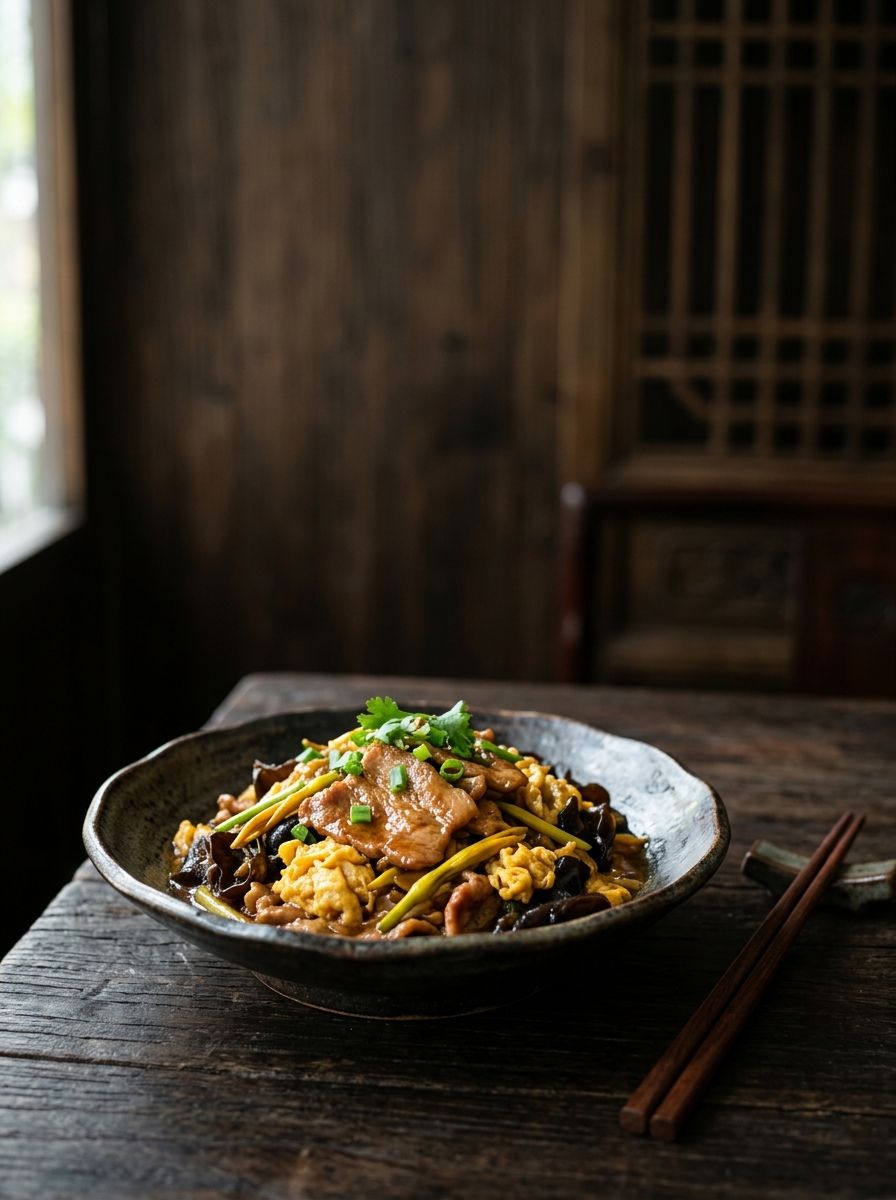
Muxu pork is a dish of separate cookings, and the separation is the point: pork sliced two millimetres thin needs forty seconds at 160 °C, egg needs thirty seconds over medium heat until just set, and wood ear with daylily needs a one-minute blanch to be both clean and safe. Cook them together and one of them is always wrong — the egg overcooks, the pork toughens, or the fungi stay gritty. So each is cooked alone, set aside, and reunited for a final thirty-second toss with soy, salt and MSG, just long enough for the flavours to meet without anything cooking further. The report's temperature discipline runs through it all: every component must reach at least 75 °C, and the finished dish must leave the pan at that temperature or above, served in a pre-warmed deep plate so it does not cool on the way to the table.
| Ingredient | US | Metric | Substitute / note |
|---|---|---|---|
| Pork tenderloin, sliced 2 mm | 4.2 oz | 120 g | Marinated with cooking wine and a little salt. |
| Eggs, beaten | 2 eggs | 100 g | Beaten with a little salt. |
| Dried wood ear, soaked | 0.5 oz dried | 15 g dried, 50 g soaked | Soaked 2 hours in cold water (adaptation: the report says soak the dried fungi 2 hours; keep the soak cold). |
| Dried daylily flowers, soaked | 0.35 oz dried | 10 g dried, 40 g soaked | Soaked 2 hours in cold water; trim the hard ends. |
| Salt | ½ tsp | 3 g | Divided between the pork, egg and final toss. |
| MSG | Pinch | 2 g | Optional — omit if you prefer (adaptation). |
| Light soy sauce | 2 tsp | 10 ml | For the final toss. |
| Cooking wine | 1 tsp | 5 ml | For marinating the pork. |
| Scallion segments | 0.35 oz | 10 g | — |
| Ginger slices | 0.2 oz | 5 g | — |
| Neutral oil, for cooking | 2 tbsp | 30 ml | — |
The final toss has a hard time limit because everything in the pan is already cooked: longer than sixty seconds total and the egg hardens, the pork dries and the fungi weep water into the sauce. That is why the fungi are blanched and the pork and egg are set aside before the pan is ever used for combining — the last step is assembly, not cooking. If the dish looks watery, the fungi were not drained well after blanching; if the egg is rubbery, it was scrambled past fully set.
Muxu refers to osmanthus blossom: the scrambled egg flecks scattered through the dish resemble tiny yellow blossoms.
You can, but wood ear and daylily give the dish its characteristic springy and silky textures; button mushrooms taste different (adaptation).
To remove impurities and ensure they are fully heated through — the report requires a one-minute boil at a centre temperature of at least 85 °C.
Best eaten fresh. Leftovers keep 1 day refrigerated; reheat until steaming hot throughout and do not reheat more than once. Do not freeze.
Pork slices, scrambled egg, wood ear and daylily in a light savoury toss.
Ingredients: 120 g pork tenderloin; 2 eggs; 15 g dried wood ear (50 g soaked); 10 g dried daylily (40 g soaked); 3 g salt; 2 g MSG (optional); 10 ml soy sauce; 5 ml cooking wine; 10 g scallion; 5 g ginger; 30 ml oil.
Steps: 1) Soak fungi 2 hours; marinate pork. 2) Blanch fungi 1 minute, chill. 3) Slide pork 40 seconds; scramble egg 30 seconds. 4) Combine all with soy and seasonings, toss 30 seconds.
Eggplant, potato and green pepper stir-fried in a savoury-sweet sauce — a Northeastern home-style classic.
First boiled, then stir-fried: pork belly slices with garlic shoots and a savoury bean-paste sauce.
Glass noodles tangled with savoury minced pork, chilli and Sichuan pepper.
Source note: ingredients, quantities and steps are adapted from the original ClouChef R&D report for 木须肉 (data/reports/94.md). The report's pricing, margin and marketing sections are deliberately omitted here; no B2B cost is presented as a home-cook cost. The report's own cost table is arithmetically wrong — its egg line is priced far above its own per-kilo rate, inflating its total — so no cost figures are reproduced. The MSG-optional note is an adaptation and is labelled as such. Original poster image: clouchef.com (木须肉_94.jpeg).