Mapo Tofu
Silky tofu in a tingly, spicy bean-paste sauce.
← Home · Sichuan pork weeknight
First boiled, then stir-fried: pork belly slices curled into little cups, coated in red bean-paste oil with garlic shoots and chillies. Adapted for a home kitchen from the original ClouChef R&D report — 回锅肉, report 4.
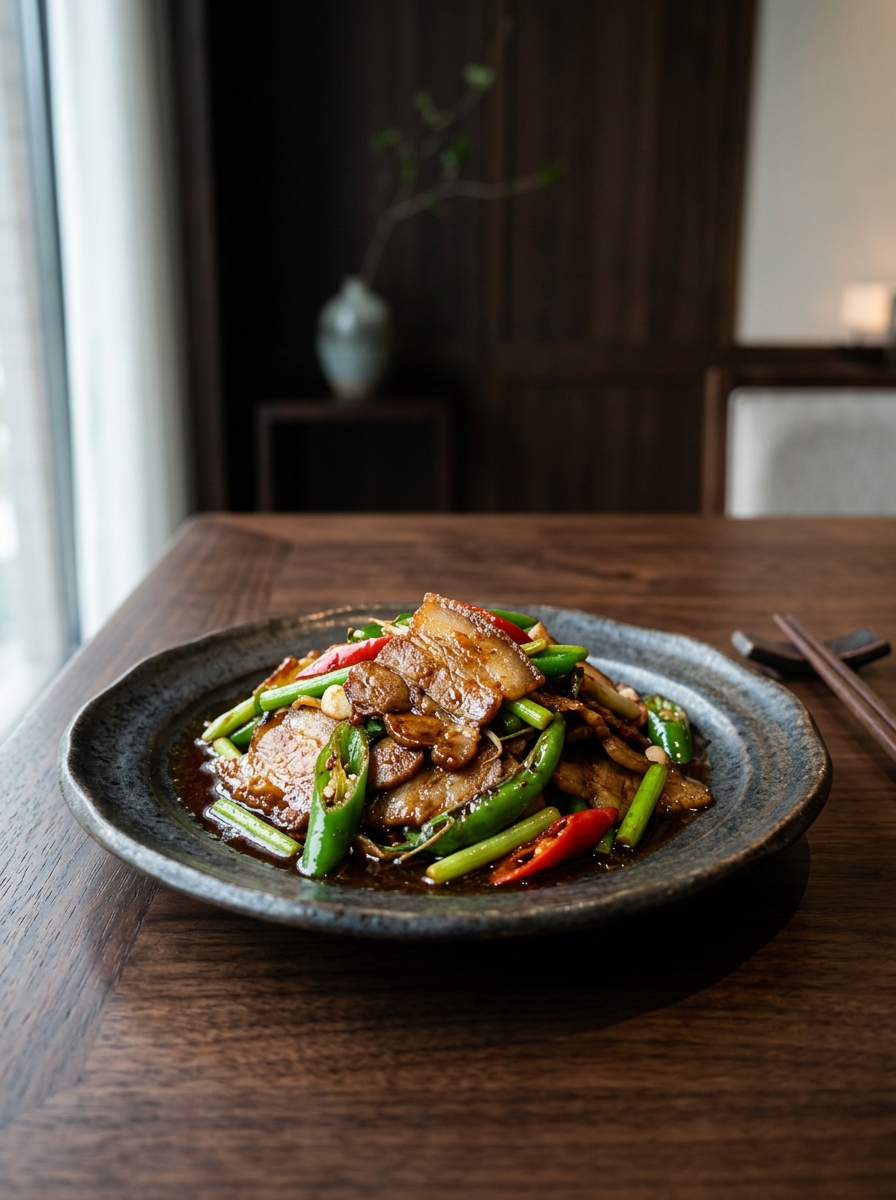
Twice-cooked pork works because the two cooks do opposite jobs. The first cook — a gentle 15-minute boil of the whole belly — renders just enough fat and firms the meat so it can be sliced 0.3 cm thin without falling apart. The second cook is fast and fierce: a minute over high heat curls those slices into the classic lamp-shaped cups, which catch the sauce instead of lying flat in it. Doubanjiang goes in on medium heat for exactly 30 seconds, long enough for its red oil to separate but not long enough to turn bitter, and sweet bean paste follows for a rounder, slightly sweet depth. Garlic shoots are split into white and green parts for a reason: the whites can take 30 seconds of heat, while the greens need only the final 10, or they yellow and weep. No thickener is needed — the rendered fat glosses the sauce on its own.
| Ingredient | US | Metric | Substitute / note |
|---|---|---|---|
| Pork belly with skin | 5.3 oz | 150 g | Skin-on belly curls best. Boneless pork shoulder is a leaner substitute but will not cup as well (adaptation). |
| Erjingtiao chillies, sliced into rings | 1.8 oz | 50 g | Long, mild red chillies. Fresno or mild long red chillies are the closest substitute (adaptation). |
| Garlic shoots (garlic sprouts), white and green parts separated | 1.8 oz | 50 g | Spring onions are the closest substitute if garlic shoots are unavailable (adaptation). |
| Pixian doubanjiang | 1 tbsp + 1 tsp | 20 g | — |
| Sweet bean paste (tianmianjiang) | 2 tsp | 10 g | — |
| Ginger slices | 1 tsp | 5 g | For the boiling water. |
| Cooking wine | 2 tsp | 10 ml | Shaoxing wine; for the boiling water. |
| Neutral cooking oil | 1 tbsp + 1 tsp | 20 ml | — |
| White sesame seeds or scallions, to garnish (optional) | 1 tsp | 3 g | Optional, from the report. |
The dish is named for its shape: slices curled like little oil lamps. That curl only happens when the belly is boiled first, sliced thin, and hit with high heat — too thick and the slices lie flat, too thin and they burn. The report's other timing rule matters just as much: doubanjiang on medium heat for 30 seconds to release red oil, never on fierce heat, or it turns bitter. Cook pork to 71 °C / 160 °F throughout (home food-safety guidance, added as an adaptation).
They were probably cut thicker than 0.3 cm, or the pan was not hot enough. Thin slices and a genuinely hot pan are what make them cup.
You can, but the dish will taste sharper and saltier. A teaspoon of sugar stirred in with the doubanjiang is the closest fallback (adaptation).
Spring onions are the usual substitute: use the white parts like the shoot whites and the greens like the leaves, with the same split timing.
Best eaten fresh, while the slices are still curled and crisp-edged. Leftovers keep 2 days refrigerated; reheat in a hot pan until steaming throughout and expect the slices to relax and soften. Do not reheat more than once.
Twice-cooked pork belly with garlic shoots and chillies in a savoury bean-paste sauce.
Ingredients: 150 g pork belly; 50 g chillies; 50 g garlic shoots; 20 g doubanjiang; 10 g sweet bean paste; 5 g ginger; 10 ml cooking wine; 20 ml oil.
Steps: 1) Boil belly 15 minutes, cool, slice 0.3 cm. 2) Stir-fry slices on high heat 1 minute until curled. 3) Doubanjiang 30 seconds, sweet paste 15 seconds. 4) Garlic-shoot whites and chillies 30 seconds, greens 10 seconds.
Silky tofu in a tingly, spicy bean-paste sauce.
Sichuan's famous sweet, sour, salty and tingly chicken — pan-fried, not deep-fried, with peanuts for crunch.
Steamed glutinous rice with pork, dried mushrooms and dried shrimp — savoury, filling and warming.
Newsletter note: the signup form on the homepage is a static placeholder and does not collect or send anything.
Source note: ingredients, quantities and steps are adapted from the original ClouChef R&D report for 回锅肉 (data/reports/4.md). The report's pricing, margin and marketing sections are deliberately omitted here; no B2B cost is presented as a home-cook cost. Original poster image: clouchef.com (回锅肉_4.jpeg). Serving size for home use (1–2), the chilli and garlic-shoot substitutes, and the safety temperature are adaptations and are labelled as such.