Beijing Zhajiang Noodles
Wheat noodles topped with a rich, savoury black bean paste and crisp julienned vegetables.
← Home · Beijing wrap-it-yourself sweet bean paste
Silky pork shreds wrapped in a glossy sweet bean-paste glaze, rolled at the table in steamed bean-curd sheets with blanched scallion. Adapted for a home kitchen from the original ClouChef R&D report — 京酱肉丝, report 84.
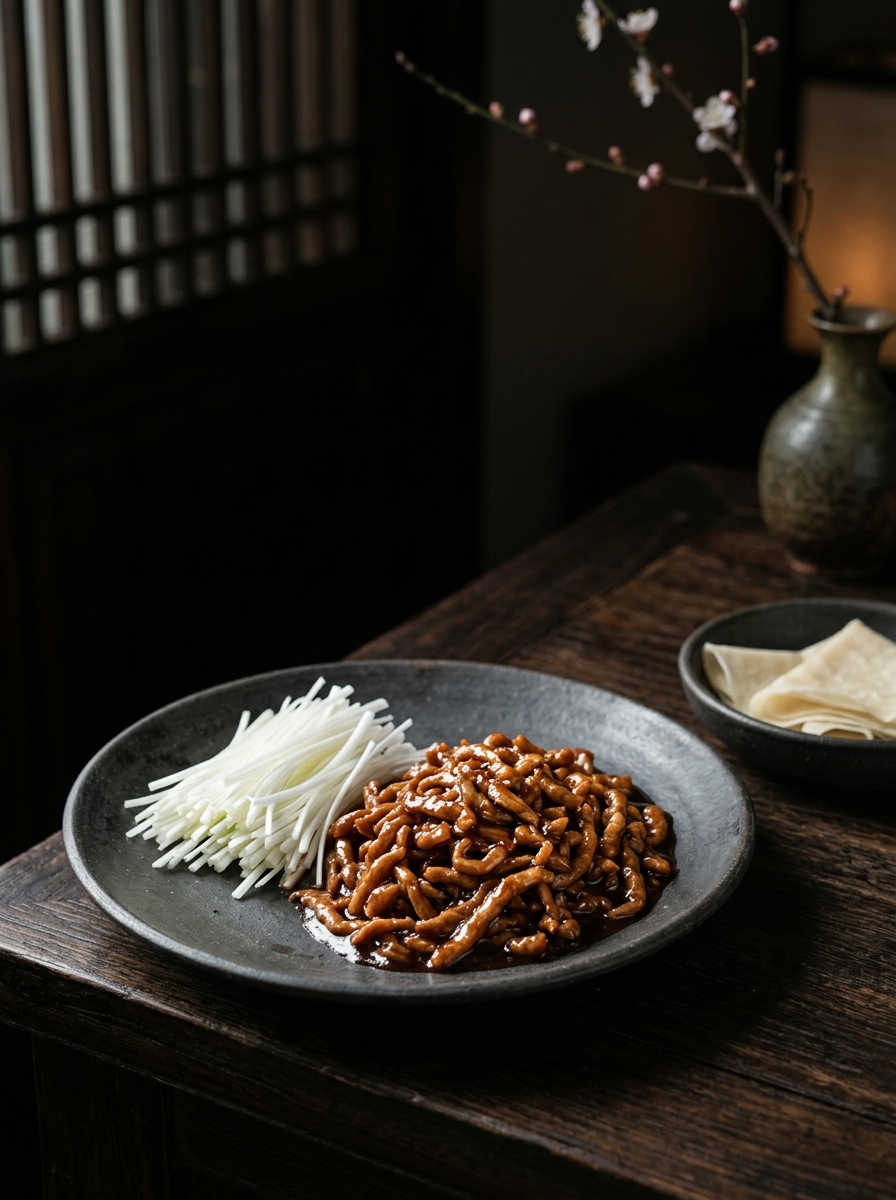
The dish is won in two short moves: a forty-second slide of the pork and a ninety-second fry of the paste. Sliding the velveted shreds at only about 120 °C keeps them tender and separate, because the coating sets before the fibres can seize; any hotter and they clump and toughen. Frying the sweet bean paste on low heat until it bubbles like fish eyes and darkens is what removes its raw, pasty edge and turns it into a glossy glaze that clings instead of pooling. The final toss lasts ten seconds by design — long enough to coat every shred, short enough that the pork never overcooks. Blanching the scallion for exactly five seconds, then shocking it in ice water, keeps its crunch and takes off the raw bite, so the roll tastes fresh rather than harsh. Serve the pork, sheets and scallion separately and let everyone roll their own. At the table, small batches and frequent dipping keep the meal paced and social rather than rushed.
| Ingredient | US | Metric | Substitute / note |
|---|---|---|---|
| Pork tenderloin, cut into 7 cm shreds, 0.3 cm thick | 8.8 oz | 250 g | Freeze 30 minutes until semi-firm before slicing — the report's slicing tip. |
| Dried bean-curd sheets (round), steamed | 2 sheets | 2 sheets | Steamed 3 minutes, then cut into 10 cm squares. Fresh tofu skin or thin flour pancakes work as a wrap (adaptation). |
| Scallion whites only, cut into fine shreds | 3.5 oz | 100 g | Middle section only, per the report. |
| Cooking wine (marinade) | 2 tsp | 10 ml | Shaoxing wine. |
| Light soy sauce (marinade) | 1 tsp | 5 ml | — |
| White pepper (marinade) | Pinch | 1 g | — |
| Corn starch (marinade) | 2 tsp | 10 g | — |
| Egg white (marinade) | ½ egg white | 15 g | — |
| Neutral oil, for sealing and sliding | About 7 tbsp | 105 ml | 5 ml to seal the marinade; 200 ml in the report is a restaurant slide-oil quantity, most of which is drained off — the home adaptation uses a smaller pan and less oil (adaptation). |
| Sweet bean paste (tianmianjiang) | 2 tbsp + 2 tsp | 40 g | The core flavour; do not substitute hoisin, which is sweeter and thinner. |
| Sugar | 1 tbsp | 15 g | Balances the paste's saltiness. |
| Dark soy sauce | ½ tsp | 3 ml | For colour only. |
| Water or stock | 2 tbsp | 30 ml | To loosen the glaze. |
The paste fry is the dish's real cooking: it must be stirred the whole ninety seconds, because sweet bean paste catches quickly and the difference between fragrant and burnt is a matter of seconds. The pork, by contrast, is barely cooked at all — the slide and the final toss together last under a minute, and the residual heat finishes the job. If the glaze looks watery, it was not reduced enough; if the pork looks grey and stiff, the slide oil was too hot.
Usually the slide oil was too hot, or the shreds were not sealed with oil in the marinade. Keep the oil at about 120 °C and stir the shreds apart as they go in.
It will taste different — sweeter and thinner — and will not fry to the same glossy glaze. Sweet bean paste is worth finding at an Asian grocery.
Five seconds in boiling water, then ice water, removes the raw bite and kills surface bacteria while keeping the crunch — the report's own control point.
Best eaten fresh; the glaze soaks into the pork on standing. Leftovers keep 1 day refrigerated; reheat gently until steaming hot throughout. The steamed sheets dry out quickly — keep them covered and do not freeze the finished dish.
Silky pork shreds in a glossy sweet bean-paste glaze, rolled in bean-curd sheets with scallion.
Ingredients: 250 g pork tenderloin; 2 bean-curd sheets; 100 g scallion whites; marinade: 10 ml cooking wine, 5 ml light soy, 1 g white pepper, 10 g corn starch, 15 g egg white; 40 g sweet bean paste; 15 g sugar; 3 ml dark soy; 30 ml water; oil for sliding.
Steps: 1) Velvet pork 15 minutes. 2) Steam sheets 3 minutes; blanch scallion 5 seconds, ice 10 minutes. 3) Slide pork in 120 °C oil ~40 seconds. 4) Fry paste on low heat 90 seconds, toss pork with glaze 10 seconds, serve for rolling.
Wheat noodles topped with a rich, savoury black bean paste and crisp julienned vegetables.
First boiled, then stir-fried: pork belly slices with garlic shoots and a savoury bean-paste sauce.
Slow-braised pork belly with rock sugar, in an Instant Pot or on the stove, with a glossy, savoury-sweet sauce.
Source note: ingredients, quantities and steps are adapted from the original ClouChef R&D report for 京酱肉丝 (data/reports/84.md). The report's pricing, margin and marketing sections are deliberately omitted here; no B2B cost is presented as a home-cook cost. The report's own cost figures are inconsistent with each other — its ingredient-table total contradicts its own opening estimate for the same dish, and one line item is priced implausibly high — so no cost figures are reproduced. The reduced slide-oil quantity and the pancake wrap option are adaptations and are labelled as such. Original poster image: clouchef.com (京酱肉丝_84.jpeg).