Lamb Noodle Soup
Henan-style lamb soup noodles with sesame paste, tofu skin and a warming, savoury broth.
← Home · Beijing noodles make-ahead
Wheat noodles topped with slow-fried black bean pork and crisp vegetable shreds. Adapted for a home kitchen from the original ClouChef R&D report — 老北京炸酱面, report 81.
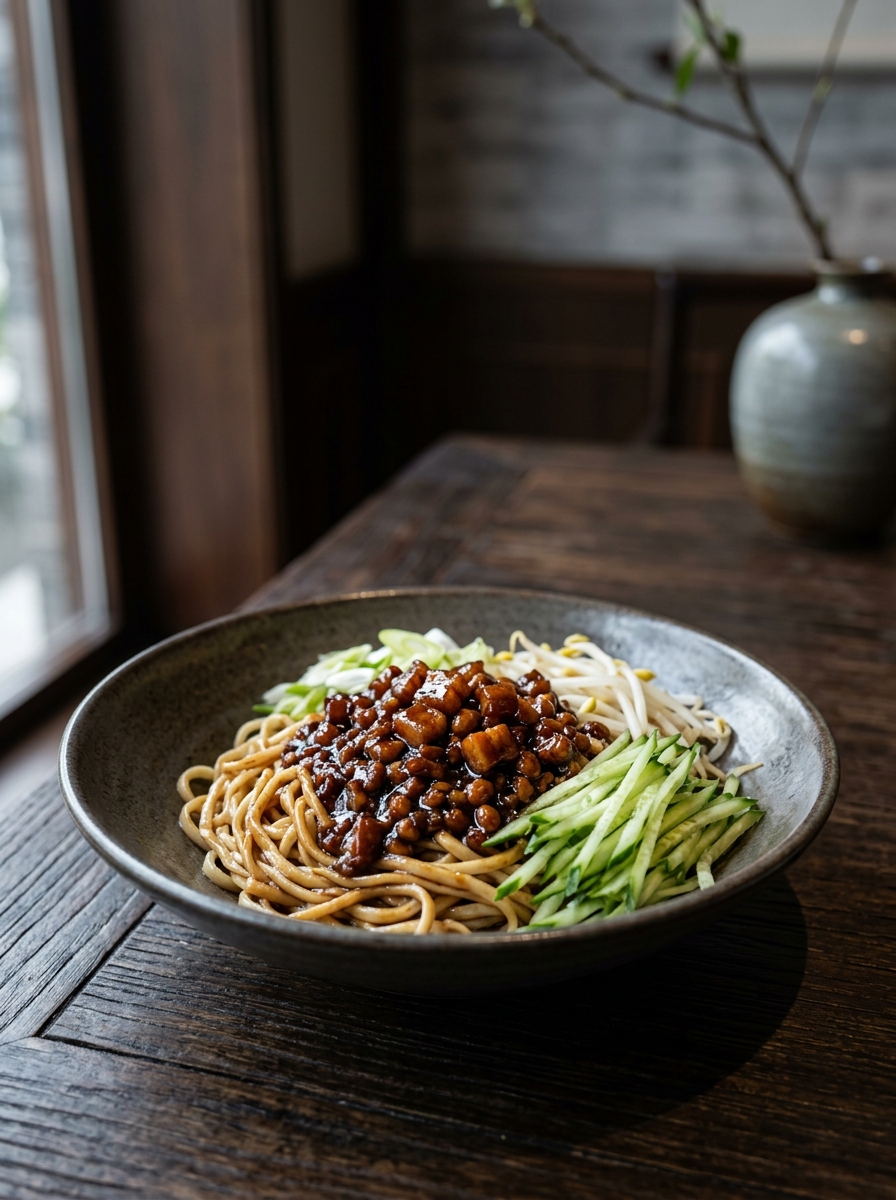
Zhajiang is really two dishes that meet in the bowl: a sauce that rewards patience, and toppings that reward speed. The sauce is yellow soybean paste and sweet bean paste in a 2:1 ratio, loosened with warm water until smooth, then fried on the lowest possible heat for a full 15 minutes with constant stirring. That slow fry is what turns a raw, salty paste into something glossy, dark and deeply savoury, and the signal to stop is visual — the oil separates and floats on the sauce. The toppings do the opposite: cucumber and radish shreds get just 10 seconds in boiling water, then ice water, so they stay crisp and cold against the warm noodles, and the noodles themselves get 30 seconds in ice water so they stay springy instead of clumping. Two heaped spoonfuls of sauce is the report's measure, and it is enough — more drowns the vegetables.
| Ingredient | US | Metric | Substitute / note |
|---|---|---|---|
| Pork belly, cut into 0.5 cm dice | 2.8 oz | 80 g | Blanched before frying. Minced pork is a home alternative (adaptation). |
| Yellow soybean paste (dry huangjiang) | 2 tbsp + 2 tsp | 40 g | Loosen with warm water before frying. |
| Sweet bean paste | 1 tbsp + 1 tsp | 20 g | Ratio to yellow paste is 2:1. |
| Warm water, to loosen the pastes | 3 tbsp + 1 tsp | 50 ml | Stir until no lumps remain. |
| Wheat noodles (fresh hand-pulled style, or dried) | 7 oz | 200 g | Dried wheat noodles work; cook to the packet time instead of 2 minutes (adaptation). |
| Cucumber, cut into fine shreds | 1.8 oz | 50 g | Blanched 10 seconds, then iced. |
| Xinlimei radish, cut into fine shreds | 1 oz | 30 g | Daikon or ordinary red radish are substitutes (adaptation). Blanched 10 seconds, then iced. |
| Mung bean sprouts | 1 oz | 30 g | Blanched 1 minute, then cooled. |
| Scallion, chopped | 2 tsp | 10 g | Stirred into the finished sauce. |
| Neutral cooking oil | 1 tbsp + 1 tsp | 20 ml | — |
Zhajiang cannot be rushed: on anything above the lowest heat, the bean pastes scorch and turn bitter before they develop flavour. Stir constantly, set a timer for 15 minutes, and watch for the moment the sauce turns dark and glossy and a layer of oil floats free — that separation is the report's doneness signal, not the clock alone. The sauce keeps for 3 days refrigerated and must be reheated past 70 °C before serving (from the report).
The heat was too high during the 15-minute fry, or the stirring stopped and the paste caught. Lowest heat and constant stirring are non-negotiable.
They probably skipped the ice-water step. Thirty seconds in ice water after boiling keeps wheat noodles springy and separate.
The 2:1 balance is the point: yellow paste alone is too salty, sweet paste alone too sweet. If you must use one, adjust salt and sugar to taste (adaptation).
The sauce keeps 3 days refrigerated (from the report); reheat past 70 °C before serving. Cooked noodles keep 1 day refrigerated but lose their spring; the chilled vegetable toppings keep 1 day. Assemble fresh each time.
Wheat noodles with slow-fried bean-paste pork and crisp chilled vegetable shreds.
Ingredients: 80 g pork belly; 40 g yellow soybean paste; 20 g sweet bean paste; 50 ml warm water; 200 g wheat noodles; 50 g cucumber; 30 g radish; 30 g bean sprouts; 10 g scallion; 20 ml oil.
Steps: 1) Blanch pork dice; loosen pastes 2:1 with warm water. 2) Blanch vegetable shreds 10 seconds, sprouts 1 minute; ice and drain. 3) Fry pork 3 minutes, then pastes on lowest heat, stirring, 15 minutes until oil separates. 4) Boil noodles, ice water 30 seconds. 5) Assemble with 2 heaped tablespoons of sauce per bowl.
Henan-style lamb soup noodles with sesame paste, tofu skin and a warming, savoury broth.
Shanghai-style noodles tossed in fragrant scallion oil and soy — fifteen minutes, pantry ingredients, big flavour.
Eggplant, potato and green pepper, fried then tossed in a savoury sauce — a classic Northeastern home dish.
Newsletter note: the signup form on the homepage is a static placeholder and does not collect or send anything.
Source note: ingredients, quantities and steps are adapted from the original ClouChef R&D report for 老北京炸酱面 (data/reports/81.md). The report's pricing, margin and marketing sections are deliberately omitted here; no B2B cost is presented as a home-cook cost. Original poster image: clouchef.com (老北京炸酱面_81.jpeg). Serving size for home use (2), the dried-noodle timing, the radish substitute and the minced-pork option are adaptations and are labelled as such.