Twice-Cooked Pork
Pork first simmered, then stir-fried with peppers and bean paste.
← Home beef snack spicy
Beef shank simmered, cut into strips, tossed in chilli and Sichuan pepper, then oven-dried until chewy. Adapted from the original ClouChef R&D report — 麻辣牛肉干, report 179. A snack, not a stir-fry — allow about four hours.
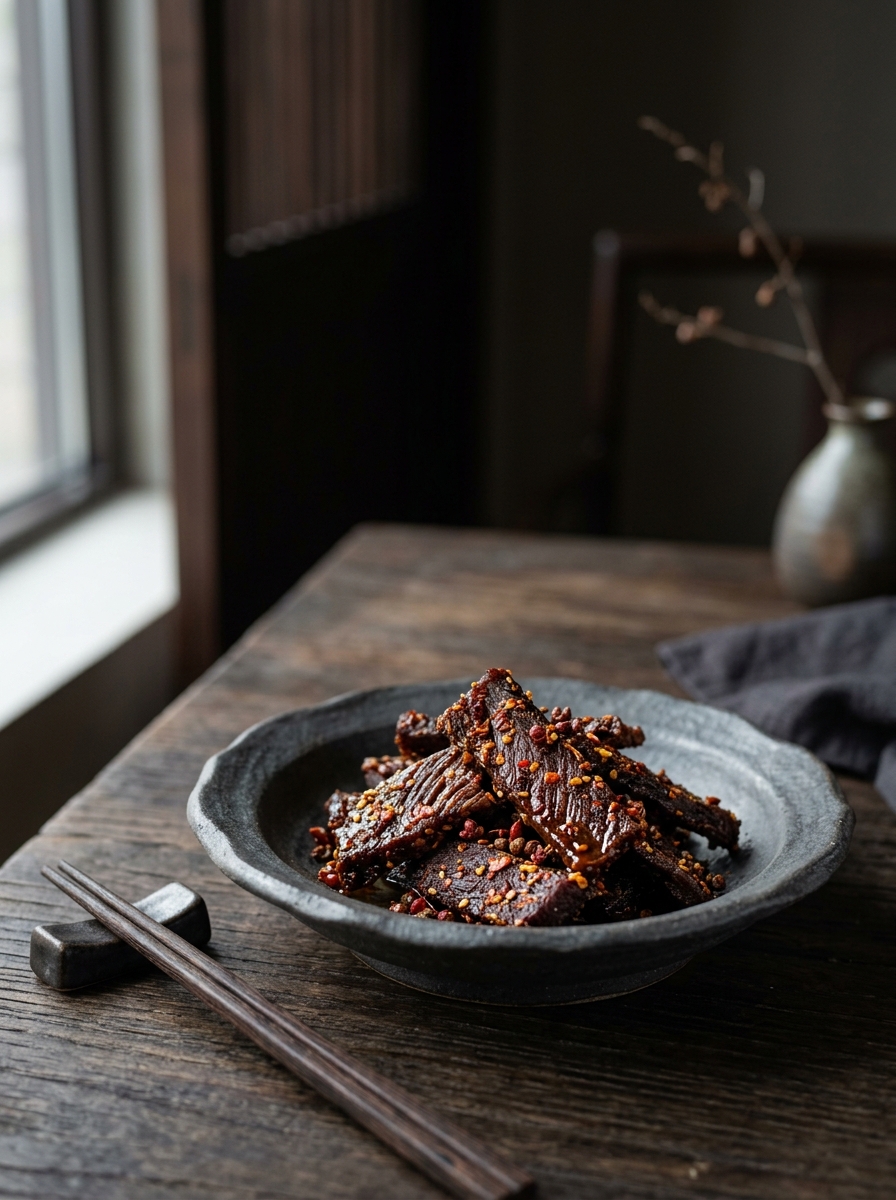
Home adaptation note: The report starts from 500 g raw shank and yields about 250 g finished jerky. Quantities below are that batch. The report's simmering liquid lists ginger, scallion and 'high-proof baijiu' without quantities for the liquor; those amounts are a home adaptation. Drying time is 45–60 minutes at 100 °C per the report; check from 45 minutes.
Good jerky is a drying exercise, not a cooking one, and this report treats it that way at every stage. Shank is soaked for two hours, then simmered for sixty minutes until a chopstick slides in with no blood — long enough to be fully cooked, short enough to still slice cleanly. The cooled meat is cut with the grain into strips one centimetre square and five centimetres long, because cutting with the grain is what gives jerky its chew instead of its crumble. The strips are then stir-fried on medium-low heat until lightly coloured and their moisture has dried off, about five minutes, before the spices go anywhere near the pan. Only on the lowest heat, for thirty seconds at most, are the chilli powders, Sichuan pepper, salt, sugar and soy added — any hotter or longer and the ground spices scorch and turn bitter. A final oven drying at one hundred degrees with fan circulation finishes the job: dry on the outside, still chewy inside.
| Ingredient | US | Metric | Substitute / note |
|---|---|---|---|
| Beef shank | 1.1 lb | 500 g | Shank, per the report, for its mix of muscle and sinew. |
| Erjingtiao chilli powder | 2 tbsp | 30 g | A fragrant, medium-heat Sichuan chilli powder. |
| Zidantou (bullet-head) chilli powder | 1 tbsp | 15 g | Hotter than erjingtiao; reduce for a milder jerky. |
| Hanyuan Sichuan pepper powder | 2 tsp | 10 g | Hanyuan pepper is prized for its aroma; any good Sichuan pepper powder works (adaptation). |
| Toasted white sesame seeds | 2 tsp | 10 g | Added off the heat. |
| Ginger slices and scallion sections | 0.7 oz each | 20 g each | For simmering. |
| High-proof baijiu (for simmering) | 1 tbsp | 15 ml | No quantity in the report; a home adaptation. Vodka works in a pinch. |
| Salt | 1 tsp + 1/2 tsp | 8 g | — |
| Sugar | 1 tbsp | 15 g | — |
| Light soy sauce | 1 tbsp | 15 ml | — |
| Dark soy sauce | 1 tsp | 5 ml | — |
| Neutral cooking oil | 3 tbsp + 1 tsp | 50 ml | For stir-frying the strips. |
Ground chilli and Sichuan pepper burn in seconds over real heat. The pan must be at its lowest setting, and the seasoning toss must be over within thirty seconds — that is the difference between fragrant jerky and bitter jerky.
The oven drying was too short, or the strips were crowded. Spread in a single layer and check from 45 minutes.
The spices were fried too hot or too long. Lowest heat, 30 seconds maximum.
It was cut against the grain. Cut with the grain for chew.
Keeps 1 week in an airtight container at room temperature, or 2 weeks refrigerated, once fully cooled and dried. If any strip feels damp, dry it longer before storing; damp jerky spoils.
Chewy Sichuan beef jerky with chilli, Sichuan pepper and sesame.
Ingredients: 500 g beef shank; 30 g erjingtiao chilli powder; 15 g zidantou chilli powder; 10 g Sichuan pepper powder; 10 g sesame; 20 g ginger; 20 g scallion; 15 ml baijiu; 8 g salt; 15 g sugar; 15 ml light soy; 5 ml dark soy; 50 ml oil.
Steps: 1) Soak shank 2 hours, simmer 60 minutes, cool. 2) Cut with the grain into 1 × 1 × 5 cm strips. 3) Stir-fry on medium-low heat 5 minutes until dry. 4) Season on lowest heat within 30 seconds. 5) Oven-dry at 100 °C for 45–60 minutes.
Pork first simmered, then stir-fried with peppers and bean paste.
Cantonese roast pork with a sweet glazed edge.
Fish poached in a fiery, numbing broth.
Source note: ingredients, quantities and steps are adapted from the original ClouChef R&D report for 麻辣牛肉干 (data/reports/179.md). The report's pricing, margin and marketing sections are deliberately omitted here; no B2B cost is presented as a home-cook cost. The report's cost table is not reproduced, and the baijiu quantity is labelled as an adaptation.