Scallion Oil Noodles
Noodles tossed in fragrant scallion oil.
← Home Shanxi noodles sour-spicy
Hand-shaved wheat noodles, chilled for bite, dressed with garlic, Shanxi aged vinegar and chilli oil, and topped with scalding-hot braised pork. Adapted from the original ClouChef R&D report — 山西刀削面, report 157.
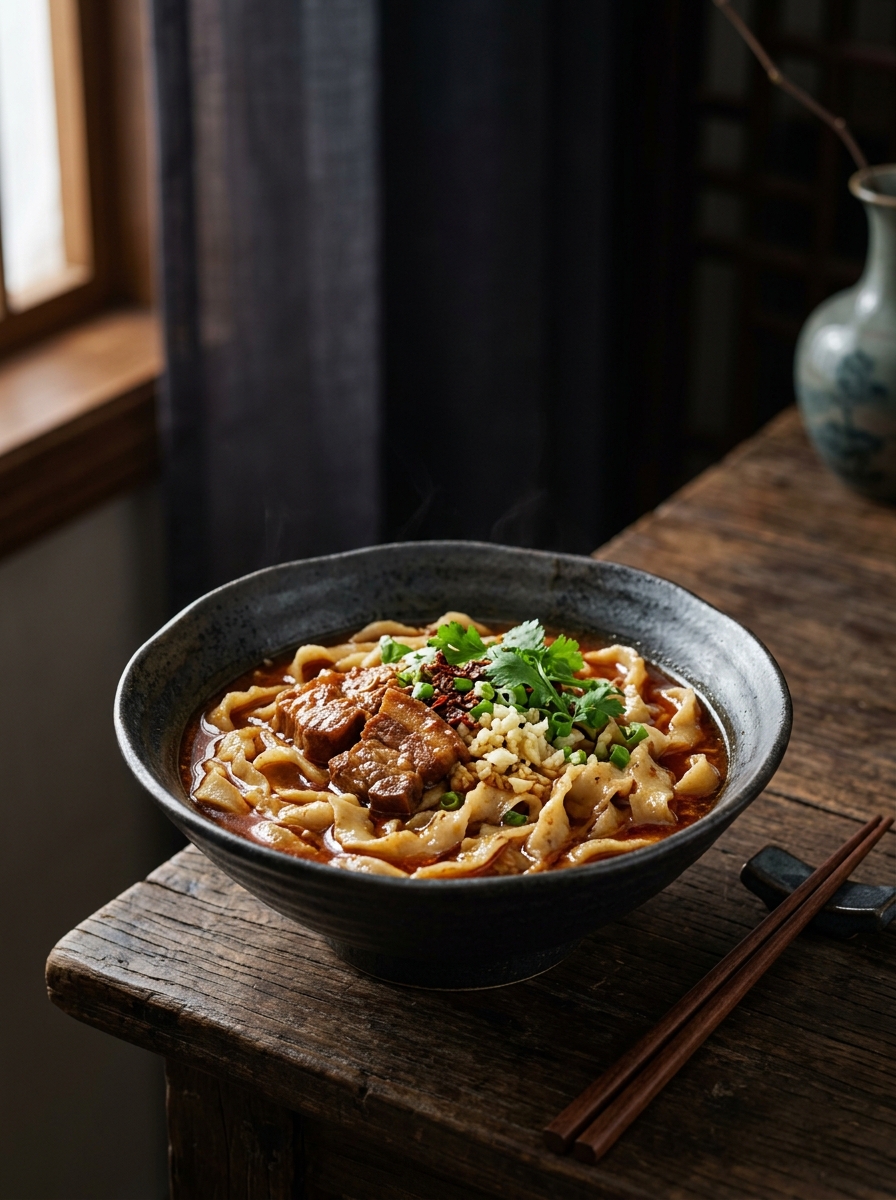
Home adaptation note: The report is one portion (200 g flour, about 350 g finished). Quantities below are that portion. No shaving knife? Cut the rested dough into thin strips with a knife instead — the shape changes but the method holds (adaptation).
Everything in this bowl is built around one contrast: cold, firm noodles against a topping served at a rolling boil. The dough is deliberately stiff, roughly two parts flour to one part water, and rested for thirty minutes so it relaxes enough to shave without springing back. Each shaving should be about three centimetres long and only two or three millimetres thick, so it cooks through quickly. A single splash of cold water while the noodles boil, the classic point-water step, lets the centre cook without turning the broth starchy. Chilling the noodles in ice water firms them up, and the pork topping must be genuinely boiling when it hits the bowl, because that heat is what blooms the raw garlic and sterilises the garnish in the report's own terms. The vinegar goes into the pork during braising as well as the bowl, so the sourness tastes rounded rather than sharp.
| Ingredient | US | Metric | Substitute / note |
|---|---|---|---|
| Bread flour (high-gluten) | 7 oz | 200 g | Bread flour, not all-purpose, for a dough stiff enough to shave. |
| Water (for dough) | 6 tbsp | 90 ml | Ice water in summer, per the report. |
| Salt (for dough) | 1/2 tsp | 3 g | — |
| Pork belly, cut into 0.5 cm dice | 2.8 oz | 80 g | Report also describes a 3:7 fat-to-lean belly; belly is the cut. |
| Shanxi aged vinegar, divided | 2 tbsp | 30 ml | 10 ml into the pork braise, 20 ml in the bowl. No substitute matches it; black vinegar is closest (adaptation). |
| Garlic, crushed to a paste | 0.5 oz | 15 g | — |
| Chilli oil | 1 tbsp | 15 ml | Shop-bought or homemade. |
| Light soy sauce | 2 tsp | 10 ml | — |
| Sichuan pepper powder | 1/4 tsp | 1 g | — |
| Ginger, minced; star anise; Sichuan pepper (for braise) | To taste | Small amounts | Report lists them without quantities; amounts are a home adaptation — a pinch each. |
| Scallion, chopped | To garnish | To garnish | Must be scalded by the hot topping or blanched, per the report. |
| Neutral cooking oil | 1 tbsp | 15 ml | For frying the pork. |
A soft dough cannot be shaved; it tears and clumps. The 30-minute rest is what lets a stiff dough relax enough to cut cleanly. And the topping must truly boil — lukewarm pork will not bloom the garlic, and the report requires the garnish to be heated by it.
The dough was not rested long enough, or it was too soft. Rest the full 30 minutes and keep the dough stiff.
The report does, for bite. Skipping it gives softer, warmer noodles — pleasant, but a different dish.
Yes, but Shanxi aged vinegar is more mellow and aromatic; ordinary black vinegar will taste sharper, so start with a little less.
Best eaten fresh. Cooked noodles keep 1 day refrigerated; reheat the pork topping to a full boil before pouring over. Do not store the assembled bowl.
Shaved wheat noodles with sour-spicy pork topping, served with garlic and aged vinegar.
Ingredients: 200 g bread flour; 90 ml water; 3 g salt; 80 g pork belly; 30 ml Shanxi aged vinegar; 15 g garlic; 15 ml chilli oil; 10 ml light soy; 1 g Sichuan pepper powder; ginger, star anise, Sichuan pepper to taste.
Steps: 1) Braise pork dice 15 minutes with vinegar and spices. 2) Rest stiff dough 30 minutes. 3) Shave into boiling water, point with cold water once, drain and chill. 4) Bowl garlic, vinegar and chilli oil; pour boiling pork over, add noodles.
Noodles tossed in fragrant scallion oil.
Warming lamb broth ladled over noodles.
Pork first simmered, then stir-fried with peppers and bean paste.
Source note: ingredients, quantities and steps are adapted from the original ClouChef R&D report for 山西刀削面 (data/reports/157.md). The report's pricing, margin and marketing sections are deliberately omitted here; no B2B cost is presented as a home-cook cost. Ginger, star anise and Sichuan pepper quantities for the braise are not given in the report and are labelled as a home adaptation.