Braised Beef with Potatoes
Beef braised until tender with potatoes that soak up the savoury sauce — a classic family stew.
← Home · Shandong offal braised
Pork intestines cleaned three times over, blanched, then braised forty minutes in a sweet-sour spiced sauce and reduced until the glaze clings — Shandong's famously fiddly 'nine-turn' classic. Adapted for a home kitchen from the original ClouChef R&D report — 九转大肠, report 91.
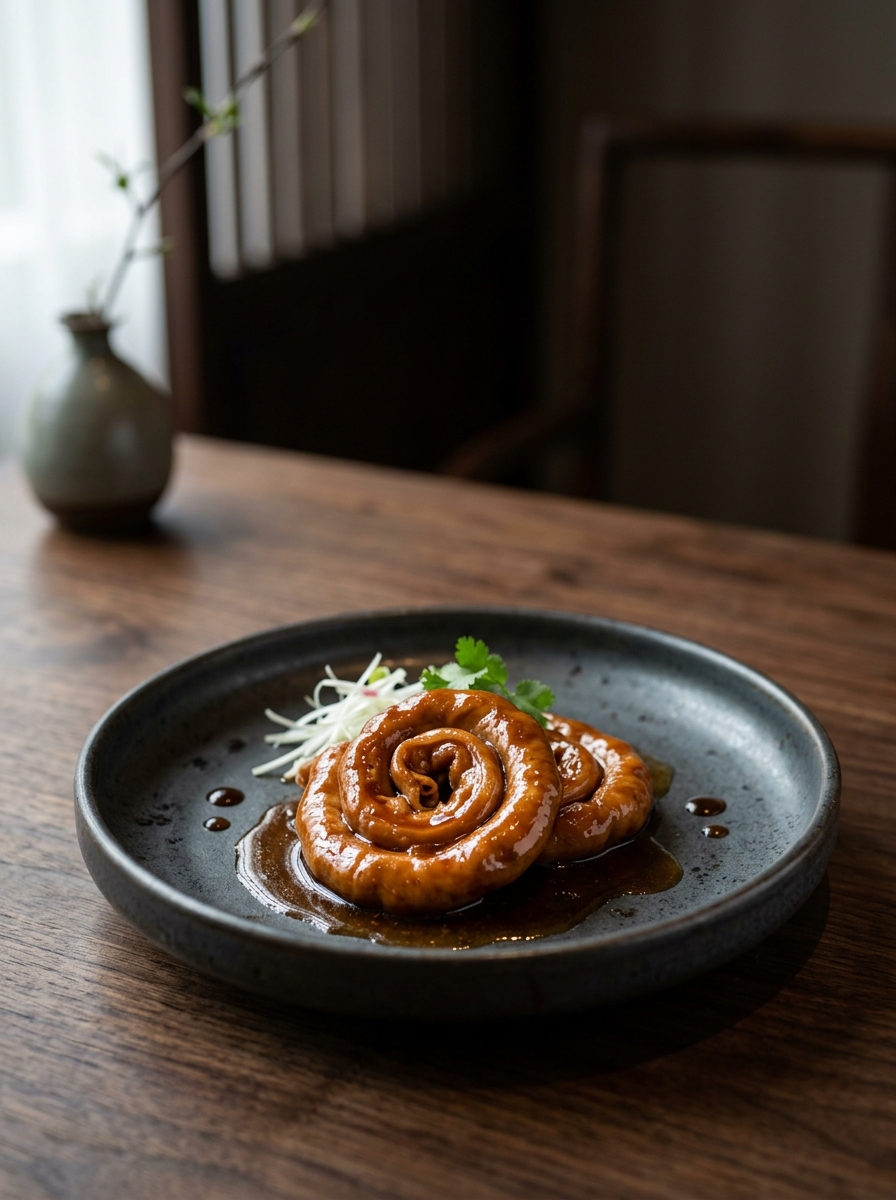
Nine turns is not a literal count but a promise of labour: the intestines are turned inside out, scrubbed with flour and salt three times, and rinsed until the water runs clear, because any trace of fat or mucus left on the wall will haunt the finished dish with odour no amount of spice can hide. Braising then does the tenderising — forty minutes at a low simmer in sugar colour, soy, sugar and vinegar, with star anise, cinnamon and Sichuan pepper — until the coils are soft but still springy. The final reduction is the signature: five to eight minutes over medium-high heat, turning constantly, until the sauce thickens from a braising liquid into a clinging glaze that makes each piece shine. Serve it as it comes from the pan, with the remaining sauce spooned over, while the glaze is still glossy and has not yet set.
| Ingredient | US | Metric | Substitute / note |
|---|---|---|---|
| Pork large intestines, raw | 8.8 oz | 250 g | Yield is about 150 g cooked. Buy from a butcher and clean as described; ready-cleaned intestines from a Chinese grocery save the hardest step (adaptation). |
| Flour and salt, for cleaning | As needed | As needed | For three rounds of scrubbing; rinse until the water is clear. |
| Scallion segments | 0.7 oz | 20 g | For blanching. |
| Ginger slices | 0.5 oz | 15 g | For blanching. |
| Cooking wine, for blanching | A splash | A splash | Report gives no quantity; about 1 tablespoon (adaptation). |
| Star anise | 0.07 oz | 2 g | — |
| Cinnamon bark | 0.1 oz | 3 g | — |
| Sichuan peppercorns | Pinch | 1 g | — |
| Soy sauce, half dark and half light | 2 tbsp | 30 ml | — |
| Sugar, half rock sugar and half white sugar | 1 tbsp + 2 tsp | 40 g | — |
| Rice vinegar | 1 tbsp | 15 ml | — |
| Salt | ½ tsp | 3 g | Added at the reduction stage. |
| Sugar colour (tangse) | 4 tsp | 20 ml | Caramelised sugar and water; make by melting sugar with a little oil and water until dark amber, or use a teaspoon of dark soy instead (adaptation). |
| Boiling water, for braising | To cover | To cover | — |
| Neutral oil, for frying the spices | 1 tbsp | 15 ml | Report gives no quantity; a tablespoon is the home adaptation. |
The braise is forgiving; the two ends are not. Skimp on cleaning and the dish smells wrong no matter how good the sauce is; walk away during the reduction and the sugar burns in seconds, turning the glaze bitter. Keep the braise at a true low simmer — a hard boil dries the pot and toughens the coils — and judge the reduction by the spoon, not the clock: it is done when the sauce clings instead of running.
For the many turns of cleaning, braising and reducing the intestines go through — the name celebrates the labour, not a literal nine steps.
Yes, and it saves the cleaning and blanching: braise them from step 3, cutting the braise to about 20 minutes (adaptation).
Almost always under-cleaning. The wall must be scrubbed until no mucus remains and the rinse water is clear.
Best eaten fresh from the pan while the glaze is glossy. Leftovers keep 2 days refrigerated; reheat gently with a splash of water until steaming hot. The braised (unreduced) intestines freeze well for up to 1 month; reduce after thawing.
Braised pork intestines reduced to a sweet-sour glossy glaze.
Ingredients: 250 g pork intestines; 20 g scallion; 15 g ginger; spices: 2 g star anise, 3 g cinnamon, 1 g Sichuan pepper; 30 ml soy sauce; 40 g sugar; 15 ml vinegar; 3 g salt; 20 ml sugar colour; oil for frying.
Steps: 1) Scrub intestines 3 times. 2) Cut 4–5 cm, blanch 5 minutes. 3) Braise on low heat 40 minutes. 4) Reduce on medium-high heat 5–8 minutes until glazed.
Beef braised until tender with potatoes that soak up the savoury sauce — a classic family stew.
Slow-braised pork belly with rock sugar, in an Instant Pot or on the stove, with a glossy, savoury-sweet sauce.
First boiled, then stir-fried: pork belly slices with garlic shoots and a savoury bean-paste sauce.
Source note: ingredients, quantities and steps are adapted from the original ClouChef R&D report for 九转大肠 (data/reports/91.md). The report's pricing, margin and marketing sections are deliberately omitted here; no B2B cost is presented as a home-cook cost. The ready-cleaned shortcut, the blanching-wine quantity and the sugar-colour substitute are adaptations and are labelled as such. Original poster image: clouchef.com (九转大肠_91.jpeg).