Beijing Zhajiang Noodles
Wheat noodles topped with a rich, savoury black bean paste and crisp julienned vegetables.
← Home · Beijing offal stew
Slow-simmered pork intestines and lung in a spiced pork-bone broth, with baked wheat buns stewed until they drink the soup, finished with garlic, chilli oil and fermented bean curd. Adapted for a home kitchen from the original ClouChef R&D report — 卤煮火烧, report 87.
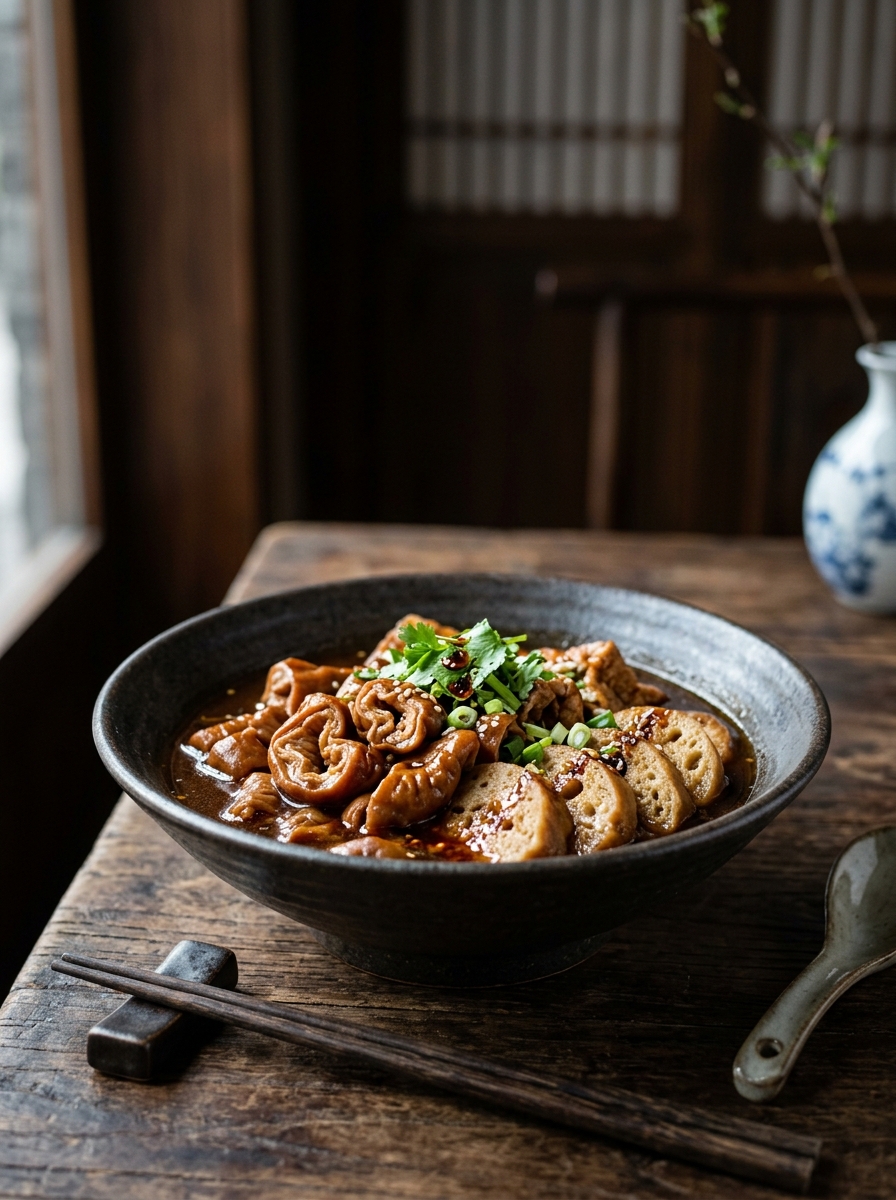
Luzhu is a dish of patience outsourced to the broth: the report's old stock simmers pork bones for four hours with star anise, cinnamon, scallion and ginger, and that long stock is what carries the offal, not the other way round. At home the honest shortcut is a good pork or chicken stock, because the offal itself is already cooked — the twenty-minute home step is about marrying, not cooking from raw. The buns go in whole, halved, and simmer gently for fifteen minutes: long enough to absorb the broth and swell, short enough to hold their shape, and the broth must stay at a low simmer, never a boil, or they fall apart. Garlic, chilli oil and bean curd go in only in the last two minutes, so their sharpness stays bright against the rich broth instead of cooking flat. The result should finish with about 100 ml of thick, spoon-coating broth, not a watery soup.
| Ingredient | US | Metric | Substitute / note |
|---|---|---|---|
| Cooked pork intestines | 4.2 oz | 120 g | Ready-cooked from a Chinese deli, or home-cooked and thoroughly cleaned — see the steps (adaptation). |
| Cooked pork lung | 2.8 oz | 80 g | Same sourcing as the intestines; omit and add extra intestine if lung is unavailable (adaptation). |
| Huoshao baked wheat buns | 2 buns, about 100 g | 2 buns, about 100 g | Plain baked buns from a Chinese bakery; thick flour flatbread is a substitute (adaptation). |
| Pork-bone stock (old stock substitute) | 1¼ cups | 300 ml | The report's old stock simmers 4 hours; a good store-bought pork or chicken stock is the home substitute (adaptation). |
| Garlic, minced | 0.5 oz | 15 g | — |
| Chilli oil | 2 tsp | 10 ml | — |
| Fermented bean curd, mashed | 1 tsp | 5 g | — |
| Soy sauce | 2 tsp | 10 ml | — |
| Salt | ½ tsp | 3 g | Adjust to taste — the stock's saltiness varies. |
| Star anise, cinnamon, scallion, ginger | 1 g each | 1 g each | For the broth; a pinch each at home. |
| Flour and vinegar, for cleaning raw offal | 50 g flour + 20 ml vinegar | 50 g flour + 20 ml vinegar | Only if cleaning raw intestines at home; skip if using ready-cooked offal. |
The buns are the failure point: a rolling boil shreds them into porridge, while too short a simmer leaves them dry inside. Fifteen minutes on low heat is the balance, and the broth should reduce to roughly a third of its starting volume, thick enough to coat a spoon. Keep the salt at 1.5–2% of the broth if you can measure it; the bean curd and soy both add salt, so season the broth lightly first and correct at the end.
From a Chinese deli or bakery; ready-cooked offal is the sensible home route, since cleaning raw intestines takes about twenty minutes and a strong stomach.
The broth was boiling, or they simmered longer than fifteen minutes. Keep it at a low simmer and watch the clock.
Yes — it will be lighter than pork-bone stock but still works; the report's old stock is pork-based.
Best eaten fresh from the pot. Leftovers keep 1 day refrigerated; reheat gently to a full simmer, but expect the buns to soften further. Do not freeze the finished dish.
Beijing offal stew with broth-soaked baked buns, garlic and chilli.
Ingredients: 120 g cooked pork intestines; 80 g cooked pork lung; 2 huoshao buns (about 100 g); 300 ml pork-bone stock; 15 g garlic; 10 ml chilli oil; 5 g fermented bean curd; 10 ml soy sauce; 3 g salt; spices to taste.
Steps: 1) Clean raw offal if starting raw, or use ready-cooked. 2) Heat stock with spices. 3) Stew offal 2 minutes, add halved buns, low simmer 15 minutes. 4) Stir in garlic, chilli oil and bean curd in the last 2 minutes.
Wheat noodles topped with a rich, savoury black bean paste and crisp julienned vegetables.
Beef braised until tender with potatoes that soak up the savoury sauce — a classic family stew.
Henan-style lamb soup noodles with a clear, warming broth and hand-pulled noodles.
Source note: ingredients, quantities and steps are adapted from the original ClouChef R&D report for 卤煮火烧 (data/reports/87.md). The report's pricing, margin and marketing sections are deliberately omitted here; no B2B cost is presented as a home-cook cost. The report's own cost table is arithmetically wrong — it prices a batch of reusable old stock as a single-serving cost, so its total contradicts its own note on the stock's real per-serving cost — so no cost figures are reproduced. The ready-cooked offal shortcut, the stock substitute and the bun substitute are adaptations and are labelled as such. Original poster image: clouchef.com (卤煮火烧_87.jpeg).