Twice-Cooked Pork
Pork belly first boiled, then stir-fried in red bean-paste oil.
← Home · Hunan weeknight seasonal
Smoky cured pork, steamed then sliced thin, flash-fried with crisp winter bamboo shoots and garlic sprouts. Adapted for a home kitchen from the original ClouChef R&D report — 腊肉炒冬笋, report 132.
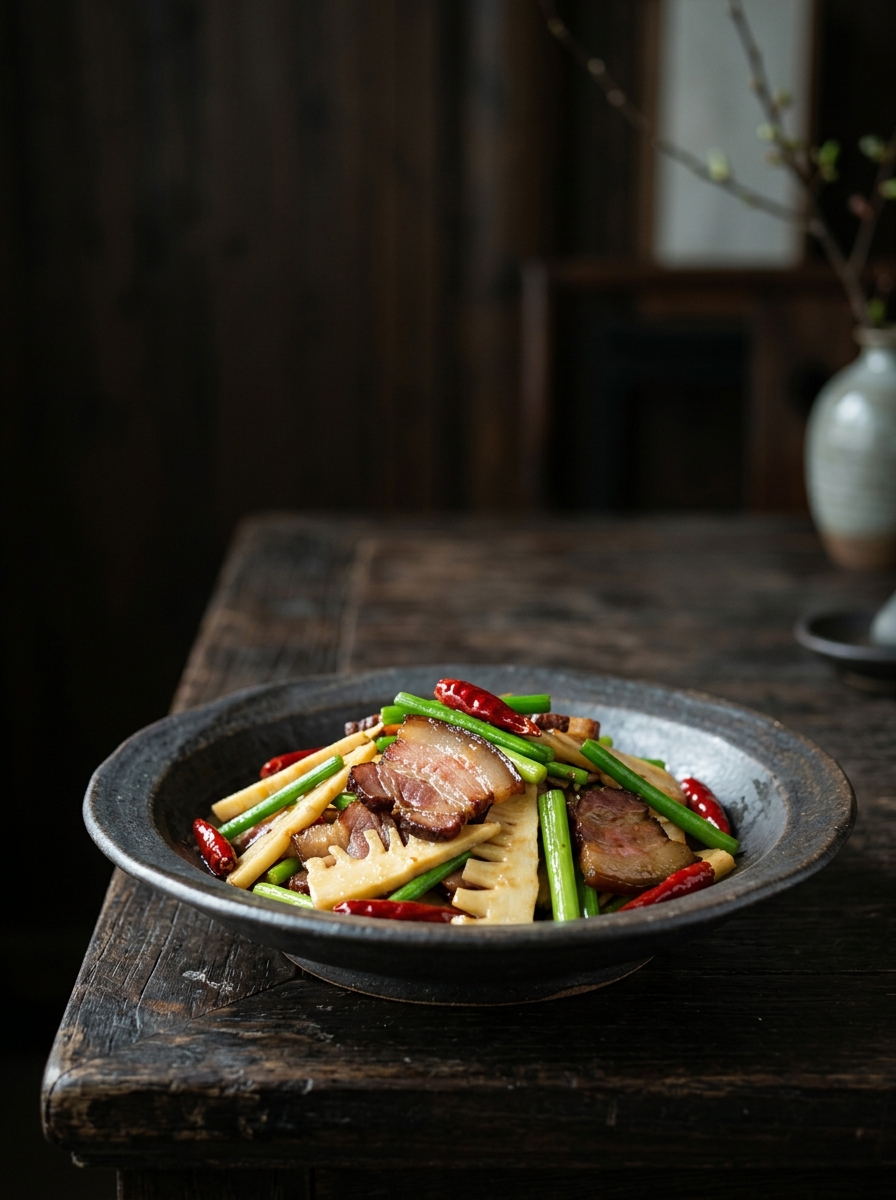
This dish is built on a single contrast: smoky, fatty cured pork against clean, crisp bamboo. The pork is steamed whole for twenty minutes first, which does two things — it softens the cured meat enough to slice thin and it renders some fat, so the later stir-fry is quick and the pork curls at the edges instead of frying tough. Bamboo shoots are blanched two minutes in salted water, which takes off their astringency while keeping their snap. Then everything happens in under five minutes: chillies bloom in oil at 160 °C, the pork fries for thirty seconds until it gives up its fat, the bamboo gets forty seconds over high heat, and garlic sprouts go in for the last fifteen seconds only. That order is the recipe — garlic sprouts in early turn soft and lose their fresh bite, and the dish's whole point is the crunch. Rice is the natural partner, catching the smoky fat the pork leaves behind.
| Ingredient | US | Metric | Substitute / note |
|---|---|---|---|
| Cured pork belly (larou), about 3:7 lean to fat | 2.8 oz | 80 g | Chinese cured pork belly from an Asian grocery; unsmoked pancetta is a distant substitute and will taste different (adaptation). |
| Winter bamboo shoots, peeled weight | 4.2 oz | 120 g | Fresh winter bamboo out of season: canned bamboo shoots, drained, work (adaptation). |
| Garlic sprouts (suanmiao), cut into 3 cm lengths | 1 oz | 30 g | Scallion greens are the nearest substitute (adaptation). |
| Dried chillies, cut into 1 cm segments, deseeded | 0.18 oz | 5 g | Deseeding keeps heat without bitterness, as in the source. |
| Light soy sauce | 1½ tsp | 8 ml | — |
| Shaoxing wine | 1 tsp | 5 ml | — |
| Salt | ¼ tsp | 1 g | Taste first — the cured pork is already salty. |
| Neutral cooking oil | 1 tbsp | 15 ml | — |
Cured pork straight from the packet is too hard and too salty to stir-fry well. Steaming softens it and mellows the salt, and slicing it thin after cooling means it fries in seconds rather than stewing in its own fat. The same logic applies to the bamboo: a short salted blanch removes the oxalic sharpness that makes undercooked bamboo taste astringent, while a longer boil would cost the crunch the dish depends on.
It was not steamed long enough or was sliced too thick. Twenty minutes whole, cooled, then 0.3 cm slices is the report's standard.
You can, but the dish changes: bacon is much saltier and smokier in a different way, and it will fry faster. Reduce added salt to nothing and taste before seasoning.
To remove the astringency (oxalic sharpness) that raw bamboo carries. Two minutes in salted water is enough; longer makes it soft.
Best eaten fresh. Leftovers keep 1 day refrigerated; reheat quickly over high heat until steaming hot — the bamboo will soften somewhat. The steamed pork slices alone keep 3 days refrigerated.
Smoky cured pork flash-fried with crisp winter bamboo shoots and garlic sprouts.
Ingredients: 80 g cured pork belly; 120 g winter bamboo shoots; 30 g garlic sprouts; 5 g dried chillies; 8 ml light soy sauce; 5 ml wine; 1 g salt; 15 ml oil.
Steps: 1) Steam pork 20 minutes, cool, slice 0.3 cm. 2) Slice bamboo 0.2 cm, blanch 2 minutes. 3) Fry chillies at 160 °C 10 seconds. 4) Fry pork 30 seconds. 5) Add bamboo, fry 40 seconds, add wine, soy, salt. 6) Add garlic sprouts, fry 15 seconds, serve.
Pork belly first boiled, then stir-fried in red bean-paste oil.
Eggplant, potato and green pepper in a savoury sauce.
Slow-braised bamboo shoots and salted pork in a clear, rich broth.
Source note: ingredients, quantities and steps are adapted from the original ClouChef R&D report for 腊肉炒冬笋 (data/reports/132.md). The report's pricing, margin and marketing sections are deliberately omitted here; no B2B cost is presented as a home-cook cost. Original poster image: clouchef.com (腊肉炒冬笋_132.jpeg). The 1–2 serving presentation, the steaming/blanching loss allowances and the canned-bamboo and scallion-green substitutes are adaptations and are labelled as such.