Kung Pao Chicken
Sweet-sour-spicy Sichuan chicken with crisp peanuts.
← Home · Jiangxi spicy blood dish
Jiangxi's fiery classic: duck pieces seared until golden, then tossed with peppers, rice wine and duck blood that coats every piece in a dark, glossy sauce — in ten seconds flat. Adapted for a home kitchen from the original ClouChef R&D report — 辣椒炒血鸭, report 146. A blood dish: buy the blood fresh, cook it fully.
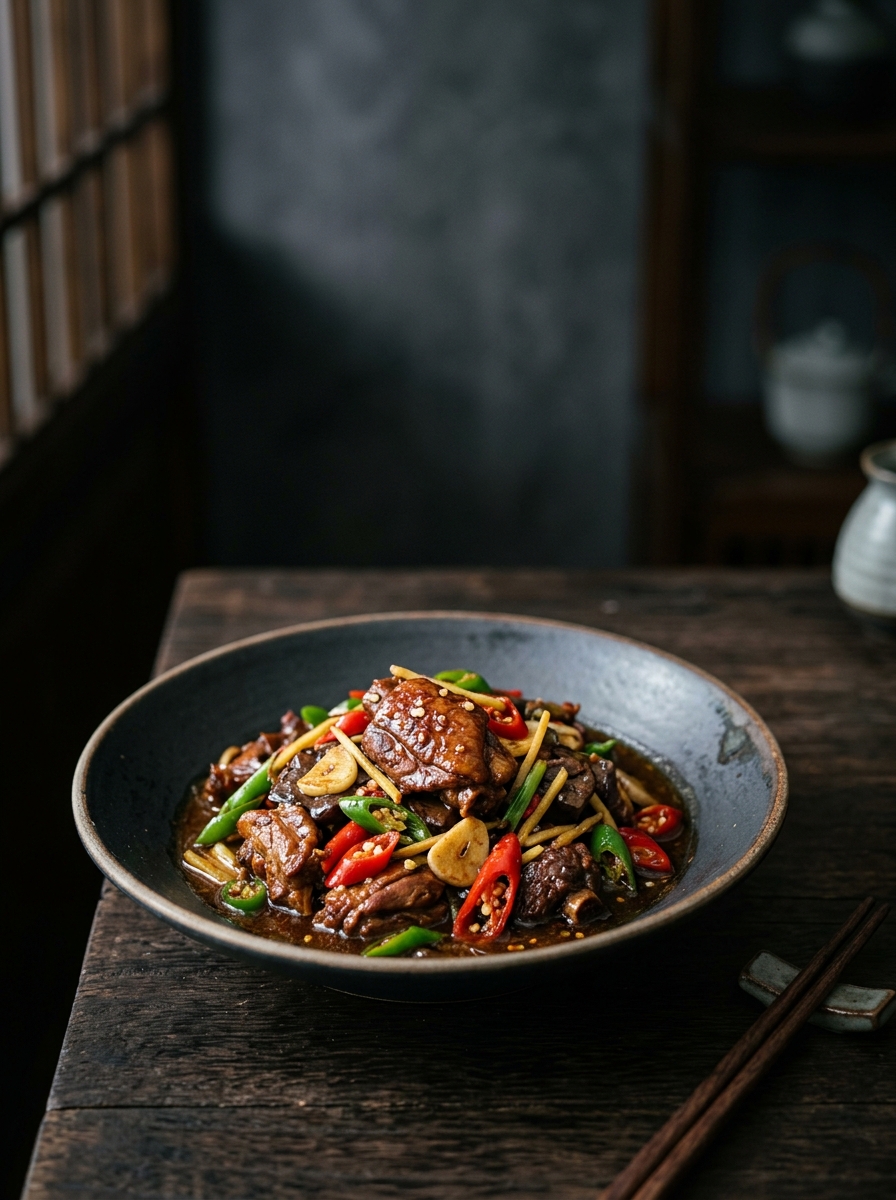
Blood duck is a dish of one decisive moment. Everything before it is preparation: duck leg cut small so it sears fast, blood sliced and blanched thirty seconds so it is safe and just set, peppers cut and aromatics ready. The duck is seared two minutes over high heat until golden at the edges, the peppers and aromatics get one minute to release their heat, and then the blood goes in over low heat for ten seconds — long enough for its proteins to set around the meat into a dark, clinging glaze, short enough that it stays silky instead of turning grainy and dull. Leave it a minute longer and the dish's whole identity is gone: the blood overcooks into crumbles and the sauce breaks. The rice wine, split between marinade and pan, is what keeps the duck from tasting merely hot — it gives the sharp, fermented lift that marks Jiangxi cooking.
| Ingredient | US | Metric | Substitute / note |
|---|---|---|---|
| Duck leg meat, boneless, cut into 1.5 cm pieces | 7 oz | 200 g | Leg meat in the source; breast dries out in this fast fry (adaptation note). |
| Duck blood, set, cut into 1 cm slices | 1.8 oz | 50 g | Buy fresh and fully set from a reputable butcher or Asian grocery; use the same day and cook fully. No substitute keeps the dish. |
| Green and red long chillies, cut into rings | 2.8 oz | 80 g | Use a mix for colour; keep the heat level you can enjoy. |
| Old ginger, sliced | 1 oz | 30 g | — |
| Garlic, crushed | 0.5 oz | 15 g | — |
| Rice wine (mijiu), divided | 2 tbsp | 30 ml | 5 ml in the marinade, 25 ml in the pan, as in the source. |
| Salt, divided | ½ tsp | 3 g | 1 g in the marinade, the rest to finish — split labelled as an adaptation, since the source lists 3 g total and 1 g in the marinade step. |
| Light soy sauce | 2 tsp | 10 ml | — |
| Neutral cooking oil | 2 tbsp | 30 ml | — |
| Scallions, to garnish (optional) | To taste | To taste | The source lists scallions as an optional garnish; blanch them briefly if using, rather than serving raw (adaptation). |
Blood sets like egg: a little heat turns it into a glossy coating, a little more turns it into grainy curds. That is why the blood is blanched first — so it is already safe and just set before it meets the pan — and why its time in the pan is ten seconds over low heat, not a stir-fry. If your pan is still ripping hot when the blood goes in, pull it off the burner for the toss; residual heat is enough.
Yes when handled right: buy it fresh and fully set, blanch it 30 seconds in boiling water, and finish it in the hot pan. Use it the same day, keep it refrigerated until cooking, and do not eat it raw.
It spent too long in a hot pan. Ten seconds over low heat is the source's rule — the blood should coat, not scramble.
You can, but duck fat and flavour are central to the dish; chicken gives a leaner, milder result (adaptation).
Best eaten fresh; the blood glaze does not reheat well. Leftovers keep 1 day refrigerated; reheat gently until steaming hot throughout and expect a softer glaze. Do not freeze.
Duck seared with chillies and rice wine, glazed in ten seconds with duck blood.
Ingredients: 200 g duck leg meat; 50 g duck blood; 80 g chillies; 30 g ginger; 15 g garlic; 30 ml rice wine; 3 g salt; 10 ml soy sauce; 30 ml oil.
Steps: 1) Marinate duck 10 minutes; blanch blood 30 seconds. 2) Sear duck at ~160 °C for 2 minutes, remove. 3) Fry ginger, garlic, peppers 1 minute. 4) Return duck, add wine and soy, fry 30 seconds. 5) Low heat, add blood, toss 10 seconds, heat off. 6) Salt, serve.
Sweet-sour-spicy Sichuan chicken with crisp peanuts.
Pork belly first boiled, then stir-fried in red bean-paste oil.
Warming winter stew of lamb and white radish in a spicy broth.
Source note: ingredients, quantities and steps are adapted from the original ClouChef R&D report for 辣椒炒血鸭 (data/reports/146.md). The report's pricing, margin and marketing sections are deliberately omitted here; no B2B cost is presented as a home-cook cost. Original poster image: clouchef.com (辣椒炒血鸭_146.jpeg). The salt split between marinade and finish and the 1–2 serving presentation are adaptations and are labelled as such. Blood dishes are cooked fully on this page, as the source requires.