Guobao Pork
Northeastern sweet-and-sour pork, fried crisp in a light, glossy sauce.
← Home · Shandong whole fish banquet
A whole carp scored so it blooms in hot oil, fried shatteringly crisp, then cloaked in a glossy tomato-vinegar glaze. Adapted for a home kitchen from the original ClouChef R&D report — 糖醋鲤鱼, report 125.
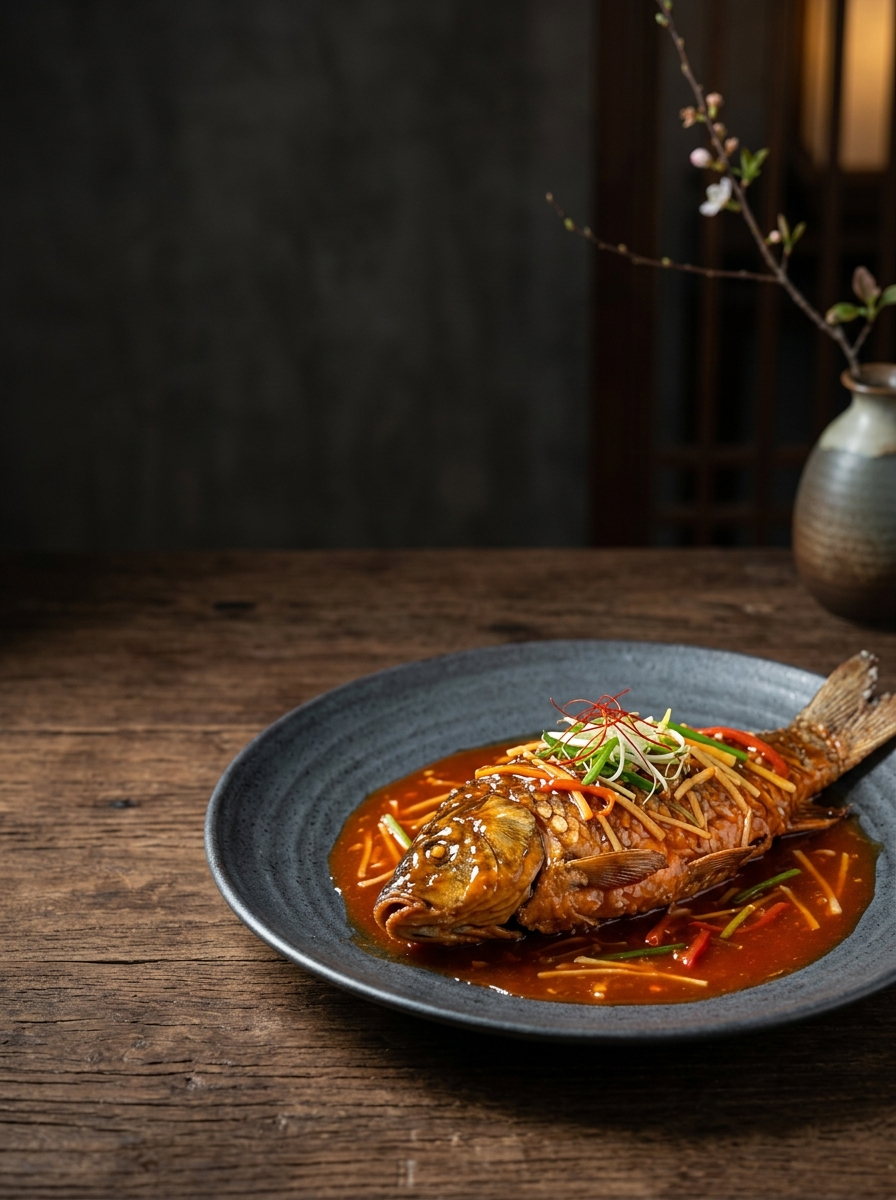
The drama of this dish is structural: diagonal cuts down to the bone let the flesh fan open in hot oil, so a whole fish arrives at the table looking like a flower and eating crisp all the way through. That only works if three things are right. The cuts must be evenly spaced and deep enough to open but never through the bone, or the fish breaks. The oil must hold near 180 °C, then around 170 °C for the full fry, so the starch shell sets instead of soaking up oil and peeling away. And the sauce must be made in under a minute — it should bubble, thicken and go on the fish while both are hot, so the glaze clings to the crisp skin instead of pooling underneath. Done right, the skin stays crackly under the glaze for the first minutes at the table, which is exactly the window to serve it in.
| Ingredient | US | Metric | Substitute / note |
|---|---|---|---|
| Whole carp, scaled, gutted, fins kept on | 2.2 lb | 1,000 g | A 2–2.5 jin carp in the source. Keep the fins: they are part of the presentation. |
| Corn starch, for coating | 5.3 oz | 150 g | — |
| Tomato ketchup | 2.8 oz | 80 g | — |
| White vinegar | 3 tbsp + 1 tsp | 50 ml | — |
| Sugar | 2 oz | 60 g | — |
| Salt | ½ tsp | 3 g | For rubbing the fish; the sauce salt below is separate in the source method. |
| Shaoxing wine, for marinating | 2 tsp | 10 ml | Appears in the source method but not its ingredient table; included here and labelled as such. |
| Corn starch, for the sauce | 1 tbsp | 10 g | Appears in the source sauce method but not its ingredient table; included here and labelled as such. |
| Water, for the sauce | ⅓ cup + 1 tbsp | 100 ml | — |
| Neutral oil, for deep-frying (mostly reusable) | about 1 cup consumed | about 200 ml consumed | The source lists 200 ml consumed from a larger pot of oil. Use a pot that lets the fish lie flat; strain and reuse the remaining oil (adaptation). |
| Oil, for the sauce pan | 1 tbsp + 1 tsp | 20 ml | — |
| Coriander or scallion shreds, to garnish | Small handful | Small handful | The source requires garnish to be blanched 5 seconds in boiling water or fried 5 seconds at 160 °C — never placed on raw. |
The cuts do two jobs: they let heat reach the thick flesh so the fish cooks through, and they let the flesh curl open into the flower shape. Even depth matters more than speed — a shallow cut stays shut, a cut through the bone snaps the fish. The oil temperature window is narrow for the same reason: hot enough to set the starch instantly, cool enough to cook the centre in 6–8 minutes without burning the shell.
Almost always oil below 160 °C, or too much loose starch. Shake off excess starch and keep the oil hot before the fish goes in.
A firm, medium whole fish such as sea bass works with the same method, but the classic bloom and flavour are carp's. Quantities and frying time scale with size (adaptation).
You cannot for long — serve within minutes of glazing. Glaze at the table if you want the full effect.
Best eaten immediately. Leftovers keep 1 day refrigerated but the skin will soften; reheat in a hot oven until steaming hot throughout and re-glaze only if you accept a softer finish. Do not freeze.
Whole carp scored and fried until it blooms, cloaked in a glossy sweet-sour glaze.
Ingredients: 1,000 g carp; 150 g corn starch; 80 g ketchup; 50 ml vinegar; 60 g sugar; 3 g salt; 10 ml wine; 10 g sauce starch; 100 ml water; ~200 ml frying oil consumed; 20 ml sauce oil.
Steps: 1) Clean, score every 2 cm to the bone, marinate 5 minutes. 2) Coat in starch, shake off excess. 3) Ladle 180 °C oil to set shape, fry ~170 °C 6–8 minutes. 4) Make sauce, boil ~30 seconds. 5) Glaze hot fish, garnish with blanched herbs, serve at once.
Northeastern sweet-and-sour pork, fried crisp in a light, glossy sauce.
Sichuan fish fillet in a tingly, chilli-topped broth.
Shrimp flash-fried until the shells turn crisp and red.
Source note: ingredients, quantities and steps are adapted from the original ClouChef R&D report for 糖醋鲤鱼 (data/reports/125.md). The report's pricing, margin and marketing sections are deliberately omitted here, and no cost figures are given: the source's ingredient table does not total correctly despite listing priced ingredients, so cost figures are omitted rather than repeated. Original poster image: clouchef.com (糖醋鲤鱼_125.jpeg). The marinating wine and sauce starch appear only in the source method, not its ingredient table, and are labelled as such; the 3–4 serving presentation is an adaptation.