Spicy Boiled Fish
Fish slices poached in a fiery, numbing chilli-oil broth.
← Home · Anhui Huizhou fermented
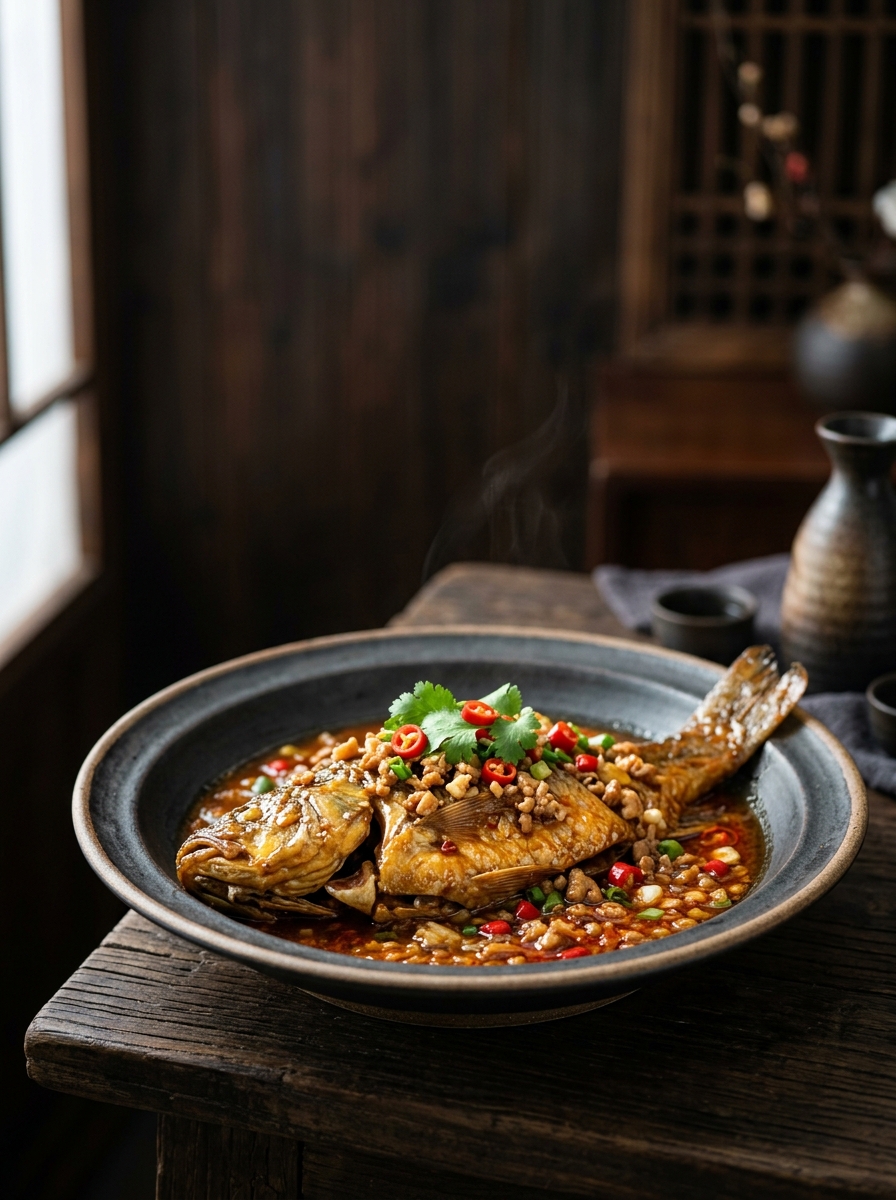
The Huizhou classic that smells strong and tastes wonderful: mandarin fish fermented for 48 hours in light salt water, pan-fried until golden, then braised with minced pork, chillies and garlic. Adapted for a home kitchen from the original ClouChef R&D report — 臭鳜鱼, report 61.
Plan ahead: the 48-hour brine is the heart of this dish — start two days before you want to eat. Keep the fish refrigerated at 0–4 °C throughout the brine, exactly as the original specifies, and discard it if it smells putrid rather than pungently fermented or shows any sign of spoilage (home food-safety guidance, adaptation).
Stinky Mandarin Fish is a Huizhou classic built on controlled fermentation: a whole mandarin fish spends forty-eight hours submerged in light salt water in the refrigerator, developing the pungent aroma that gives the dish its name and a deeply savoury, tender flesh. The fish is then patted dry and pan-fried undisturbed until each side forms a crisp golden crust, which seals in moisture and keeps the fish from breaking apart. A braise with minced pork, dried chillies, ginger and garlic, finished with soy, sugar and cooking wine, turns that fermented character into a rich, spicy sauce that clings to the fish. Ladling the reducing sauce over the fish as it thickens gives even colour and flavour. Served hot with rice, it is famously a case of smelling strong and tasting wonderful. Because the aroma is strong, this is a dish best cooked with the kitchen ventilated and served to guests who already enjoy bold, fermented flavours.
| Ingredient | US | Metric | Substitute / note |
|---|---|---|---|
| Fresh whole mandarin fish (Siniperca chuatsi), cleaned, bone-in | 1.3 lb | 600 g | The report specifies fresh mandarin fish; about 500 g net flesh. No substitute gives the same flavour (see FAQ). |
| Salt, for the brine | 3½ tbsp | 50 g | — |
| Water, for the brine | 8½ cups | 2000 ml | Enough to fully submerge the fish; use a larger container if needed (adaptation). |
| Minced pork, about 30% fat / 70% lean | 2.8 oz | 80 g | Original fat-to-lean ratio 3:7. |
| Dried chilli segments | 0.5 oz | 15 g | — |
| Garlic, minced | 0.7 oz | 20 g | About 4 cloves (adaptation for measuring). |
| Ginger, sliced | 0.35 oz | 10 g | About 2 thin slices (adaptation for measuring). |
| Scallion, cut into lengths | 0.5 oz | 15 g | About 1 scallion (adaptation for measuring). |
| Light soy sauce | 2 tbsp | 30 ml | — |
| Sugar | 2 tsp | 10 g | — |
| Cooking wine | 4 tsp | 20 ml | Shaoxing wine; dry sherry in a pinch. |
| Hot water, for braising | ¾ cup + 1 tbsp | 200 ml | From the original braising step; enough to cover about half the fish. |
| Neutral cooking oil, for frying | 3½ tbsp | 50 ml | Any neutral oil works. |
Three control points carry this dish. First, the brine must stay cold and steady — warmth speeds fermentation past pungent into spoiled. Second, the fish must be dry before frying and then left alone, so a crust forms instead of the flesh flaking apart. Third, the sauce must be ladled over the fish as it reduces, so the top colours and flavours as evenly as the side sitting in the liquid.
No — it is deliberately fermented. The 48-hour cold brine at 0–4 °C develops a pungent aroma while the fish stays safe to cook. If it smells putrid rather than pungently fermented, or shows any sign of spoilage, discard it (home food-safety guidance, adaptation).
The original specifies 48 hours with one turn, and shortening it changes the dish: the aroma will be weaker and the flesh less savoury. There is no shortcut version in the report.
The report specifies mandarin fish. A firm white freshwater fish would cook the same way, but the flavour and texture will differ — treat it as a different dish, not a like-for-like swap (adaptation).
Best eaten fresh, while hot. Leftovers keep 1 day refrigerated; reheat gently until steaming hot throughout and do not reheat more than once. The uncooked brined fish should not be held beyond the 48-hour brine — cook it on schedule (home guidance, adaptation). Freezing the finished dish is not recommended: the fried crust softens and the flesh turns mushy on thawing (home guidance, adaptation).
Fermented Huizhou mandarin fish, pan-fried and braised spicy with minced pork.
Ingredients: 600 g whole mandarin fish; brine: 50 g salt + 2000 ml water; 80 g minced pork; 15 g dried chillies; 20 g garlic; 10 g ginger; 15 g scallion; 30 ml soy sauce; 10 g sugar; 20 ml cooking wine; 200 ml hot water; 50 ml oil.
Steps: 1) Brine fish sealed at 0–4 °C for 48 hours, turning once. 2) Pat dry; pan-fry medium-low heat 3–4 minutes per side until golden, without frequent flipping. 3) Bloom ginger, garlic and chillies, fry pork until it gives off oil, add fish, soy, sugar, wine, scallion and 200 ml hot water; simmer on low heat 10 minutes. 4) Reduce on high heat ~3 minutes, basting constantly, until thick with about one-third of the sauce left; serve hot.
Fish slices poached in a fiery, numbing chilli-oil broth.
Silky tofu in a tingly, spicy bean-paste sauce.
Beef braised until tender with potatoes that soak up the savoury sauce — a classic family stew.
Source note: ingredients, quantities and steps are adapted from the original ClouChef R&D report for 臭鳜鱼 (data/reports/61.md — report ID 61). The report’s pricing, margin and marketing sections are deliberately omitted here; no B2B cost is presented as a home-cook cost. The report’s cost table does not reconcile arithmetically (its subtotals do not add up to its own line items), so no cost figure from it is reproduced. Original poster image: clouchef.com (臭鳜鱼_61.jpeg). The 2–3 serving presentation, measuring equivalents, container note and food-safety guidance are home adaptations and are labelled as such.