Oil-Blast Shrimp
Shrimp flash-fried in hot oil until the shells turn crisp and red, in a lightly sweet, savoury glaze.
← Home · Jiangsu Suzhou sweet-sour banquet
A whole mandarin fish, cross-hatched so it blooms like a squirrel's tail in hot oil, then glossed with a sweet-sour tomato sauce. Adapted for a home kitchen from the original ClouChef R&D report — 松鼠鳜鱼, report 31.
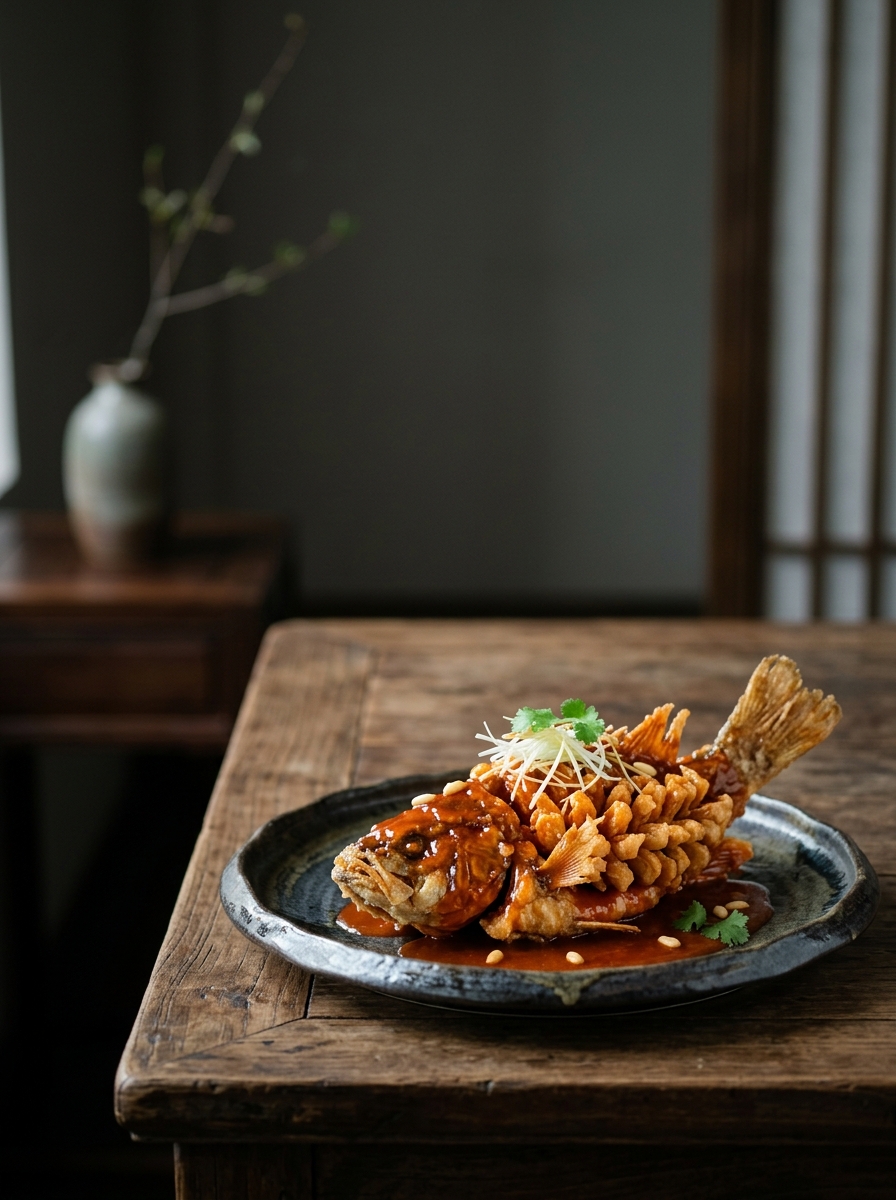
The report's whole idea is shape before sauce: the fish is boned in one piece, scored in a diamond lattice that stops just short of the skin, and fried twice, so the cuts curl open and the flesh turns crisp outside while staying tender inside. That is why the scoring angles and depths matter more than any garnish, and why a rushed single fry leaves the fish either limp or overcooked. The sauce is deliberately simple — tomato paste, sugar and vinegar at roughly two parts sugar to one part vinegar — so it reads sweet first and sour second, coating rather than drowning the crisp fish. Pouring it on only at serving keeps the crust audible for a few minutes, which is the point of the dish. Home cooks should treat the second, hotter fry as non-negotiable, keep the sauce thin enough to cling, and use only cooked pine nuts and canned cherries for garnish, exactly as the report insists for food safety.
| Ingredient | US | Metric | Substitute / note |
|---|---|---|---|
| Fresh mandarin fish (guiyu), scaled, gutted, boned in one piece with tail attached | 1.3 lb | 600 g | Sea bass or another firm white fish of similar size works at home, but it will not bloom quite the same way (adaptation). Ask the fishmonger to bone it if you can. |
| Corn starch, for coating | 5.3 oz | 150 g | Use enough to fill every cut; shake off the excess. Potato starch is an acceptable substitute (adaptation). |
| Cooking wine, for marinating | 2 tsp | 10 ml | Shaoxing wine. |
| Salt, for marinating | ½ tsp | 3 g | — |
| Tomato paste | 2.8 oz | 80 g | — |
| Sugar | 2.1 oz | 60 g | — |
| White vinegar | 2 tbsp | 30 ml | Rice vinegar in a pinch; the 2:1 sugar-to-vinegar balance is the report's control point. |
| Clear stock | ⅓ cup + 1 tbsp | 100 ml | Chicken stock, brought to a boil first (report requires stock at 80 °C or above). |
| Salt, for the sauce | ¼ tsp | 2 g | — |
| Starch slurry, for thickening | 2 tsp | 10 ml | Corn starch mixed with water; amount is the report's figure (adaptation: mix just before use). |
| Toasted pine nuts | 0.5 oz | 15 g | Must be pre-toasted until lightly golden — the report requires cooked nuts, never raw. |
| Canned cherries in syrup | 2 | 2 | Canned only, as the report requires; do not use fresh cherries as garnish. |
| Neutral frying oil | As needed, to deep-fry | As needed, to deep-fry | Report does not state a volume; use enough to submerge the fish in a deep pot or wok (adaptation, labelled here). |
The lattice only blooms if the cuts stop short of the skin and the first fry sets the shape before the second, hotter fry crisps it. Keep the oil at the report's temperatures — 180 °C then 200 °C — and check fish is cooked through and steaming hot; the report's two-fry timing (about 3 minutes, then 1–2 minutes) is the control, not the colour alone.
Yes, but you lose the squirrel-tail presentation. Score fillets the same way and fry them flat; the sauce and timing still apply (adaptation).
Usually the cuts were too shallow, too deep, or the first fry was too cool to set the lattice. Cut to about 3 mm from the skin and hold 180 °C for the first fry.
No. Sauce softens the crust within minutes, so pour it on at the table.
Best eaten immediately. Leftovers keep 1 day refrigerated; reheat until steaming hot throughout — the crust will not recover its crispness. Do not freeze.
Cross-hatched mandarin fish, twice-fried until it blooms, in a sweet-sour tomato sauce.
Ingredients: 600 g mandarin fish; 150 g corn starch; 10 ml cooking wine + 3 g salt for marinating; 80 g tomato paste; 60 g sugar; 30 ml white vinegar; 100 ml stock; 2 g salt; 10 ml starch slurry; 15 g toasted pine nuts; 2 canned cherries; frying oil as needed (amount not stated in report).
Steps: 1) Bone and score, marinate 5 minutes. 2) Coat with starch. 3) Fry at 180 °C about 3 minutes, then 200 °C for 1–2 minutes. 4) Make the sauce, pour over, garnish and serve at once.
Shrimp flash-fried in hot oil until the shells turn crisp and red, in a lightly sweet, savoury glaze.
Gently poached chicken, chilled for a firm, silky texture, served with a ginger-scallion dip.
Spring bamboo shoots, tofu knots and salted pork in a rich savoury-fresh broth.
Source note: ingredients, quantities and steps are adapted from the original ClouChef R&D report for 松鼠鳜鱼 (data/reports/31.md). The report's pricing, margin and marketing sections are deliberately omitted here; no B2B cost is presented as a home-cook cost. The report's cost table is arithmetically wrong (its line items do not add to its stated total, and the stock line is priced at 50.00 for a 0.50 item), so no cost figures from it are reproduced here. Home servings (2–3, from one restaurant portion) and the frying-oil amount, which the report does not state, are adaptations and are labelled as such. Original poster image: clouchef.com (松鼠鳜鱼_31.jpeg).