Char Siu
Cantonese roast pork made in a home oven or air fryer, with a sticky, caramelised edge and no barbecue pit.
← Home · Fujian fried chicken red lees wine lees
Boneless chicken thigh marinated in red wine lees, coated in a yeasted batter and fried crisp — Fujian's answer to fried chicken, naturally red. Adapted for a home kitchen from the original ClouChef R&D report — 红糟鸡, report 44.
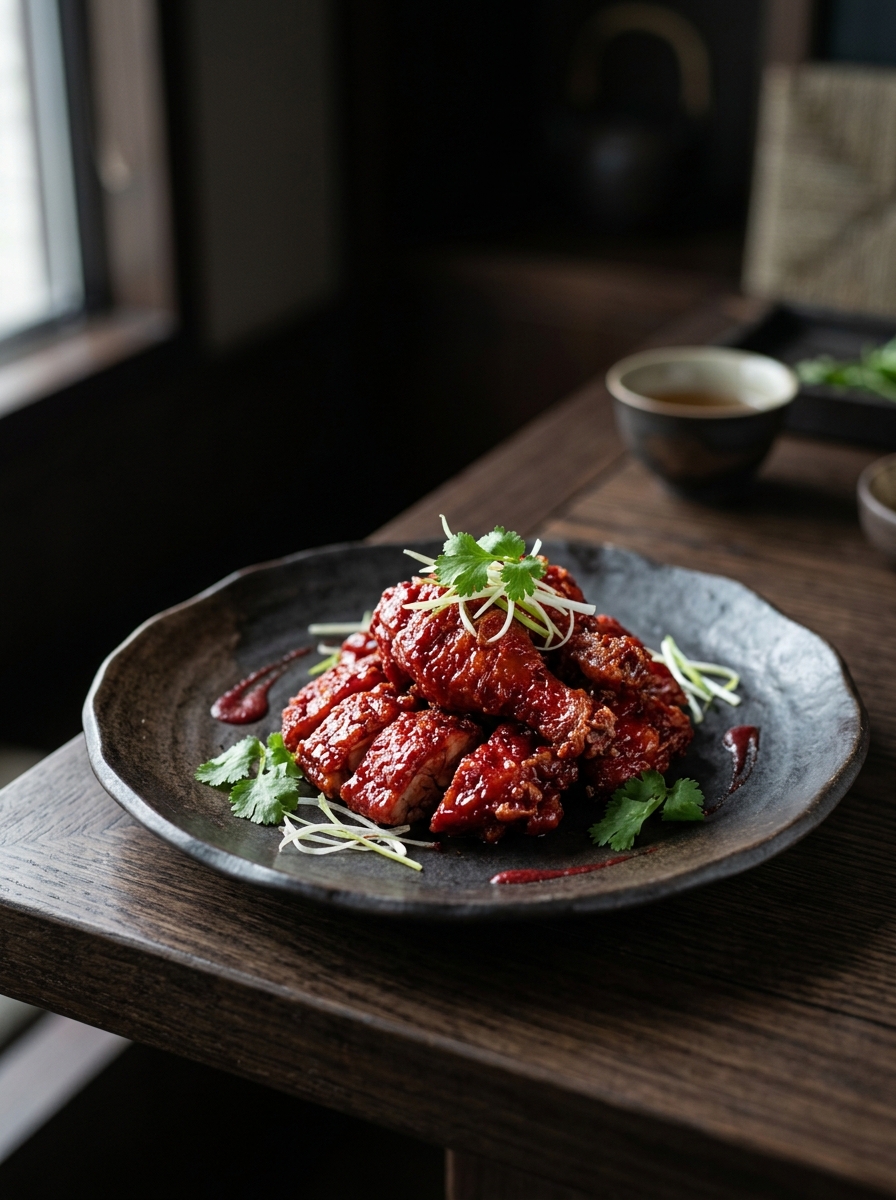
Red lees, the residue of red rice wine fermentation, does three jobs at once in this dish: it colours the chicken a deep red without any dye, it perfumes it with wine, and it tenderises it during a marinade that must last at least two hours, and is better overnight. The batter is the second decision point: a yeasted flour batter, left to ferment for fifteen minutes until it flows like yoghurt and falls from a spatula in a continuous stream, gives a puffed, crisp crust that a plain flour batter cannot match, and the report warns that too thick a batter fries hard while too thin a batter slides off. Frying itself is at a steady one hundred and seventy to one hundred and eighty degrees for four to five minutes, until the chicken floats and the centre passes seventy-five degrees, with an optional twenty-second second fry at one hundred and ninety degrees just before serving for extra crispness. Serve it hot, with a sweet-sour or chilli dip; do not let it sit.
| Ingredient | US | Metric | Substitute / note |
|---|---|---|---|
| Boneless chicken thigh meat | 5.3 oz | 150 g | Cut into 4 cm × 3 cm × 2 cm pieces and patted dry. Chicken breast works but is drier (adaptation). |
| Red lees (hongzao) | Not stated in report | Not stated in report | Report gives no weight; section 1 notes 20–30 g per portion. Use enough to coat the chicken evenly (adaptation, labelled here). |
| Cooking wine | Not stated in report | Not stated in report | Quantity not stated in the report (adaptation, labelled here). |
| Salt | Not stated in report | Not stated in report | Quantity not stated in the report; a pinch for the marinade is the home amount (adaptation, labelled here). |
| Five-spice powder | Not stated in report | Not stated in report | Quantity not stated in the report; a pinch is the home amount (adaptation, labelled here). |
| Sugar | Not stated in report | Not stated in report | Quantity not stated in the report; a pinch for the marinade and 1 g for activating the yeast (adaptation, labelled here). |
| Plain flour, for the batter | Not stated in report | Not stated in report | Quantity not stated in the report; enough for a yoghurt-thick batter (adaptation, labelled here). |
| Dried yeast | Not stated in report | Not stated in report | Quantity not stated in the report; activate in 30 °C warm water with 1 g sugar for 5 minutes (adaptation, labelled here). |
| Warm water, for the batter | Not stated in report | Not stated in report | Quantity not stated in the report; add until the batter flows like yoghurt (adaptation, labelled here). |
| Frying oil | As needed, to deep-fry | As needed, to deep-fry | Quantity not stated in the report; use enough to float the chicken (adaptation, labelled here). |
| Sweet-sour sauce or chilli sauce, to serve | To taste | To taste | As a dip, per the report. |
The report's batter test is visual: it must fall from a spatula in a continuous stream, like yoghurt. Thicker batter fries hard and doughy; thinner batter will not cling at all. And the marinade time is a floor, not a suggestion — under two hours the red colour does not penetrate and the wine flavour stays on the surface.
The fermented residue of red rice wine, sold in jars at Asian groceries. It colours and perfumes the chicken naturally.
Usually batter too thick, or oil too cool so the chicken sat and absorbed oil instead of crisping.
Yes, but thigh is the report's cut and stays juicier through a 4–5 minute fry (adaptation).
Best eaten hot, within minutes of frying. Leftovers keep 1 day refrigerated; reheat in a hot oven or air fryer until steaming hot — the crust will be less crisp. Do not freeze battered fried chicken.
Red-lees marinated chicken thigh in a puffed yeasted batter, fried crisp.
Ingredients: 150 g boneless chicken thigh; red lees, cooking wine, salt, five-spice powder, sugar, plain flour, dried yeast and warm water (quantities not stated in the report — see ingredient notes); frying oil as needed (amount not stated in report); sweet-sour or chilli dip to serve.
Steps: 1) Marinate at least 2 hours. 2) Activate yeast, make batter, rest 15 minutes. 3) Fry at 170–180 °C for 4–5 minutes. 4) Optional second fry 20 seconds, serve hot.
Cantonese roast pork made in a home oven or air fryer, with a sticky, caramelised edge and no barbecue pit.
Northeastern sweet-and-sour pork, fried crisp and coated in a light, glossy sauce.
Gently poached chicken, chilled for a firm, silky texture, served with a ginger-scallion dip.
Source note: ingredients, quantities and steps are adapted from the original ClouChef R&D report for 红糟鸡 (data/reports/44.md). The report's pricing, margin and marketing sections are deliberately omitted here; no B2B cost is presented as a home-cook cost. This report gives almost no ingredient quantities, so quantities that are not stated are labelled as such in the table and are not invented here; the home amounts suggested are adaptations and are labelled as such. Home servings (2, from one restaurant portion) are also an adaptation. Original poster image: clouchef.com (红糟鸡_44.jpeg).