Hakka Sticky Rice
Steamed glutinous rice with pork, dried mushrooms and dried shrimp — savoury, filling and warming.
← Home · Fujian crab sticky rice autumn
A live red crab, cut and laid roe-side up over savoury sticky rice with mushrooms and dried seafood, then steamed so the crab juices soak the rice. Adapted for a home kitchen from the original ClouChef R&D report — 红鲟蒸糯饭, report 42.
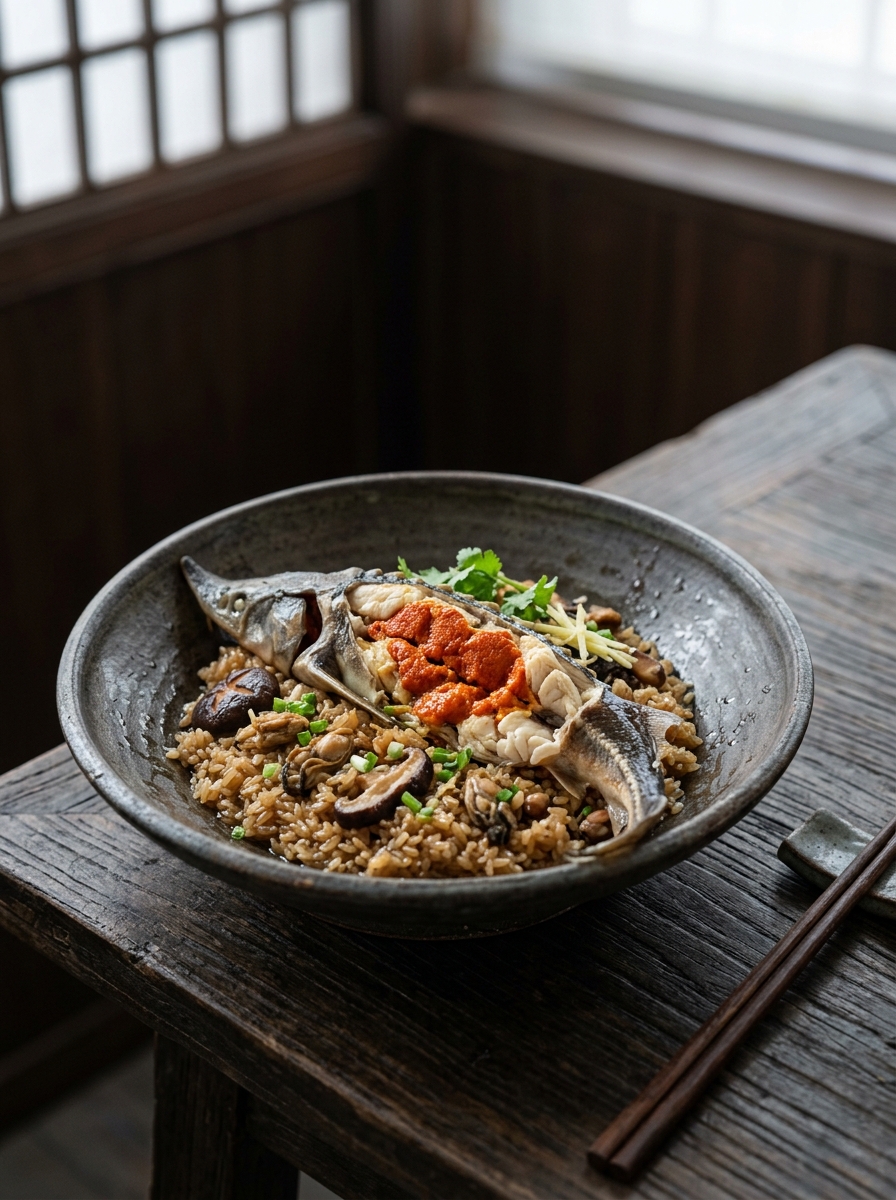
The logic of this dish is that the rice is seasoned twice: once when it is stir-fried with mushrooms, dried oysters, scallops and dried shrimp in soy and wine, and again when the crab steams above it and its juices drip down. That is why the rice is steamed first to about eighty percent done and kept in distinct grains — fully cooked rice would turn to mush under the crab, and uncooked rice would stay hard in the centre. The crab itself must be alive until the moment it is cut, because the report is explicit that dead crab develops histamine and is unsafe, and it must be cut into six pieces with the roe kept intact and facing up, so the roe sets into a rich cap rather than dissolving into the rice. Steaming is twenty minutes on high heat, with the crab centre held at seventy-five degrees for two minutes. A final drizzle of hot oil over scallion wakes the whole plate.
| Ingredient | US | Metric | Substitute / note |
|---|---|---|---|
| Live red crab (hongxun / mud crab) | 1, about 10.6 oz | 1, about 300 g | Must be alive and active before killing, per the report. Any live mud crab works (adaptation). |
| Glutinous rice, soaked 2 hours | 5.3 oz | 150 g | Steam 30 minutes to about 80% done before stir-frying. |
| Dried shiitake, soaked, in 0.5 cm dice | 0.7 oz | 20 g | — |
| Dried oysters (hailigan), soaked, in 0.5 cm dice | 0.5 oz | 15 g | Soak in warm water 20 minutes. |
| Dried scallops, soaked | 0.35 oz | 10 g | Soak in warm water 20 minutes. |
| Dried shrimp | 0.2 oz | 5 g | — |
| Light soy sauce | 1 tbsp | 15 ml | — |
| Dark soy sauce | 1 tsp | 5 ml | — |
| Cooking wine | 2 tsp | 10 ml | Shaoxing wine. |
| Scallion segments | 0.35 oz | 10 g | For frying. |
| Ginger slices | 0.35 oz | 10 g | For frying. |
| Cooking oil, for frying | 1 tbsp + 1 tsp | 20 ml | — |
| Hot oil, to finish | 1 tsp | 5 ml | — |
| Scallion, chopped, to garnish | To taste | To taste | — |
Pre-steaming the rice to eighty percent is the control that stops it going mushy under the crab, and the crab's own juices are the second seasoning — which is why the roe must face up and the shell must cap the pile. Never steam a crab that was already dead when you bought it: the report flags histamine risk, and no cooking time makes dead crab safe.
Dead crab builds up histamine quickly, which cooking does not remove; the report requires an active, live crab.
So it finishes cooking under the crab without turning to mush from the crab's juices.
No — glutinous rice is what absorbs the crab juices and holds together in a 2 cm layer (adaptation).
Best eaten fresh and hot. Leftovers keep 1 day refrigerated; reheat by steaming until steaming hot throughout. Do not freeze, and never reheat crab rice more than once.
Live red crab steamed over savoury sticky rice with dried seafood.
Ingredients: 1 live red crab (about 300 g); 150 g glutinous rice; 20 g shiitake; 15 g dried oysters; 10 g scallops; 5 g shrimp; 15 ml light soy; 5 ml dark soy; 10 ml cooking wine; 10 g scallion; 10 g ginger; 20 ml oil; 5 ml hot oil; scallion to garnish.
Steps: 1) Soak and pre-steam rice. 2) Prepare crab, cut into 6 pieces. 3) Fry rice with dried seafood. 4) Top with crab, steam 20 minutes, finish.
Steamed glutinous rice with pork, dried mushrooms and dried shrimp — savoury, filling and warming.
Gently poached chicken, chilled for a firm, silky texture, served with a ginger-scallion dip.
Shrimp flash-fried in hot oil until the shells turn crisp and red, in a lightly sweet, savoury glaze.
Source note: ingredients, quantities and steps are adapted from the original ClouChef R&D report for 红鲟蒸糯饭 (data/reports/42.md). The report's pricing, margin and marketing sections are deliberately omitted here; no B2B cost is presented as a home-cook cost. Home servings (2, from one restaurant portion) and the steamer substitute are adaptations and are labelled as such. Original poster image: clouchef.com (红鲟蒸糯饭_42.jpeg).