Guobao Pork
Northeastern sweet-and-sour crispy pork.
← Home · Northeast China stew sauerkraut blood sausage winter
Sauerkraut, pork belly, blood sausage and glass noodles simmered in bone broth — the Northeastern pig-feast stew, sour, rich and built for cold weather. Adapted for a home kitchen from the original ClouChef R&D report — 杀猪菜, report 72.
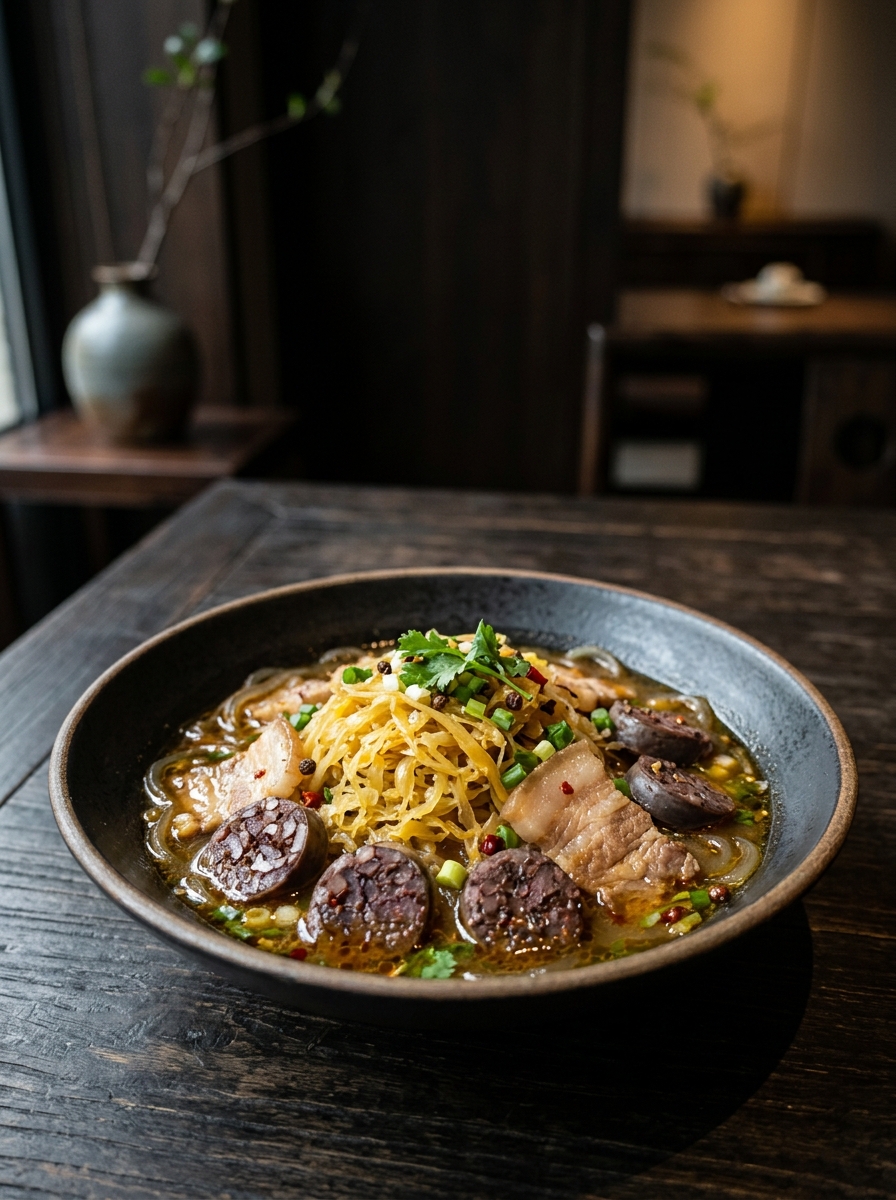
The report's logic is layering: each ingredient enters the pot at the moment it needs, and none earlier. Sauerkraut is soaked, squeezed and fried for three minutes first, because unfried sauerkraut tastes raw and flat; pork belly is boiled to eighty percent done before slicing, so it finishes tender rather than greasy; glass noodles go in with the pork for five minutes, long enough to turn transparent and drink up broth; and blood sausage goes in last, into a rolling boil, for at least two minutes, because it is already cooked but must be heated right through to a safe temperature. The bone broth underneath matters too — the report wants pork bones simmered four hours or more, or a stock-powder stand-in at home — since a thin broth leaves the whole pot tasting flat. Served in a preheated clay pot, it stays bubbling at the table, which is half the experience.
| Ingredient | US | Metric | Substitute / note |
|---|---|---|---|
| Sauerkraut, shredded | 7.1 oz | 200 g | Northeastern-style fermented sauerkraut; rinse and squeeze per steps. |
| Pork belly | 5.3 oz | 150 g | Sliced 3 mm thin after parboiling. |
| Blood sausage, thick slices | 3.5 oz | 100 g | Sliced 1.5 cm thick; buy pre-cooked blood sausage — raw blood sausage is not used here (adaptation). |
| Dried glass noodles | 1.8 oz | 50 g | Soaked 30 minutes in warm water. |
| Bone broth | 33 tbsp | 500 ml | Pork-bone broth simmered 4+ hours, or stock powder dissolved per packet (adaptation). |
| Scallion segments | 0.4 oz | 10 g | — |
| Ginger slices | 0.2 oz | 5 g | — |
| Star anise | 2 pieces | 2 pieces | For parboiling the pork. |
| Salt | 0.1 oz | 3 g | — |
| MSG | 0.1 oz | 2 g | Optional; omit without harm (adaptation). |
| Cooking oil, for frying sauerkraut | 1.0 tbsp | 15 ml | — |
| Scallion greens, to garnish | to taste | to taste | Per the report's plating. |
Blood sausage is the safety control point: it goes into a boiling pot, stays at a gentle boil for at least two minutes, and must reach 75 °C / 167 °F at the centre — checked with a thermometer, not guessed. Stir it gently, never vigorously, or the slices break and cloud the broth. And the sauerkraut must fry for the full three minutes: under-fried sauerkraut tastes raw no matter how long it simmers.
Yes when bought pre-cooked from a reputable supplier and reheated to at least 75 °C at the centre, as the report requires.
Soaking and squeezing removes excess acidity and salt, so the pot tastes sour and balanced rather than harsh.
The broth, pork and sauerkraut can be prepared ahead; add noodles and blood sausage only when serving, so neither overcooks.
Best eaten fresh. Leftovers keep 1–2 days refrigerated; reheat until boiling throughout and do not reheat more than once. Noodles will soften on reheating.
Sauerkraut, pork belly, blood sausage and glass noodles simmered in bone broth — the Northeastern pig-feast stew, sour, rich and built for cold weather. Adapted
Ingredients: 200 g sauerkraut; 150 g pork belly; 100 g blood sausage; 50 g dried glass noodles; 500 ml bone broth; 10 g scallion; 5 g ginger; 2 star anise; 3 g salt; 2 g MSG (optional); 15 ml oil.
Steps: 1) Soak and squeeze sauerkraut; parboil pork about 20 minutes and slice; soak noodles 30 minutes. 2) Fry sauerkraut 3 minutes. 3) Add broth; simmer 10 minutes. 4) Add pork and noodles; simmer 5 minutes. 5) Boiling broth: add blood sausage, boil at least 2 minutes to 75 °C; season and serve in a heated pot.
Northeastern sweet-and-sour crispy pork.
Pork ribs braised with green beans until tender.
Lamb stewed with radish in a warming Hunan style.
Source note: ingredients, quantities and steps are adapted from the original ClouChef R&D report for 杀猪菜 (data/reports/72.md). The report's pricing, margin and marketing sections are deliberately omitted here; no B2B cost is presented as a home-cook cost. The report's ingredient cost table is arithmetically wrong — it prices two star anise at a sum far above any plausible unit price — so all cost figures are omitted. Original poster image: clouchef.com (杀猪菜_72.jpeg).