White Cut Chicken
Gently poached chicken, chilled for a firm, silky texture, served with a ginger-scallion dip.
← Home · Jiangsu salted cold dish
Duck legs cured in salt and wine, buried in hot salt fried with Sichuan pepper and star anise, then gently steamed until tender and served cool — the report's home-scale take on Nanjing's salted duck. Adapted for a home kitchen from the original ClouChef R&D report — 盐水鸭, report 109.
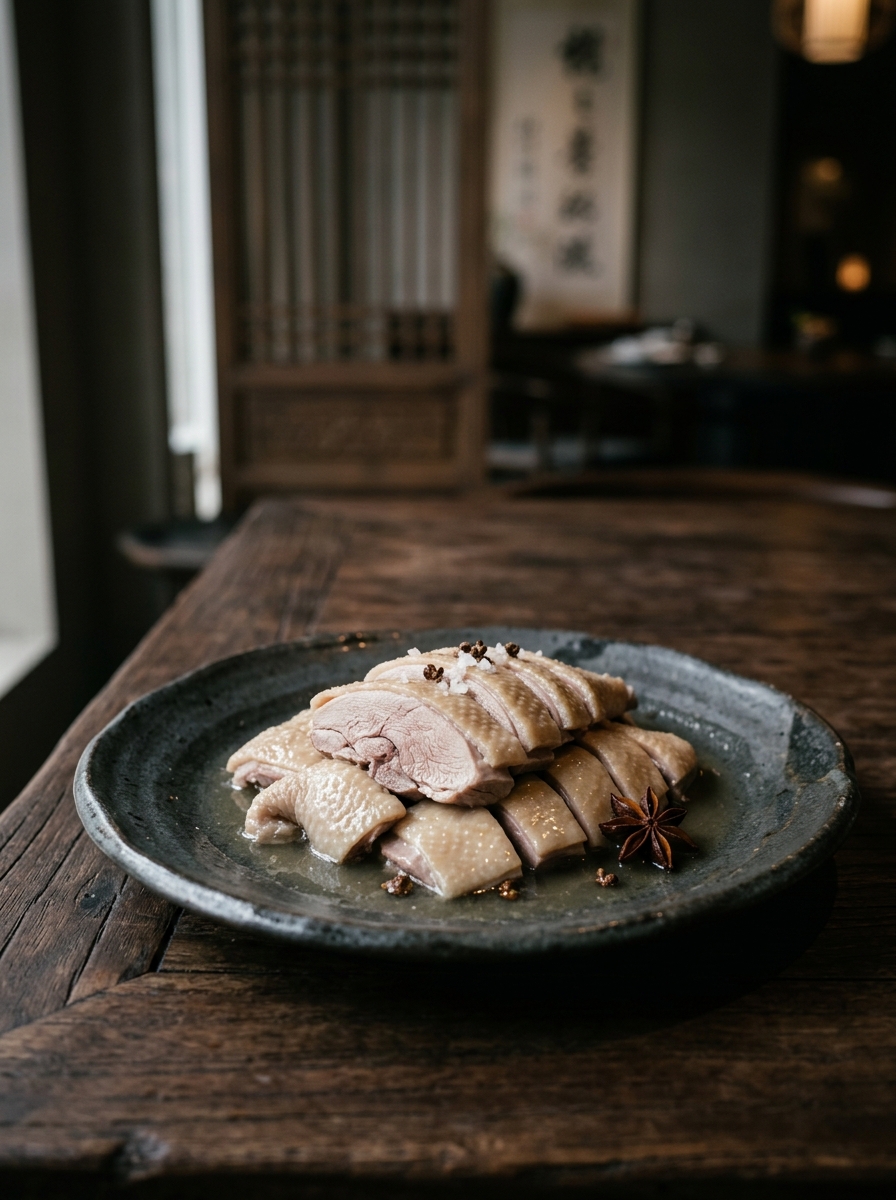
Salted duck is a dish of restraint: the cure is just coarse salt and wine, two hours minimum, because shorter leaves the meat bland inside and longer than four hours makes it harshly salty. Frying the salt with Sichuan pepper and star anise before it touches the duck is what perfumes the cure — raw spices sprinkled on cold meat never bloom the same way, and the salt must stay below 150 °C or the pepper turns bitter. Wrapping the legs tightly in foil and steaming on low heat, or in a rice cooker's cook mode, cooks them gently without drying, and the centre must reach 75 °C and hold for two minutes. Cooling to room temperature before carving is not optional: hot salted duck shreds and tastes one-dimensional, while cooled duck slices cleanly and its salt and spice settle into balance. Serve sliced on a plain plate, with nothing more than a little of its own juices, so the clean salt flavour stays forward.
| Ingredient | US | Metric | Substitute / note |
|---|---|---|---|
| Duck legs | 10.5 oz | 300 g | Skin-on, bone-in; the report uses legs rather than a whole duck (adaptation note: a whole duck needs a longer cure and braise). |
| Coarse salt, uniodised sea salt | 1¾ oz | 50 g | For the cure; do not use fine table salt, which over-salts. |
| Sichuan peppercorns, red | 0.2 oz | 5 g | Fried with the salt. |
| Star anise | 0.1 oz | 3 g | Whole, fried with the salt. |
| Ginger slices | 0.35 oz | 10 g | Fresh old ginger. |
| Cooking wine | 1 tbsp | 15 ml | Huangjiu or Shaoxing wine. |
| Foil, for wrapping | As needed | As needed | — |
| Braising liquid, to drizzle (optional) | A little | A little | Only if you have it; it must be boiled before use, per the report. |
The two failure points are salt temperature and cure time, and both are unforgiving: salt fried past 150 °C makes the pepper bitter and the whole cure harsh, and a cure past four hours cannot be undone by any later step. Dry the legs thoroughly before curing — water on the surface dilutes the salt and invites uneven seasoning. And do not carve hot: the meat needs its ten minutes of cooling to firm up and let the salt distribute, or it shreds and tastes saltier than it is.
Fine salt dissolves too fast and over-salts the surface; coarse salt seasons gradually and is easier to control.
Yes — the report itself suggests it: cook mode for the steaming, or keep-warm (80–90 °C) for a gentler finish.
Cooled salted duck slices cleanly and tastes balanced; hot it shreds and tastes one-dimensionally salty.
Best eaten the day it is made, cool. Leftovers keep 2 days refrigerated; serve cool or gently warmed, not reheated hard. Do not freeze the finished dish.
Duck legs cured in spiced salt, steamed tender and served cool.
Ingredients: 300 g duck legs; 50 g coarse salt; 5 g Sichuan pepper; 3 g star anise; 10 g ginger; 15 ml cooking wine; foil for wrapping.
Steps: 1) Rub legs with salt and wine; cure 2 hours. 2) Fry salt with pepper and star anise 3–5 minutes below 150 °C. 3) Bury legs in hot salt, wrap in foil. 4) Steam on low heat 30 minutes to 75 °C, cool, carve.
Gently poached chicken, chilled for a firm, silky texture, served with a ginger-scallion dip.
Cantonese roast pork made in a home oven or air fryer, with a sticky, caramelised edge and no barbecue pit.
Slow-braised pork belly with rock sugar, in an Instant Pot or on the stove, with a glossy, savoury-sweet sauce.
Source note: ingredients, quantities and steps are adapted from the original ClouChef R&D report for 盐水鸭 (data/reports/109.md). The report's pricing, margin and marketing sections are deliberately omitted here; no B2B cost is presented as a home-cook cost. The report uses duck legs rather than a whole duck; this page follows the report and says so. Original poster image: clouchef.com (盐水鸭_109.jpeg).