Oil-Blast Shrimp
Shrimp flash-fried in hot oil until the shells turn crisp and red, in a lightly sweet, savoury glaze.
← Home · Zhejiang Hangzhou tea shrimp
River shrimp, velveted and slipped through oil for under half a minute, tossed with Longjing tea infusion and finished with the tea leaves themselves. Adapted for a home kitchen from the original ClouChef R&D report — 龙井虾仁, report 53.
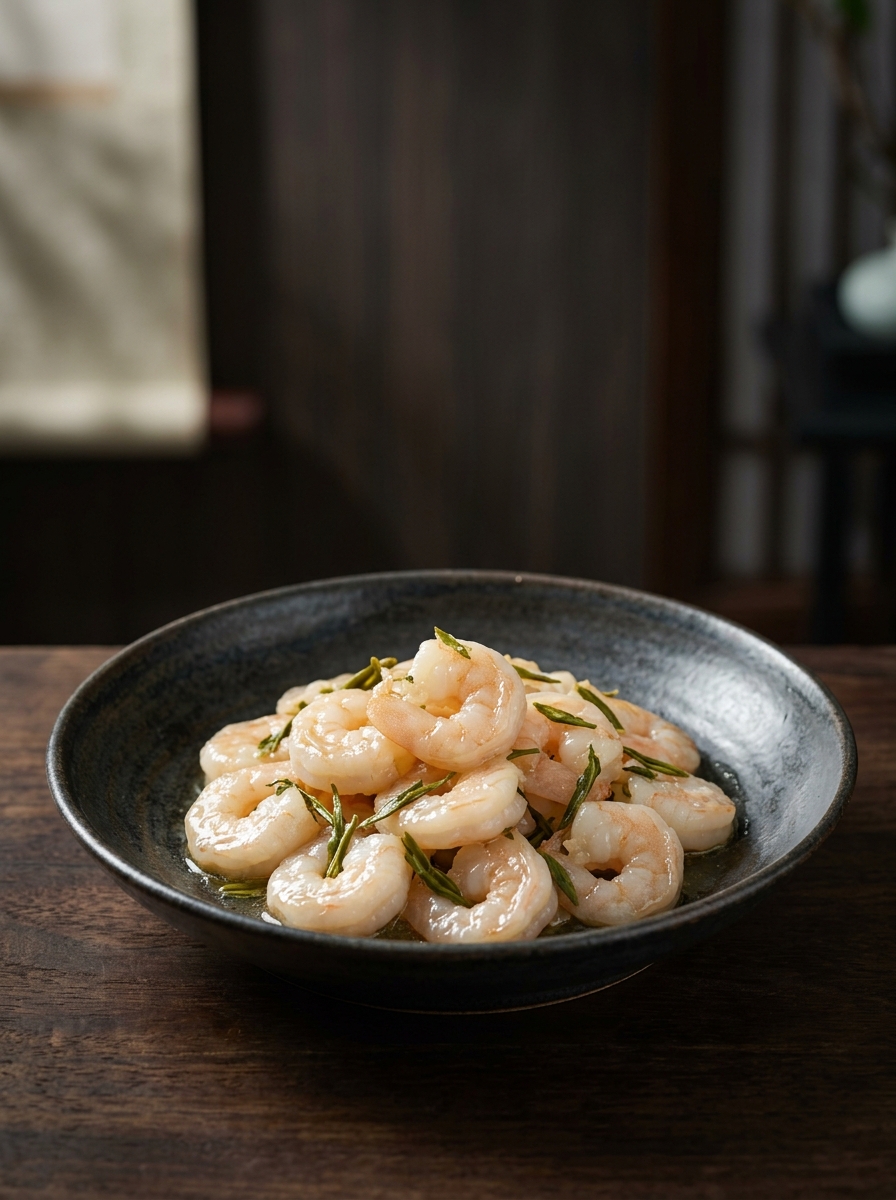
Longjing shrimp is a dish that punishes inattention in both directions: oil too hot or a few seconds too long, and the shrimp turn hard; oil too cool, and the velvet coating slips off before the shrimp colour. The report's window is precise — oil at one hundred and twenty degrees, judged by fine bubbles around a chopstick, and twenty to thirty seconds until the shrimp are fully coloured with no translucent centre — and it pairs that with a centre-temperature rule of seventy-five degrees, so tenderness is never an excuse for undercooking. The tea is treated with equal care: Longjing brewed at eighty degrees for two minutes, never boiling, so its fragrance survives, and only ten millilitres of infusion go into the pan, with the leaves themselves as garnish. The sauce is a thin veil, not a coating, and the final toss lasts five seconds, which is why everything must be measured and beside the stove before the shrimp go anywhere near the oil.
| Ingredient | US | Metric | Substitute / note |
|---|---|---|---|
| Fresh river shrimp, shelled, tails kept | 5.3 oz | 150 g | Keep the tails on for appearance, per the report. Frozen peeled shrimp, thawed, works (adaptation). |
| Longjing tea leaves | 0.07 oz | 2 g | Brew at 80 °C for 2 minutes; use 10 ml infusion in the pan and the leaves as garnish. |
| Egg white, for velveting | About 2 tsp | 10 g | — |
| Corn starch, for velveting | 1 tsp | 5 g | — |
| Cooking wine | 1 tsp | 5 ml | — |
| Salt | Pinch | 1 g | — |
| MSG | Pinch | 0.5 g | Optional; omit if you prefer (adaptation). |
| Scallion and ginger | 0.2 oz | 5 g | For frying. |
| Slipping oil | About 2 cups | 500 ml | Report's figure for slipping; most is left in the pan (adaptation: use a smaller pot to reduce waste, keeping the temperature rule). |
| Tea infusion, for the pan | 2 tsp | 10 ml | From the 80 °C brew. |
The chopstick test is the report's thermometer substitute: fine bubbles mean about 120 °C, vigorous bubbling means too hot. At the right temperature the velvet coating sets without toughening the shrimp, and the shrimp come out the moment no translucent centre remains — colour, not time alone, is the test, with 75 °C at the centre as the safety floor.
For appearance — the report calls the tail a visual signature of the dish.
Boiling water destroys the delicate Longjing fragrance and makes the infusion bitter.
Almost always too hot an oil or too long a slip. Hold 120 °C and 20–30 seconds.
Best eaten fresh, within minutes. Leftovers keep 1 day refrigerated; reheat very gently until steaming hot — the shrimp will firm further. Do not freeze.
Velveted river shrimp tossed with Longjing tea infusion and leaves.
Ingredients: 150 g river shrimp (tails kept); 2 g Longjing tea (10 ml infusion + leaves to garnish); 10 g egg white; 5 g starch; 5 ml cooking wine; 1 g salt; 0.5 g MSG (optional); 5 g scallion and ginger; 500 ml slipping oil (most left in the pan).
Steps: 1) Velvet shrimp, chill 15 minutes. 2) Brew tea at 80 °C, 2 minutes. 3) Slip shrimp at 120 °C, 20–30 seconds. 4) Finish with infusion, toss 5 seconds, garnish.
Shrimp flash-fried in hot oil until the shells turn crisp and red, in a lightly sweet, savoury glaze.
Gently poached chicken, chilled for a firm, silky texture, served with a ginger-scallion dip.
Sichuan fish fillet in a tingly, chilli-topped broth — made with fillet, not a whole fish.
Source note: ingredients, quantities and steps are adapted from the original ClouChef R&D report for 龙井虾仁 (data/reports/53.md). The report's pricing, margin and marketing sections are deliberately omitted here; no B2B cost is presented as a home-cook cost. Home servings (1–2, from one 200 g restaurant portion) and the smaller-pot oil note are adaptations and are labelled as such. Original poster image: clouchef.com (龙井虾仁_53.jpeg).