Lamb Noodle Soup
Henan-style lamb soup noodles with sesame paste and a warming broth.
← Home · Shaanxi soup noodles-and-bread
Xi'an's beloved ritual bowl: hand-torn flatbread cubes soaked in rich lamb broth with tender lamb and coriander, assembled in three minutes from pre-made parts. Adapted for a home kitchen from the original ClouChef R&D report — 羊肉泡馍, report 138.
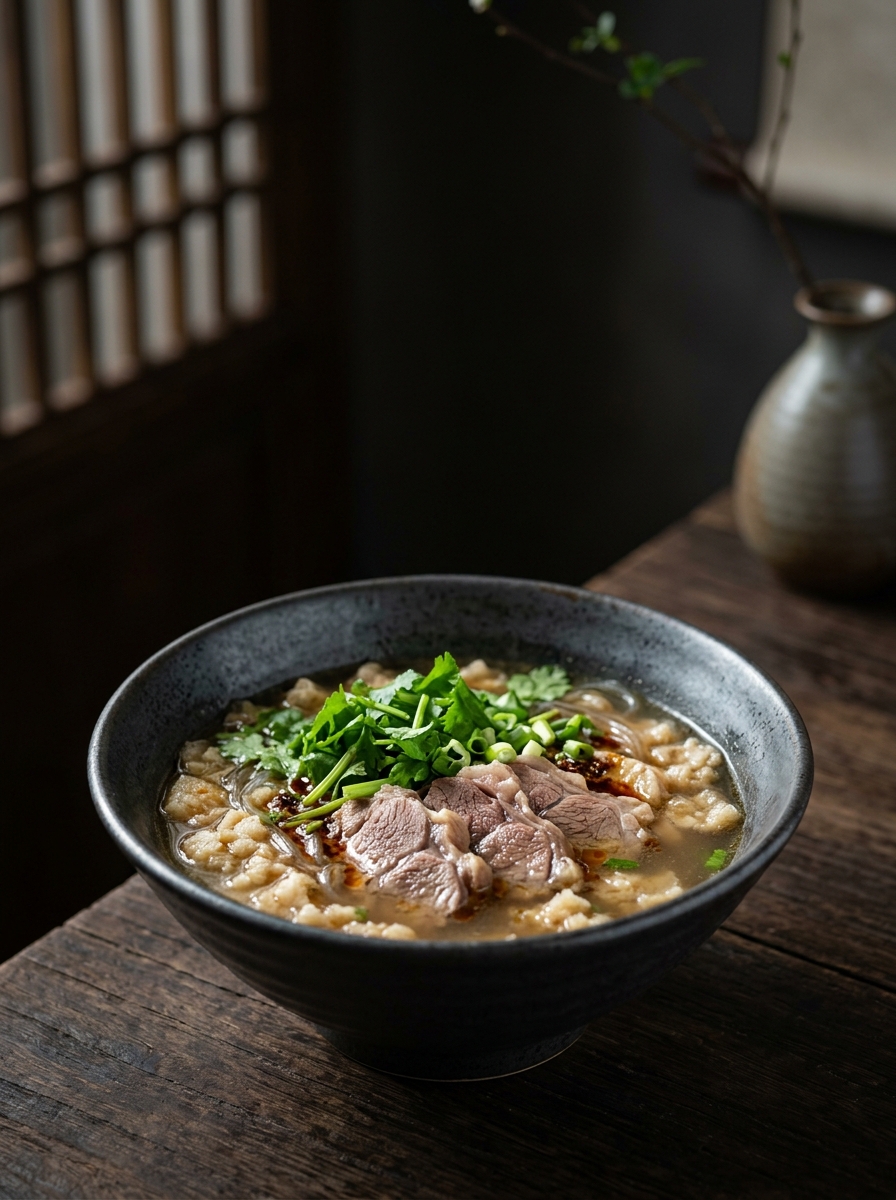
Pao mo is a dish of three preparations that meet only at the end, and its pleasure is in the bread. The broth is made by simmering lamb bones and meat for two hours until it is rich but still clear; the flatbread is leavened, rolled thin and pan-cooked until golden, then torn or cut into half-centimetre cubes; and the assembly takes three minutes, which is the whole point of the pre-made parts. Bread cubes simmered for exactly one minute drink up broth without dissolving into porridge, lamb goes in for thirty seconds so it warms without toughening, and coriander is added at a rolling boil for five seconds so it is scalded safe and still green. Get the cube size wrong and the dish fails either way — too big and the bread stays dry inside, too small and it disintegrates before the bowl reaches the table. Eat it hot, straight from the bowl, before the bread has time to turn to porridge.
| Ingredient | US | Metric | Substitute / note |
|---|---|---|---|
| Cooked lamb, cut into 1 cm cubes | 3.5 oz | 100 g | Leg or belly lamb from the broth pot, as in the source. |
| Plain flour, for the flatbread | 3.5 oz | 100 g | Part of the flatbread dough below; do not serve separately. |
| Warm water, for the flatbread | ¼ cup | 55 ml | At 30 °C, for the dough below. |
| Flatbread, finished weight | 5.3 oz | 150 g | Yield maths: 100 g flour + 55 ml water + 1 g yeast = 156 g dough; pan-cooking loses about 6 g of moisture, yielding about 150 g of finished flatbread for this one serving. |
| Lamb broth | 1 cup | 250 ml | From simmering lamb bones and meat (see steps); the source's bone-and-meat broth, costed as free because it uses trimmings. |
| Coriander | small handful | 5 g | — |
| Salt | ½ tsp | 3 g | To taste, added to the boiling broth. |
| Shaoxing wine, for blanching the lamb | 1 tsp | 5 ml | — |
| Ginger, sliced, for the broth | a few slices | a few slices | Quantity not specified in the source. |
| Yeast, for the bread | ¼ tsp | 1 g | As listed in the source ingredient table. |
Bread cubes absorb broth at a predictable rate, and one minute is the line between soaked and dissolved. The lamb is already fully cooked from the broth pot, so its thirty seconds is only a reheat — longer, and twice-cooked lamb turns dry and stringy. The coriander rule follows food-safety logic rather than flavour: five seconds at a rolling boil is enough to scald it without wilting it into the soup.
Yes — tearing is the traditional Xi'an way and the source's marketing celebrates it. Cutting into 0.5 cm cubes is the report's standardised version and gives a more even soak.
The cubes were too small, or they simmered longer than a minute. Keep them 0.5 cm and time the soak.
Yes — the source's control point is a clear broth, which is why the heat drops after the initial boil and the broth is strained.
Best eaten immediately; soaked bread does not keep. Keep broth, meat and bread separate for up to 2 days refrigerated, and assemble fresh, reheating the broth to a full boil. Broth freezes well for up to 1 month.
Hand-torn flatbread cubes soaked in rich lamb broth with tender lamb and coriander.
Ingredients: 100 g cooked lamb; 100 g plain flour, 55 ml warm water and 1 g yeast for about 150 g flatbread; 250 ml lamb broth; 5 g coriander; 3 g salt; 5 ml wine; ginger slices.
Steps: 1) Soak, blanch lamb; simmer bones and meat 2 hours, strain, cube meat. 2) Make flatbread, cool, cut 0.5 cm cubes. 3) Boil broth, season. 4) Add bread, 1 minute. 5) Add lamb, 30 seconds. 6) Add coriander at a boil, 5 seconds, serve.
Henan-style lamb soup noodles with sesame paste and a warming broth.
Warming winter stew of lamb and white radish in a spicy broth.
Shanghai-style noodles tossed in fragrant scallion oil and soy.
Source note: ingredients, quantities and steps are adapted from the original ClouChef R&D report for 羊肉泡馍 (data/reports/138.md). The report's pricing, margin and marketing sections are deliberately omitted here; no B2B cost is presented as a home-cook cost. Original poster image: clouchef.com (羊肉泡馍_138.jpeg). The source gives no flour or water quantity for the flatbread, so the bread quantities on this page are calculated to yield the source's 150 g finished bread: 156 g of dough less about 6 g of cooking loss. The source's 2-hour broth simmer is followed here; a longer time quoted elsewhere in the report is not used. The 1-bowl serving presentation is an adaptation.