Braised Beef with Potatoes
Beef braised until tender with potatoes that soak up the savoury sauce.
← Home · Hunan braise make-ahead
Beef shin brined, then braised three hours in tea oil with chillies and spices, cooled in its own juices and sliced thin against the grain. Adapted for a home kitchen from the original ClouChef R&D report — 酱牛肉, report 133. Served cold or warm, never hot-sliced.
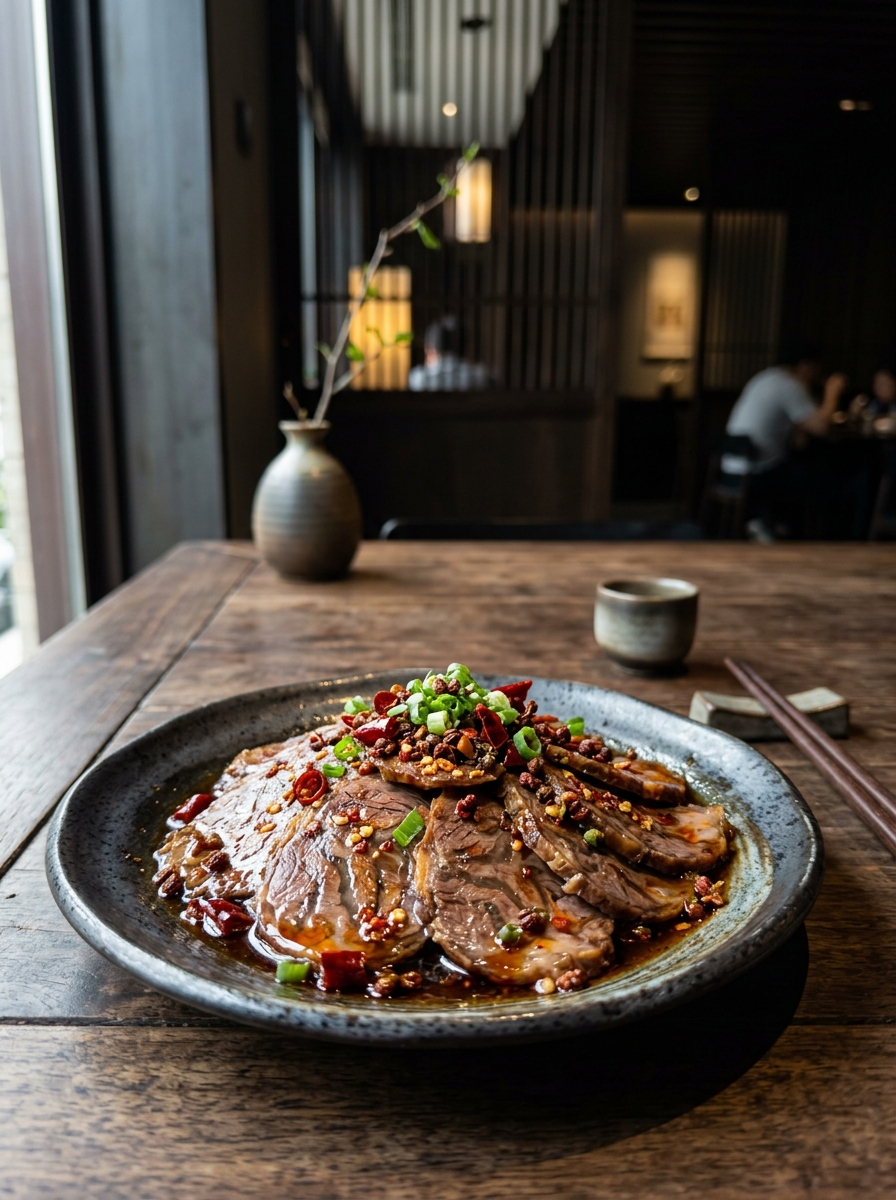
Good braised beef is less about the braise than about what happens around it. Soaking the shin in iced water for two hours, changing the water every half hour, pulls out blood that would otherwise grey the meat and sour the flavour. A two-hour cold brine with salt, pepper, star anise and cinnamon seasons the meat through before it ever meets heat. Then the braise itself is deliberately uneventful: a bare simmer for three hours with the lid on and never lifted, so the collagen-rich shin turns tender without shredding. The final discipline is patience — cooling the beef in its own cooking liquid for about ninety minutes lets it reabsorb juices, and slicing only when cold, against the grain, is what gives clean, intact slices with the marbled tendon showing instead of a pile of strands. A sharp knife and a cold joint are worth more here than any extra seasoning, so slice slowly and arrange the pieces overlapping on the plate.
| Ingredient | US | Metric | Substitute / note |
|---|---|---|---|
| Beef shin (front or hind shank), whole | 1.1 lb | 500 g | Shin is essential: its tendon turns to jelly in the braise. Lean stewing beef will dry out (adaptation note). |
| Camellia (tea) oil | 2 tbsp | 30 ml | Neutral oil is the substitute if tea oil is unavailable (adaptation). |
| Dried red chillies, whole | 0.5 oz | 15 g | — |
| Sichuan peppercorns (green or red) | 1 tbsp | 8 g | — |
| Star anise | about 2 pieces | 3 g | — |
| Cassia bark (cinnamon) | 1 small piece | 2 g | — |
| Salt | 1 tbsp | 15 g | The source does not specify how the salt and spices split between brine and braise; this page uses them in the brine as written and adds the chillies and remaining pepper at the braise — see source note. |
| Light soy sauce | 2 tbsp | 30 ml | Part of the source's 40 ml combined soy (30 ml light + 10 ml dark). |
| Dark soy sauce | 2 tsp | 10 ml | For colour. |
| Water, for brining, blanching and braising | about 2 litres total | about 2,000 ml total | 500 ml for the brine, the rest for blanching and braising to cover the beef by 2 cm. |
| Chilli oil, to drizzle (optional) | To taste | To taste | The source says to heat chilli oil to 160 °C then cool it before use if drizzling. |
Hot braised beef falls apart under a knife because its collagen is still liquid jelly; cold, it sets and slices cleanly. Against the grain matters just as much: shin is a bundle of long fibres, and cutting across them shortens every fibre so the slice eats tender instead of stringy. Warm-water rinsing after blanching follows the same logic — cold water contracts the surface and squeezes juices out before the braise begins.
The beef was sliced hot, or with the grain. Cool it fully in its liquid first, then slice thin and against the grain.
You can, but the beef will be seasoned only on the surface. The two-hour brine is the source's method for seasoning through.
It is the source's signature fat, but neutral oil works; the spice and braise carry the dish. Do not use olive oil — its flavour fights the spices.
Keeps 4 days refrigerated in its cooking liquid; slice as needed. Freezes well for up to 1 month in liquid; thaw overnight in the fridge. Always reheat until steaming hot if serving warm.
Beef shin brined and braised three hours, cooled in its juices, sliced thin against the grain.
Ingredients: 500 g beef shin; 30 ml tea oil; 15 g dried chillies; 8 g peppercorns; 3 g star anise; 2 g cassia; 15 g salt; 30 ml light soy; 10 ml dark soy.
Steps: 1) Soak in iced water 2 hours. 2) Brine 2 hours cold. 3) Blanch, rinse in warm water. 4) Braise covered at a bare simmer 3 hours. 5) Cool in liquid ~1½ hours. 6) Slice 0.3 cm against the grain, drizzle with liquid or chilli oil.
Beef braised until tender with potatoes that soak up the savoury sauce.
Glossy, amber pork belly braised until it trembles.
Warming winter stew of lamb and white radish in a spicy broth.
Source note: ingredients, quantities and steps are adapted from the original ClouChef R&D report for 酱牛肉 (data/reports/133.md). The report's pricing, margin and marketing sections are deliberately omitted here; no B2B cost is presented as a home-cook cost. Original poster image: clouchef.com (酱牛肉_133.jpeg). The source does not specify how the salt and spices split between the brine and the braise, so the split described here is a labelled home adaptation; the 4–6 serving presentation is also an adaptation.