Guobao Pork
Northeastern sweet-and-sour pork, fried crisp in a light, glossy sauce.
← Home · Henan whole fish banquet
Henan's old-style sweet-and-sour carp: a whole Yellow River-style carp scored into a peony bloom, fried crisp in a starch batter, and glazed with a tomato-vinegar sauce in the 8:5:6 sweet-sour ratio. Adapted for a home kitchen from the original ClouChef R&D report — 糖醋鲤鱼河南版, report 150. Distinct from the Shandong sweet-and-sour carp in this batch.
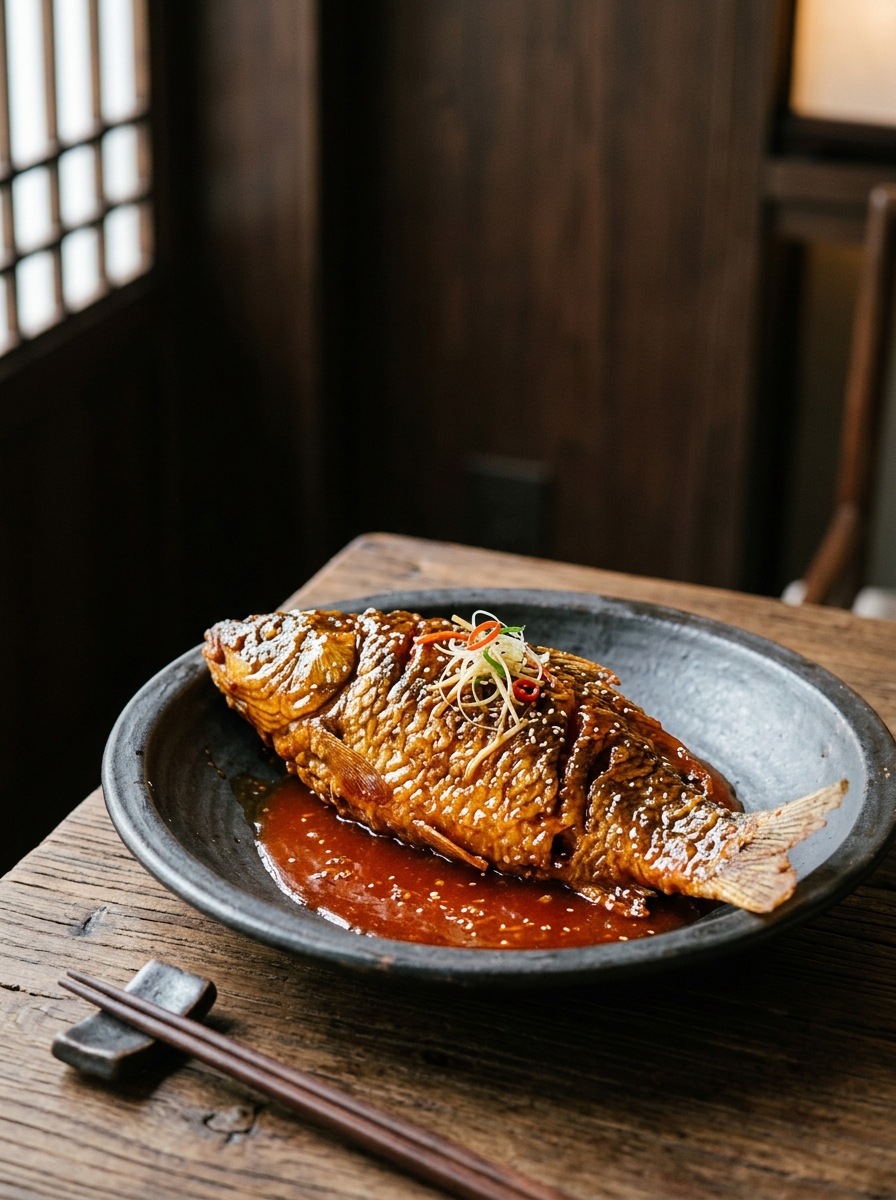
The Henan version differs from its Shandong cousin in the coating and the sauce. Where Shandong dusts dry starch over the fish, Henan mixes the starch into a batter with water, so the fried shell is thicker, more golden and more forgiving — it holds the glaze without going soggy as fast. The sauce ratio is the report's signature: sugar, vinegar and tomato paste at 8:5:6, sweeter and redder than the Shandong balance, simmered only until it bubbles big and thick, about three minutes, so the sugar melts fully without caramelising into bitterness. And the timing rule is absolute: the fish is glazed the moment it leaves the oil, while both fish and sauce are hot, because a cooling fish sweats under its glaze and a cooling sauce slides off instead of clinging. Serve it whole and ungarnished until the last moment, so the first sight of the bloom is at the table.
| Ingredient | US | Metric | Substitute / note |
|---|---|---|---|
| Whole carp, scaled, gutted, black membrane removed | 1.65 lb | 750 g | Yellow River carp or ordinary farmed carp, 1.5–2 jin, in the source. |
| Corn starch, for the batter | 5.3 oz | 150 g | — |
| Water, for the batter | 3 tbsp + 1 tsp | 50 ml | Appears in the source method but not its ingredient table; included here and labelled as such. |
| Sugar | 2.8 oz | 80 g | — |
| 9° rice vinegar | 3 tbsp + 1 tsp | 50 ml | Plain rice vinegar or white vinegar works (adaptation). |
| Tomato paste / ketchup | 2.1 oz | 60 g | The source says tomato paste; ketchup is sweeter, so reduce sugar slightly if using it (adaptation). |
| Salt | 1 tsp | 5 g | — |
| Water, for the sauce | ⅓ cup + 1 tbsp | 100 ml | — |
| Neutral oil, for deep-frying (mostly reusable) | about 1 cup consumed | about 200 ml consumed | The source lists 1,000 ml in the pot with about 200 ml consumed; strain and reuse the rest (adaptation). |
| Oil, for the sauce pan | 2 tsp | 10 ml | — |
| Scallions or white sesame, to garnish | To taste | To taste | — |
A batter shell fries thicker than a dusted one, which matters for a whole fish: it insulates the flesh so the outside can crisp deeply in five minutes without the centre drying, and it gives the glaze a rougher surface to grip. The 8:5:6 ratio is worth measuring the first time — Henan sweet-and-sour is deliberately sweet-forward, and eyeballing it usually lands too sharp or too cloying.
Three things: Henan uses a wet starch batter instead of dry dusting, its sauce ratio is 8:5:6 (sugar:vinegar:tomato) and sweeter, and its fish is a 750 g carp rather than a 1,000 g one. Both are in this batch — compare them side by side.
Usually the fish was wet or the oil was too cool. Pat the fish dry before battering and wait for a full 170 °C before it goes in.
Yes, with the same scoring and batter; a slimmer fish fries faster, so check at 4 minutes (adaptation).
Best eaten immediately. Leftovers keep 1 day refrigerated but the shell will soften; reheat in a hot oven until steaming hot throughout. Do not freeze.
Henan-style whole carp in a crisp starch batter, glazed with a sweet 8:5:6 tomato-vinegar sauce.
Ingredients: 750 g carp; 150 g corn starch; 50 ml batter water; 80 g sugar; 50 ml rice vinegar; 60 g tomato paste; 5 g salt; 100 ml sauce water; ~200 ml frying oil consumed; 10 ml sauce oil.
Steps: 1) Clean, score every 2 cm to the bone. 2) Batter with starch and 50 ml water, coat evenly. 3) Ladle 170 °C oil 30 seconds to set shape, fry 5–6 minutes. 4) Simmer sauce ~3 minutes until big bubbles. 5) Glaze hot fish immediately, garnish, serve.
Northeastern sweet-and-sour pork, fried crisp in a light, glossy sauce.
Sichuan fish fillet in a tingly, chilli-topped broth.
Shrimp flash-fried until the shells turn crisp and red.
Source note: ingredients, quantities and steps are adapted from the original ClouChef R&D report for 糖醋鲤鱼河南版 (data/reports/150.md). The report's pricing, margin and marketing sections are deliberately omitted here, and no cost figures are given: the source's ingredient table and its cost table disagree with each other on the carp cost and on the total, so cost figures are omitted rather than repeated. Original poster image: clouchef.com (糖醋鲤鱼河南版_150.jpeg). The batter water appears only in the source method, not its ingredient table, and is labelled as such; the 3–4 serving presentation is an adaptation. The Shandong sweet-and-sour carp in this same batch is a separate page (sweet-and-sour-carp) and is not linked here, since related links on this page point only to the earlier homepage dishes.