Hong Shao Rou — Red Braised Pork
Glossy, amber pork belly braised until it trembles.
← Home · Hakka braise tonic
Pork trotters slow-braised in Hakka rice wine lees with old ginger and rock sugar until the skin trembles and the sauce turns amber. Adapted for a home kitchen from the original ClouChef R&D report — 客家猪脚姜, report 142.
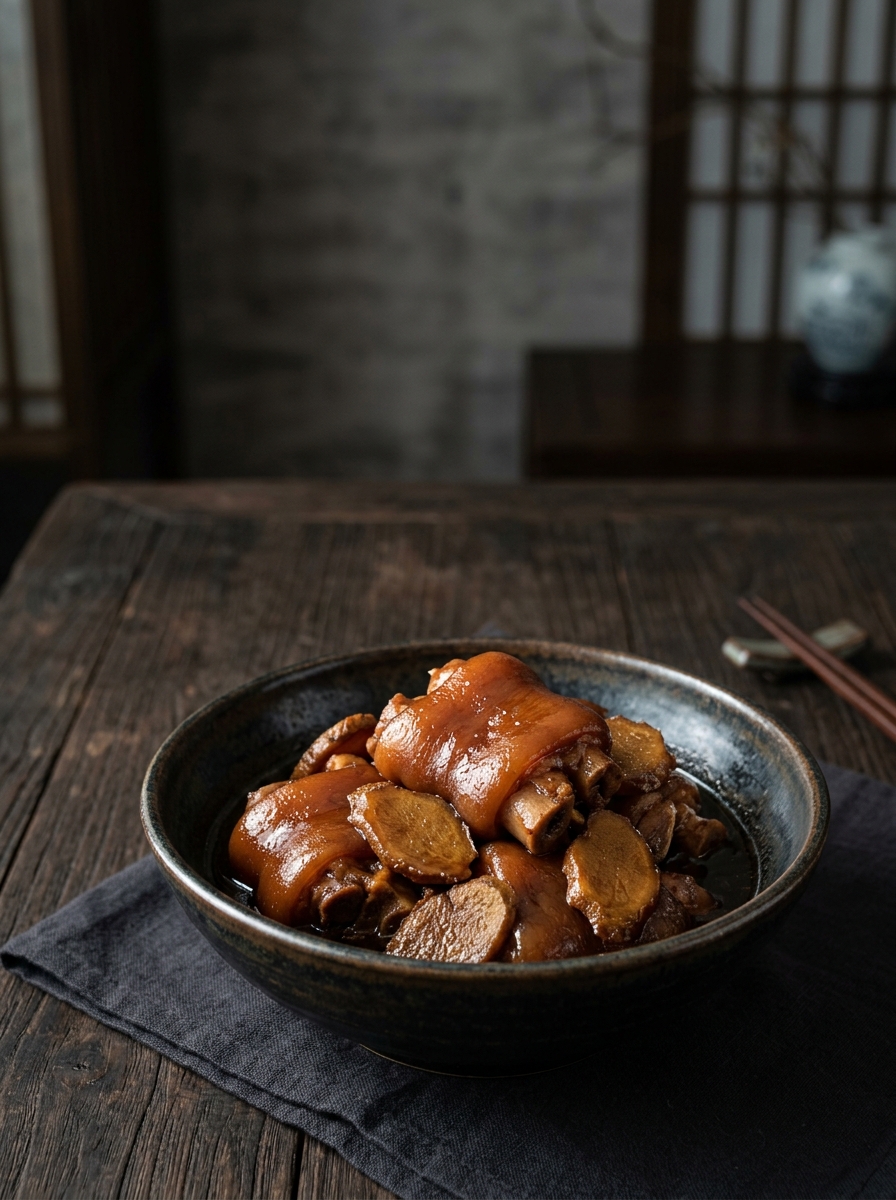
Pork trotters with ginger works on a long, gentle extraction: two hours of barely simmering turns skin and tendon into trembling gelatin, while the ginger gives warmth and the rice wine lees give a sweet, fermented depth that plain wine cannot. The order of operations protects the texture. Blanching for three minutes — no longer — cleans the trotters without losing the gelatin that is the whole point. Frying the ginger first until its edges colour wakes its heat, and browning the trotters briefly in the same pan gives the sauce a base to build on. Salt waits until the end, because salted early it firms the skin and slows the softening. And the reduction is stopped at about 200 ml of thick, spoon-coating sauce: further, and the same sugar and salt that make it glossy turn it harsh. Rice is the essential partner, soaking up the amber sauce that is too good to leave in the bowl.
| Ingredient | US | Metric | Substitute / note |
|---|---|---|---|
| Pork front trotters, cut into 4–5 cm pieces | 1.1 lb | 500 g | Front trotters in the source; they have more meat than hind trotters. |
| Old ginger, sliced about 3 mm thick | 5.3 oz | 150 g | Old ginger is hotter and drier than young ginger; do not substitute young ginger piece for piece (adaptation note). |
| Hakka rice wine lees (jiuniang), including the rice grains | ¾ cup + 1 tbsp | 200 ml | Sold jarred at Asian groceries as sweet rice wine lees; if unavailable, use sweet fermented rice wine with its grains, not plain wine (adaptation). |
| Rock sugar, crushed | 1 oz | 30 g | — |
| Dark soy sauce, for colour | 1 tbsp + 1 tsp | 20 ml | — |
| Salt | 1 tsp | 5 g | Added at the end, as in the source. |
| Boiling water, for braising | 5 cups | 1,200 ml | Must be boiling when added, so the proteins do not seize (source control point). |
| Ginger, for blanching | 0.35 oz | 10 g | Appears in the source method but not its ingredient table; included here and labelled as such. |
| Shaoxing wine, for blanching | 1 tbsp | 15 ml | Appears in the source method but not its ingredient table; included here and labelled as such. |
| Neutral cooking oil, for frying the ginger | 3 tbsp + 1 tsp | 50 ml | Appears in the source method but not its ingredient table; included here and labelled as such. |
Every rule here protects gelatin. A short blanch cleans without melting the skin's collagen away; adding boiling rather than cold water keeps the meat's proteins from seizing tight on contact; and holding salt until the end stops the skin firming up before it has softened. Break any one of them and the trotters stay chewy instead of trembling — the braise time alone will not rescue them.
They carry more meat relative to bone and skin than hind trotters, so the finished dish eats meatier. Hind trotters work but give a bonier, fattier result.
The flavour will be thinner: the lees bring sweetness, body and fermented rice character that clear wine lacks. If you must, add a tablespoon of sugar and a splash of sweet rice wine, and accept a different result.
Cold water added to hot meat makes surface proteins seize and tighten, which slows softening. The source makes boiling water a control point.
Keeps 4 days refrigerated in its sauce; the sauce sets to jelly when cold, which is normal — reheat gently until steaming hot throughout. Freezes well for up to 1 month in sauce; thaw overnight in the fridge.
Pork trotters braised in rice wine lees with old ginger until trembling, in an amber sauce.
Ingredients: 500 g pork front trotters; 150 g old ginger; 200 ml Hakka rice wine lees; 30 g rock sugar; 20 ml dark soy sauce; 5 g salt; 1,200 ml boiling water; 50 ml oil.
Steps: 1) Blanch trotters 3 minutes with ginger and wine, rinse warm. 2) Fry ginger until edges colour, fry trotters 2 minutes. 3) Add wine lees, soy, sugar, 1,200 ml boiling water; simmer covered 1½ hours. 4) Reduce to ~200 ml sauce. 5) Salt last, serve.
Glossy, amber pork belly braised until it trembles.
Steamed glutinous rice with pork, dried mushrooms and dried shrimp.
One-pot braised ribs cooked until the meat falls off the bone.
Source note: ingredients, quantities and steps are adapted from the original ClouChef R&D report for 客家猪脚姜 (data/reports/142.md). The report's pricing, margin and marketing sections are deliberately omitted here; no B2B cost is presented as a home-cook cost. Original poster image: clouchef.com (客家猪脚姜_142.jpeg). The blanching ginger and wine and the frying oil appear only in the source method, not its ingredient table, and are labelled as such; the braise follows the source's 1½-hour step rather than its 2-hour section heading, and the 2–3 serving presentation is an adaptation.