Hong Shao Rou — Red Braised Pork
Glossy, amber pork belly braised until it trembles.
← Home · Hakka steamed banquet
Pork belly boiled, fried to a blistered skin, sliced and steamed ninety minutes over pickled mustard until it collapses — the Hakka扣肉 of the report. Adapted for a home kitchen from the original ClouChef R&D report — 梅菜扣肉客家版, report 143.
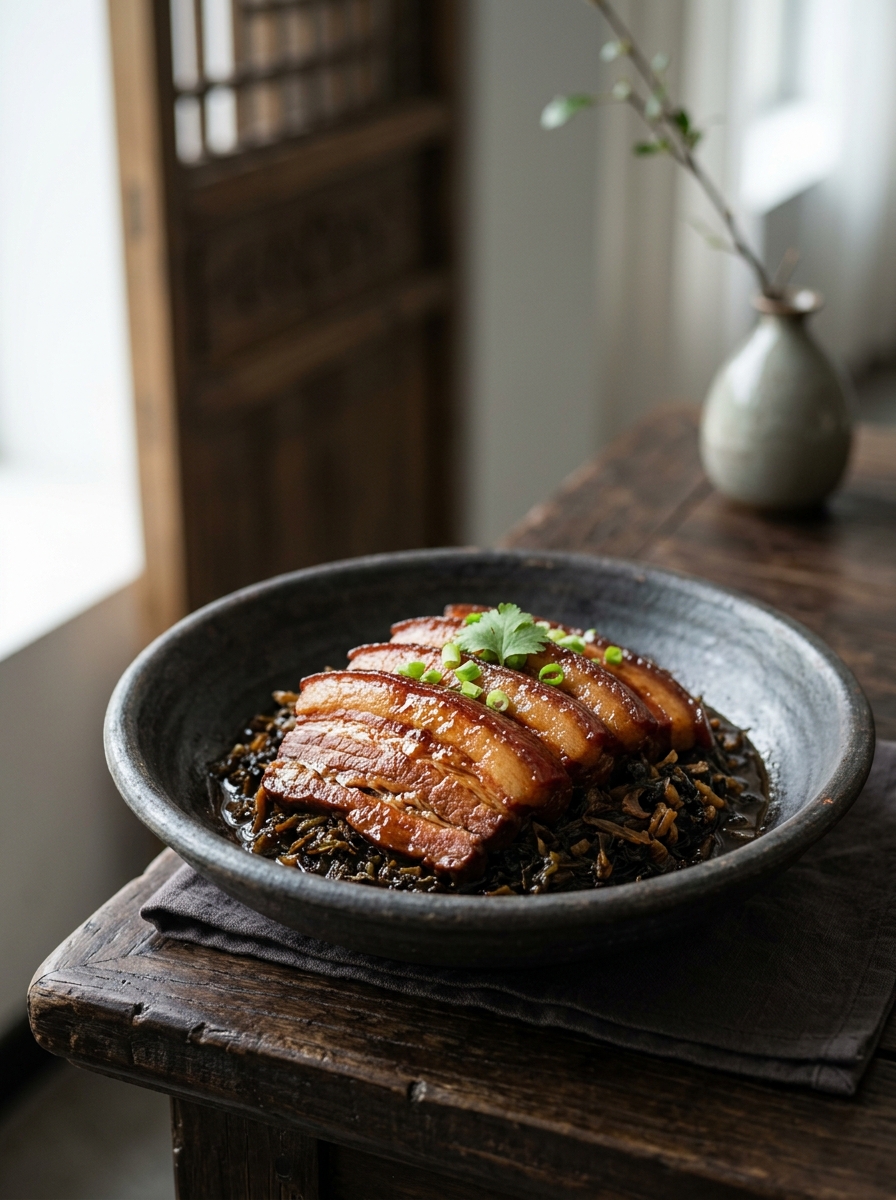
Kou rou is a dish of transformations, each one setting up the next. Boiling the belly for twenty-five minutes to seventy percent done firms it enough to slice cleanly later, while pricking the skin all over lets the frying fat bubble it into a crisp, blistered crust. A ten-minute ice-water bath after frying is not a pause but a step: it tightens the skin into the springy, slightly chewy texture that defines good kou rou. Marinating the slices in fermented bean curd, soy and sugar seasons the meat from within, and the ninety-minute steam over pickled mustard does the final work — the fat melts into the vegetables below while the vegetables' fermented sourness cuts back through the fat, so the finished slice eats rich but not greasy. The flip at the end is theatre with a purpose: it presents the skin side up, glossy and intact. Steamed rice is mandatory, not optional, because it balances the salt and carries the melted fat.
| Ingredient | US | Metric | Substitute / note |
|---|---|---|---|
| Pork belly with skin, fat about 40–50% | 12.3 oz | 350 g | Choose belly with even layers of fat and lean. |
| Hakka pickled mustard (suan cai), soaked | 5.3 oz | 150 g | Soak 30 minutes to remove excess salt (see steps). For the mei cai swap, see Variations. |
| Fermented bean curd (fuyu) | 0.5 oz | 15 g | Red or white; mash to a paste. |
| Light soy sauce | 2 tsp | 10 ml | — |
| Sugar | 1½ tsp | 8 g | — |
| Ginger | 1 tsp | 5 g | 3 g for the boiling water, the rest for general use — split labelled as an adaptation, since the source lists 5 g total and 3 g in the boiling step. |
| Salt | ½ tsp | 3 g | 2 g for the boiling water, the rest to taste — split labelled as an adaptation. |
| Neutral oil, for frying (reusable) | about ¼ cup in the pot | about 50 ml in the pot | The source lists 50 ml with about 20 ml consumed. |
| Scallions, blanched, to garnish | small handful | small handful | The source requires scallions blanched 5 seconds in boiling water, cooled and drained — never raw. |
Each step changes the skin's structure: pricking lets steam and fat escape so the skin bubbles instead of splitting; frying sets the blister; the ice bath contracts the skin into its characteristic chew; and the long steam then melts the fat underneath without softening that skin away. Skip the ice bath and the skin stays leathery; shorten the steam and the fat stays solid and greasy instead of melting into the vegetables.
Yes — swap the pickled mustard for mei cai, soaked the same way; it will be sweeter and less sharp. The main recipe uses pickled mustard, as in the report's ingredient list.
Usually the skin was not pricked densely enough or the oil was below 180 °C. Dense pricking and a fully dry surface before frying are the controls.
Not below 80 minutes — the source sets that as the minimum for the fat to melt. Shorter steaming leaves the pork greasy rather than melting.
Keeps 3 days refrigerated; re-steam for 10 minutes to serve. Freezes well for up to 1 month in its bowl juices; thaw overnight in the fridge and re-steam until steaming hot throughout.
Pork belly blistered, sliced and steamed ninety minutes over pickled mustard until melting.
Ingredients: 350 g pork belly; 150 g Hakka pickled mustard; 15 g fermented bean curd; 10 ml light soy sauce; 8 g sugar; 5 g ginger; 3 g salt; ~50 ml frying oil.
Steps: 1) Boil belly 25 minutes with ginger and salt, dry. 2) Prick skin densely, fry at 180 °C skin-side down 2 minutes, flip 1 minute. 3) Ice water 10 minutes. 4) Slice 0.8 cm, marinate 15 minutes. 5) Pack skin-side down, cover with soaked mustard. 6) Steam 100 °C 90 minutes, flip onto a plate, garnish.
Glossy, amber pork belly braised until it trembles.
Steamed glutinous rice with pork, dried mushrooms and dried shrimp.
One-pot braised ribs cooked until the meat falls off the bone.
Source note: ingredients, quantities and steps are adapted from the original ClouChef R&D report for 梅菜扣肉客家版 (data/reports/143.md). The report's pricing, margin and marketing sections are deliberately omitted here; no B2B cost is presented as a home-cook cost. Original poster image: clouchef.com (梅菜扣肉客家版_143.jpeg). The report's title names mei cai but its quantified ingredient is Hakka pickled mustard, and this page follows the ingredient list, with the mei cai swap given as a labelled variation. The ginger and salt splits and the 2–3 serving presentation are adaptations and are labelled as such.