Hong Shao Rou
Slow-braised pork belly with rock sugar, in an Instant Pot or on the stove, with a glossy, savoury-sweet sauce.
← Home · Northeastern pork sweet-sour
Northeastern sweet-and-sour pork, fried crisp and coated in a light, glossy sauce. Adapted for a home kitchen from the original ClouChef R&D report — 锅包肉, report 70.
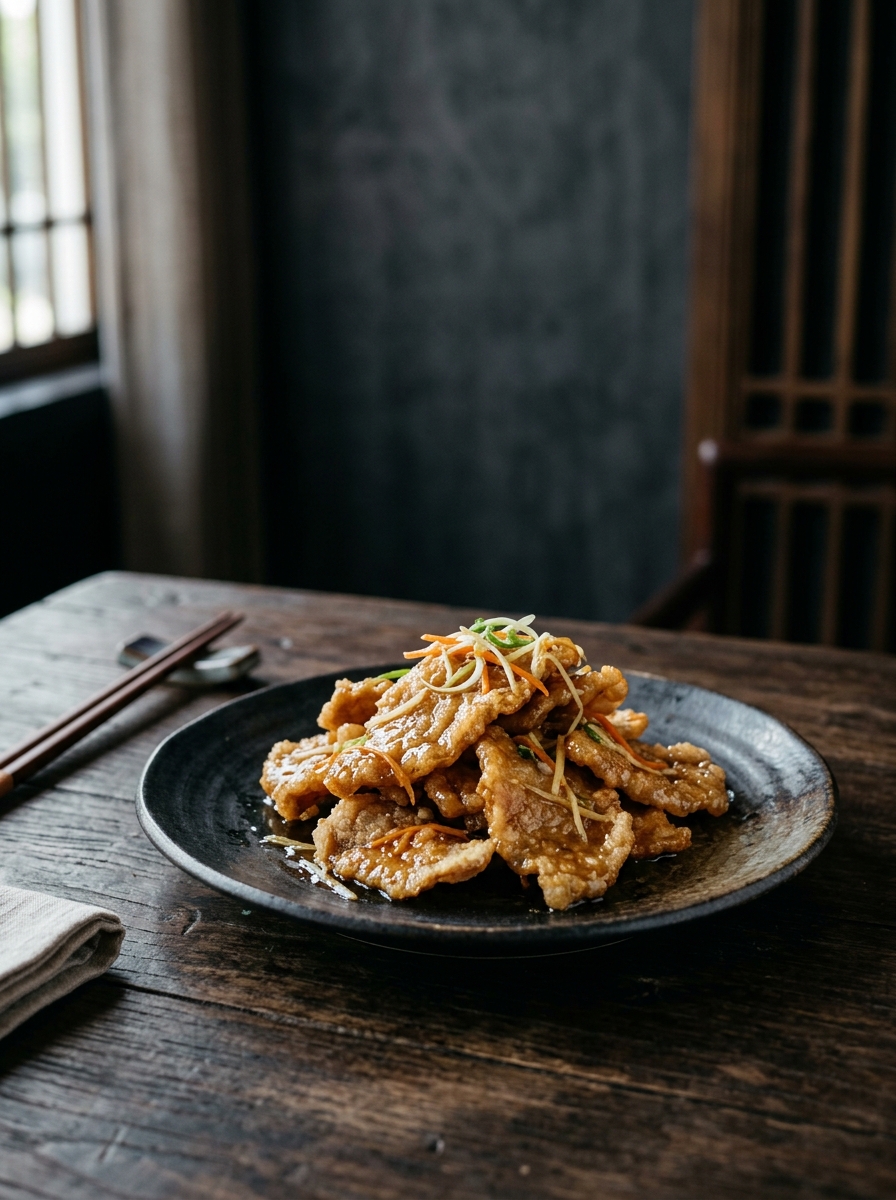
Guobao pork fails in exactly one place: the moment the crisp pork meets the sauce. The report solves it by separating the two jobs completely. First the pork is pounded from 0.5 cm down to 0.2 cm, which breaks the fibres so thin slices stay tender inside a shattering crust, then coated in a potato-starch batter the consistency of yoghurt — potato starch, not corn starch, is the report's crispness secret, because it fries up brittle and does not soften as fast. Two fries finish the job: 170 °C to set the coating, then 190 °C to drive off the last moisture and turn it golden. Only then does the sauce appear, boiled to big bubbles in about 30 seconds, and the pork is tossed in it for seconds, not minutes, so the crust is lacquered rather than soaked. The five-second rule at the end is literal.
| Ingredient | US | Metric | Substitute / note |
|---|---|---|---|
| Pork tenderloin, sliced 0.5 cm thick | 8.8 oz | 250 g | Pound each slice to 0.2 cm before coating. |
| Potato starch | 1.8 oz | 50 g | Potato starch fries crisper than corn starch here; the report specifies it. |
| Cold water, for the batter | 6 tbsp + 2 tsp | 100 ml | Mix to a yoghurt-like consistency. |
| Sugar | 2 tbsp + 1 tsp | 30 g | For the sweet-sour sauce (ratio 3:2:1 sugar to vinegar to soy). |
| Rice vinegar (9° if available) | 1 tbsp + 1 tsp | 20 ml | Ordinary rice vinegar is the closest substitute; it is a little less sharp (adaptation). |
| Light soy sauce | 2 tsp | 10 ml | — |
| Water, for the sauce | 1 tbsp + 1 tsp | 20 ml | — |
| Salt | 1/3 tsp | 2 g | For seasoning the pork. |
| Cooking wine | 1 tsp | 5 ml | For seasoning the pork. From the report's steps; the table omits it. |
| Scallion and ginger shreds | 2 tsp | 10 g | For the sauce. |
| Coriander leaves | 1 tbsp | 5 g | Stirred through the hot sauce at the end. |
| Neutral oil, for deep-frying | 2 cups | 500 ml | The report reuses this oil across batches; strain and reuse it for frying only (adaptation). |
The two oil temperatures do different work: 170 °C sets the batter without browning it, and 190 °C drives out moisture for a crust that stays crisp. A batter the thickness of yoghurt is the other half — too thin and it slides off, too thick and it turns leathery. And the sauce toss must be fast: once the pork is in, count seconds, not minutes, or the crust you just built dissolves. Cook pork to 71 °C / 160 °F throughout (home food-safety guidance, added as an adaptation).
Almost always the pork sat in the sauce too long, or the sauce was not boiled to big bubbles first. Toss fast and serve immediately.
You can, but the crust will soften faster. Potato starch is the report's specified choice for a reason.
Pounding to 0.2 cm breaks the fibres, so the meat stays tender under a crisp crust. Thicker slices turn chewy and refuse to crisp evenly.
Best eaten within minutes of saucing — crispness is the dish. Unsauced fried pork keeps 2 days refrigerated; re-crisp in hot oil or a hot oven, then sauce fresh. Once sauced, leftovers keep 1 day refrigerated but will be soft; reheat gently until steaming throughout.
Crisp double-fried pork in a light, glossy sweet-sour sauce.
Ingredients: 250 g pork tenderloin; 50 g potato starch; 100 ml water for batter; 30 g sugar; 20 ml rice vinegar; 10 ml light soy; 20 ml water for sauce; 2 g salt; 5 ml cooking wine; 10 g scallion and ginger shreds; 5 g coriander; 500 ml frying oil.
Steps: 1) Pound pork to 0.2 cm, season 5 minutes. 2) Coat in potato-starch batter, rest 2 minutes. 3) Fry at 170 °C for 2 minutes, then 190 °C for 1 minute. 4) Boil the sweet-sour sauce to big bubbles. 5) Toss pork and coriander through, serve in seconds.
Slow-braised pork belly with rock sugar, in an Instant Pot or on the stove, with a glossy, savoury-sweet sauce.
Cantonese roast pork made in a home oven or air fryer, with a sticky, caramelised edge and no barbecue pit.
Steamed glutinous rice with pork, dried mushrooms and dried shrimp — savoury, filling and warming.
Newsletter note: the signup form on the homepage is a static placeholder and does not collect or send anything.
Source note: ingredients, quantities and steps are adapted from the original ClouChef R&D report for 锅包肉 (data/reports/70.md). The report's pricing, margin and marketing sections are deliberately omitted here; no B2B cost is presented as a home-cook cost. Original poster image: clouchef.com (锅包肉_70.jpeg). Serving size for home use (2), the vinegar substitute, the smaller-pot frying note and the safety temperature are adaptations and are labelled as such.