White-Cut Chicken
Poached chicken served at room temperature with a ginger-scallion dip — the classic Cantonese preparation.
← Home · stew chicken ginseng
A whole chicken gently steamed in a covered pot with fresh ginseng, goji berries and red dates, served with its clear golden broth. Adapted for a home kitchen from the original ClouChef R&D report — 人参炖鸡, report 189.
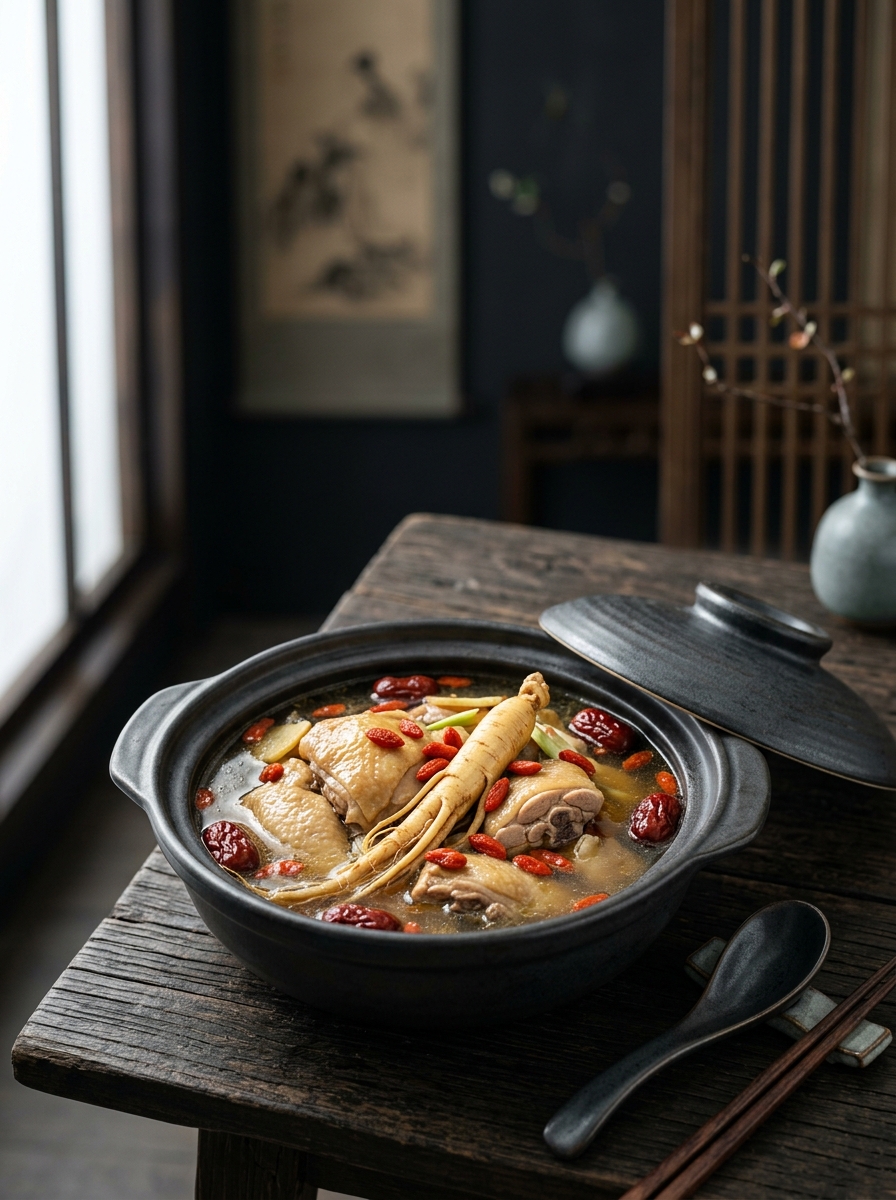
The report treats this as a dish of restraint: a whole chicken, water, and four aromatics, with salt withheld until the last half hour so the meat never tightens. Steaming the pot inside a larger pot — the traditional double-boiling method — keeps the broth at a gentle 95 to 98 °C, never a rolling boil, which is why the soup stays clear and golden instead of cloudy. Fresh ginseng is used whole, root hairs and all, because the report values it as the centrepiece on the plate as much as a flavouring; dried ginseng is an accepted fallback but at a quarter of the weight, since it is far more concentrated. The timing note about goji and dates deserves attention: cooked too long they turn sour and lose their colour, so the report's own guidance is to add them later if a bright garnish matters. Served whole in a deep dish with its broth poured over, this is a quiet, restorative soup that depends entirely on good chicken and unhurried heat.
| Ingredient | US | Metric | Substitute / note |
|---|---|---|---|
| Whole chicken (about 1.2 kg), head and feet removed | 2.6 lb | 1200 g | A stewing hen or free-range chicken gives the clearest broth (adaptation). |
| Fresh ginseng, with root hairs | 0.7 oz | 20 g | If using dried ginseng, use 5 g instead, per the report. |
| Goji berries | 0.35 oz | 10 g | Soak in warm water 10 minutes. |
| Red dates, pitted | 1 oz | 30 g | About 3 dates; soak in warm water 10 minutes. |
| Old ginger, sliced | 0.5 oz | 15 g | — |
| Scallion, cut into segments | 0.7 oz | 20 g | — |
| Cooking wine (yellow wine) | 4 tsp | 20 ml | Half for blanching, half for the pot. |
| Sea salt | 1 tsp | 5 g | Add only in the last 30 minutes, per the report. |
| Filtered water | 6 1/3 cups | 1500 ml | — |
Two rules carry this dish. First, salt goes in only for the final 30 minutes: salted early, the chicken's proteins tighten and the meat turns tough. Second, the broth must barely simmer: double-boiling keeps it just below boiling, which extracts flavour without clouding the soup or shredding the meat. Overcooking past 2 hours makes the chicken fall off the bone and ruins the whole-bird presentation.
Yes — 5 g dried replaces 20 g fresh, per the report. The soup will taste more concentrated but the root will not look as good on the plate.
The outer pot boiled too hard, or the chicken was not blanched and skimmed. Keep the simmer gentle and seal the inner pot.
With the chicken if flavour matters most; only for the last hour if you want them to stay red and intact for presentation.
Keeps 2 days refrigerated; reheat gently until steaming hot throughout. The cooked chicken and broth can be frozen separately up to 1 month, though the whole-bird presentation will be lost. Do not reheat more than once.
Whole chicken double-boiled with fresh ginseng, goji berries and red dates in a clear golden broth.
Ingredients: 1200 g whole chicken; 20 g fresh ginseng (or 5 g dried); 10 g goji berries; 30 g red dates; 15 g ginger; 20 g scallion; 20 ml cooking wine; 5 g salt; 1500 ml water.
Steps: 1) Prepare chicken and aromatics. 2) Blanch 3 minutes. 3) Double-boil sealed pot 2 hours at a bare simmer. 4) Salt at 1.5 hours, serve whole with broth.
Poached chicken served at room temperature with a ginger-scallion dip — the classic Cantonese preparation.
Beef braised until tender with potatoes that soak up the savoury sauce — a classic family stew.
Slow-braised pork belly in a dark, sweet-savoury glaze.
Source note: ingredients, quantities and steps are adapted from the original ClouChef R&D report for 人参炖鸡 (data/reports/189.md). The report's pricing, margin and marketing sections are deliberately omitted here; no B2B cost is presented as a home-cook cost. The 74 °C safety temperature and slow-cooker variation are home adaptations and are labelled as such. Original poster image: clouchef.com (人参炖鸡_189.jpeg).