Lamb Noodle Soup
Henan-style lamb soup noodles with sesame paste and a warming broth.
← Home · Yunnan noodles soup
Yunnan's ritual bowl: silky rice noodles under layers of ham, chicken, bean sprouts and quail egg, brought to life by a ladle of scalding broth poured over toppings that are already fully cooked. Adapted for a home kitchen from the original ClouChef R&D report — 过桥米线, report 151. With one safety change: the chicken is fully cooked before the broth is poured.
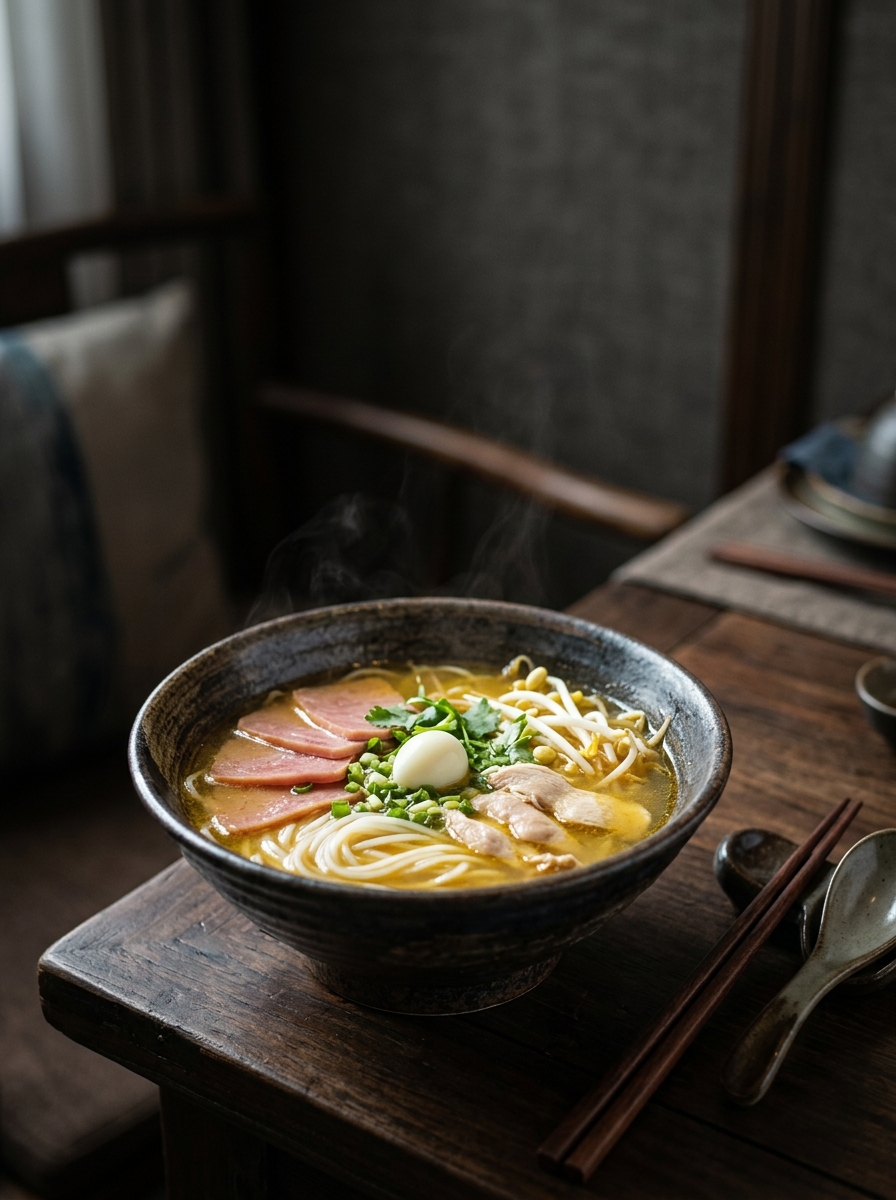
Crossing bridge noodles are theatre with a thermal purpose. A layer of oil on a near-boiling broth keeps it scalding hot for a long time, and that stored heat keeps the already-cooked toppings scalding hot in the bowl — the diner watches the layers come together under the hot broth. The bowl itself is part of the apparatus: preheated to at least 80 °C, it does not steal heat from the broth the moment it is poured. The toppings are layered, not mixed, so each one meets the broth in turn and nothing overcooks before the last layer goes in. The one change this page makes to the report is about safety, and it is stated plainly: the report blanches chicken slices for five seconds and relies on the poured broth to finish them, but a home cook cannot verify that finish, so here the chicken is fully poached first and the broth is poured boiling — the ritual survives, the risk does not.
| Ingredient | US | Metric | Substitute / note |
|---|---|---|---|
| Dried crossing-bridge rice noodles | 5.3 oz | 150 g | Soak in cold water for 2 hours first, as in the source. |
| Cooked Xuanwei ham slices, 2 mm thin | 1 oz | 30 g | Cooked ham in the source; good cooked country ham or Jinhua ham works (adaptation). Keep hot (above 60 °C) until serving, as the source requires. |
| Chicken breast, sliced 1.5 mm across the grain | 1.8 oz | 50 g | SAFETY ADAPTATION: poach fully in boiling water or broth until it reaches 74 °C throughout, instead of the source's 5-second blanch. See steps and source note. |
| Mung bean sprouts | 1.8 oz | 50 g | Blanched 3 seconds in boiling water, as in the source, then refreshed. |
| Quail eggs, boiled, halved | 2 eggs | about 30 g | — |
| Chicken-and-pork bone broth | 1⅔ cups | 400 ml | Bones 1:1 chicken to pork, simmered 4 hours and strained, as in the source; good shop-bought chicken stock is the shortcut (adaptation). |
| Salt | ½ tsp | 3 g | — |
| Chicken bouillon powder (optional) | ¼ tsp | 2 g | The source lists it; omit if your broth is already well seasoned (adaptation). |
| White pepper | ¼ tsp | 1 g | — |
| Shaoxing wine, for the chicken | 1 tsp | 5 ml | For the marinade in the source method. |
| Corn starch, for the chicken | 1 tsp | 5 g | For the marinade in the source method. |
| Coriander and scallions, to garnish | small handful | 5 g | — |
The oil film on a proper crossing-bridge broth is insulation: it slows heat loss from the surface, so the broth stays near boiling long enough to keep the cooked toppings scalding. Layering matters for the same reason — toppings piled together insulate each other from the broth, while layers let the hot liquid reach each one. Preheating the bowl is the unglamorous third leg: a cold bowl can drop a boiling broth ten degrees on contact, which is the difference between cooked and lukewarm.
Because the traditional finish relies on broth hot enough and poured precisely enough to cook raw chicken in seconds, and a home cook cannot verify that. Fully poaching the chicken first keeps the ritual and removes the risk; the source's own safety controls require the finished dish to hold 70 °C at its centre.
A cold bowl steals heat from the broth on contact. The source sets 80 °C as the minimum bowl temperature for exactly this reason.
Yes — skip the soak and boil briefly until just tender, then rinse cold (adaptation). Dried noodles are the source's choice.
Best eaten immediately; the noodles swell and the broth cools fast. Keep broth, noodles and toppings separate for up to 2 days refrigerated and assemble fresh, with the broth at a rolling boil. Broth freezes well for up to 1 month.
Yunnan rice noodles layered with ham, chicken, sprouts and quail egg under scalding broth.
Ingredients: 150 g dried rice noodles; 30 g cooked ham; 50 g chicken breast; 50 g bean sprouts; 2 quail eggs; 400 ml bone broth; 3 g salt; 2 g bouillon powder; 1 g white pepper; 5 ml wine; 5 g starch.
Steps: 1) Simmer bones 4 hours, strain. 2) Soak noodles 2 hours, boil 30 seconds. 3) Fully poach chicken to 74 °C; blanch sprouts 3 seconds. 4) Preheat bowl ≥80 °C, layer noodles, ham, chicken, sprouts, eggs, herbs. 5) Pour ≥95 °C broth around the wall. 6) Rest 15 seconds, season, stir, serve.
Henan-style lamb soup noodles with sesame paste and a warming broth.
Shanghai-style noodles tossed in fragrant scallion oil and soy.
Crisp bean sprouts, chives, egg and glass noodles.
Source note: ingredients, quantities and steps are adapted from the original ClouChef R&D report for 过桥米线 (data/reports/151.md). The report's pricing, margin and marketing sections are deliberately omitted here, and no cost figures are given: the source's pricing note uses a cost figure that differs from its own cost-table total, so cost figures are omitted rather than repeated. Original poster image: clouchef.com (过桥米线_151.jpeg). SAFETY ADAPTATION, stated on the page: the source blanches chicken slices for 5 seconds and relies on the poured broth to finish them; this page instead fully poaches the chicken to 74 °C first, because the home finish cannot be verified. The 1-bowl serving presentation and the shop-bought stock shortcut are adaptations and are labelled as such.