Oil-Blast Shrimp
Shrimp flash-fried until crisp and fragrant.
← Home crab fish lips banquet
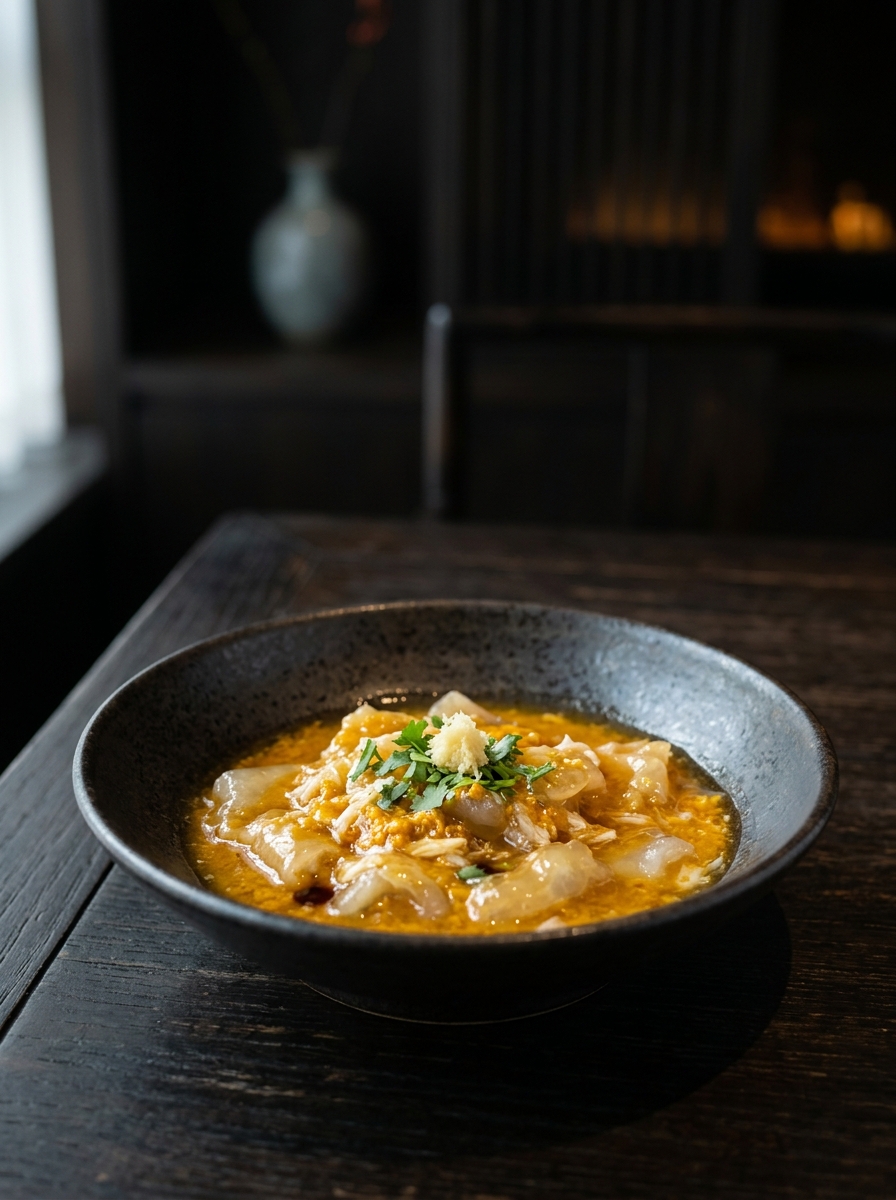
Fish lips simmered in a rich stock with crab roe, ginger and a splash of black vinegar, finished with coriander warmed in the boiling broth. Adapted from the original ClouChef R&D report — 蟹粉鱼唇, report 186.
Home adaptation note: The report is one portion (100 g crab roe, 120 g fish lips). Quantities below are that portion. Fish lips (dried shark or fish lip cartilage, sold as yuchun) need a 24-hour soak and are the hard ingredient here — start a day ahead, and buy from a reputable dried-seafood shop. The 200 ml stock is a concentrate diluted 1:10 per the report; good chicken stock is the home substitute (adaptation).
This is a dish of expensive ingredients treated with restraint. Fish lips are soaked in cold water for twenty-four hours, boiled for five minutes and rinsed, then cut into three-centimetre squares and squeezed dry — any water left in them will thin the sauce. The stock must be at a full boil before anything goes in, so the crab roe hits high heat immediately and its centre reaches at least eighty-five degrees. The roe is stirred gently apart and cooked for one to two minutes only; longer and its fresh flavour evaporates. Fish lips then simmer for three minutes, just until they turn translucent and curl slightly — past that they harden. Ginger goes in with the seasoning and must cook for a full thirty seconds, coriander for five seconds in the boiling broth, and the whole reduction is capped at thirty seconds so the sauce stays just thick enough to coat a spoon. Nothing here is left to chance, because at these prices nothing should be.
| Ingredient | US | Metric | Substitute / note |
|---|---|---|---|
| Frozen crab roe (xiefen), fully thawed | 3.5 oz | 100 g | Thaw completely with no ice crystals; use roe from cooked crabs, not raw. |
| Dried fish lips (yuchun), rehydrated | 4.2 oz | 120 g | Soak 24 hours in cold water, boil 5 minutes, rinse, cut into 3 cm squares, squeeze dry. |
| Stock (concentrate diluted 1:10, or chicken stock) | 3/4 cup + 1 tbsp | 200 ml | Chicken stock is the home substitute (adaptation). |
| Ginger, minced | 0.2 oz | 5 g | Must cook in the hot soup at least 30 seconds. |
| Coriander, cut into 3 cm sections | 0.35 oz | 10 g | Must cook in boiling broth 5 seconds; do not scatter raw. |
| Salt | 1/4 tsp | 2 g | — |
| Shaoxing wine | 2 tsp | 10 ml | — |
| Zhenjiang black vinegar | 1 tsp | 5 ml | — |
Two rules protect the expensive ingredients: the stock must already be boiling when the roe goes in, and the final reduction must end within thirty seconds. Either rule broken and the dish is either unsafe or overcooked.
The dried lip and cartilage of large fish, sold as yuchun in dried-seafood shops. Rehydrated, they are soft, gelatinous and almost flavourless — a texture ingredient that carries the crab flavour.
The fish lips were not squeezed dry after rehydrating, or the reduction ran too short. Squeeze well and reduce until the sauce just coats a spoon.
The report specifies crab roe. Crab meat gives a different, milder dish — pleasant, but not this one (adaptation).
Best eaten immediately at 85 °C or hotter. Do not store the finished dish; crab roe deteriorates quickly. Store uncooked rehydrated fish lips refrigerated up to 2 days.
Fish lips in rich stock with crab roe, ginger and black vinegar.
Ingredients: 100 g crab roe; 120 g fish lips; 200 ml stock; 5 g ginger; 10 g coriander; 2 g salt; 10 ml wine; 5 ml black vinegar.
Steps: 1) Soak fish lips 24 hours, boil 5 minutes, cut and squeeze dry; thaw roe fully. 2) Boil stock. 3) Add roe, stir gently, cook 1–2 minutes. 4) Add fish lips, simmer 3 minutes. 5) Season, reduce 30 seconds, add coriander for 5 seconds, serve hot.
Shrimp flash-fried until crisp and fragrant.
Poached chicken served cool with a ginger-scallion dip.
Slow-braised pork in a dark, sweet-savoury sauce.
Source note: ingredients, quantities and steps are adapted from the original ClouChef R&D report for 蟹粉鱼唇 (data/reports/186.md). The report's pricing, margin and marketing sections are deliberately omitted here; no B2B cost is presented as a home-cook cost.