Braised Beef with Potatoes
Beef braised until tender with potatoes that soak up the savoury sauce.
← Home · Jiangxi braise winter
Beef brisket slow-braised with star anise and cassia until yielding, then finished with white radish that turns translucent drinking up the sauce. Adapted for a home kitchen from the original ClouChef R&D report — 萝卜牛腩, report 148.
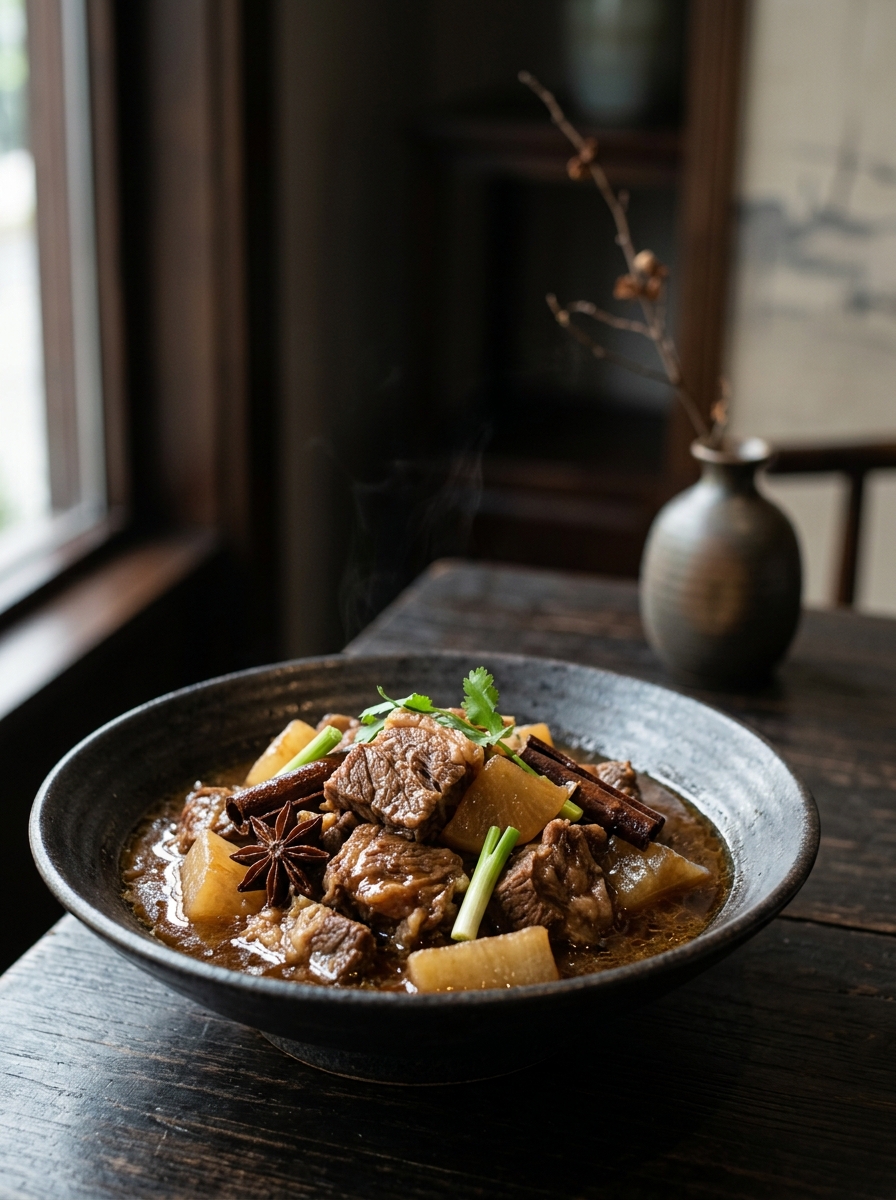
Brisket and radish are a natural pair because they swap qualities in the pot: the brisket gives the broth its body as its fat and collagen melt, and the radish gives the dish its sweetness and lightness as it drinks that broth up. The method respects their different clocks. Brisket gets ninety minutes alone at a bare simmer, so its connective tissue softens without the meat shredding; the radish only joins for the last thirty minutes, long enough to turn translucent and tender but short enough to hold its shape. Spices are fried briefly — thirty seconds, no more — because scorched star anise and cassia turn the whole pot bitter, and salt waits until the final five minutes for the same reason it always does in a long braise: salted early, beef firms and never fully relaxes. The finish is judged by the radish, not the clock — when a chopstick slides in easily and the sauce coats a spoon, it is done.
| Ingredient | US | Metric | Substitute / note |
|---|---|---|---|
| Beef brisket (brisket / flank), cut into 3–4 cm chunks | 10.6 oz | 300 g | — |
| White radish (daikon), peeled, cut into rolling chunks | 7 oz | 200 g | — |
| Star anise | 2 pieces | about 2 g | — |
| Cassia bark (cinnamon) | 1 small piece | about 3 g | — |
| Ginger, sliced | 0.5 oz | 15 g | — |
| Scallions, cut into lengths | 0.7 oz | 20 g | — |
| Light soy sauce | 1 tbsp + 1 tsp | 20 ml | — |
| Dark soy sauce, for colour | 1 tsp | 5 ml | — |
| Rock sugar or granulated sugar | 2 tsp | 10 g | — |
| Shaoxing wine | 1 tbsp | 15 ml | For blanching; the source lists wine in the blanching step. |
| Salt | ½ tsp | 3 g | Added near the end, as in the source. |
| Hot water, for braising | about 3⅓ cups | 800 ml | Enough to cover the brisket, as in the source. |
| Neutral cooking oil, for frying the spices | 2 tbsp | 30 ml | Appears in the source method but not its ingredient table; included here and labelled as such. |
Staggering the ingredients is the whole technique: brisket needs ninety minutes to soften, radish needs thirty to become tender without collapsing, and putting them in together would give you either tough beef or dissolved radish. The bare simmer matters too — a rolling boil agitates the meat apart and clouds the sauce, while a gentle 95–98 °C lets collagen convert quietly and keeps the pieces intact for the plate.
Usually the simmer was too short or too hot. Ninety minutes at a bare simmer is the minimum; a rolling boil tightens rather than softens.
It went in too early or the final reduction was too vigorous. Thirty minutes, gentle heat, and stop when a chopstick slides in.
Yes — 30 minutes at pressure for the brisket, then add radish and simmer uncovered 15 minutes. Timings are a home adaptation; the source method is stovetop.
Keeps 4 days refrigerated in its sauce; the flavour deepens overnight. Reheat gently until steaming hot throughout. Freezes well for up to 1 month; thaw overnight in the fridge.
Slow-braised beef brisket with translucent white radish in a spiced, glossy sauce.
Ingredients: 300 g beef brisket; 200 g white radish; 2 g star anise; 3 g cassia; 15 g ginger; 20 g scallions; 20 ml light soy; 5 ml dark soy; 10 g sugar; 15 ml wine; 3 g salt; 800 ml hot water; 30 ml oil.
Steps: 1) Soak brisket 30 minutes; cut radish into chunks. 2) Blanch brisket 2–3 minutes. 3) Fry spices 30 seconds. 4) Fry brisket 3–4 minutes, add soy and sugar. 5) Braise covered 1½ hours. 6) Add radish, 30 minutes. 7) Reduce 5–8 minutes, salt near the end, serve.
Beef braised until tender with potatoes that soak up the savoury sauce.
Warming winter stew of lamb and white radish in a spicy broth.
Glossy, amber pork belly braised until it trembles.
Source note: ingredients, quantities and steps are adapted from the original ClouChef R&D report for 萝卜牛腩 (data/reports/148.md). The report's pricing, margin and marketing sections are deliberately omitted here, and no cost figures are given: the source's cost table does not add up from its own components, so cost figures are omitted rather than repeated. Original poster image: clouchef.com (萝卜牛腩_148.jpeg). The frying oil and blanching wine appear only in the source method, not its ingredient table, and are labelled as such; the 2–3 serving presentation is an adaptation.