Oil-Blast Shrimp
Shrimp flash-fried in hot oil until the shells turn crisp and red, in a lightly sweet, savoury glaze.
← Home · Cantonese seafood specialist ingredient delicate
Geoduck sliced paper-thin, blanched for twenty seconds, iced, and served over glass noodles with aged tangerine peel and a soy-wasabi dip. Adapted for a home kitchen from the original ClouChef R&D report — 白灼象拔蚌, report 24.
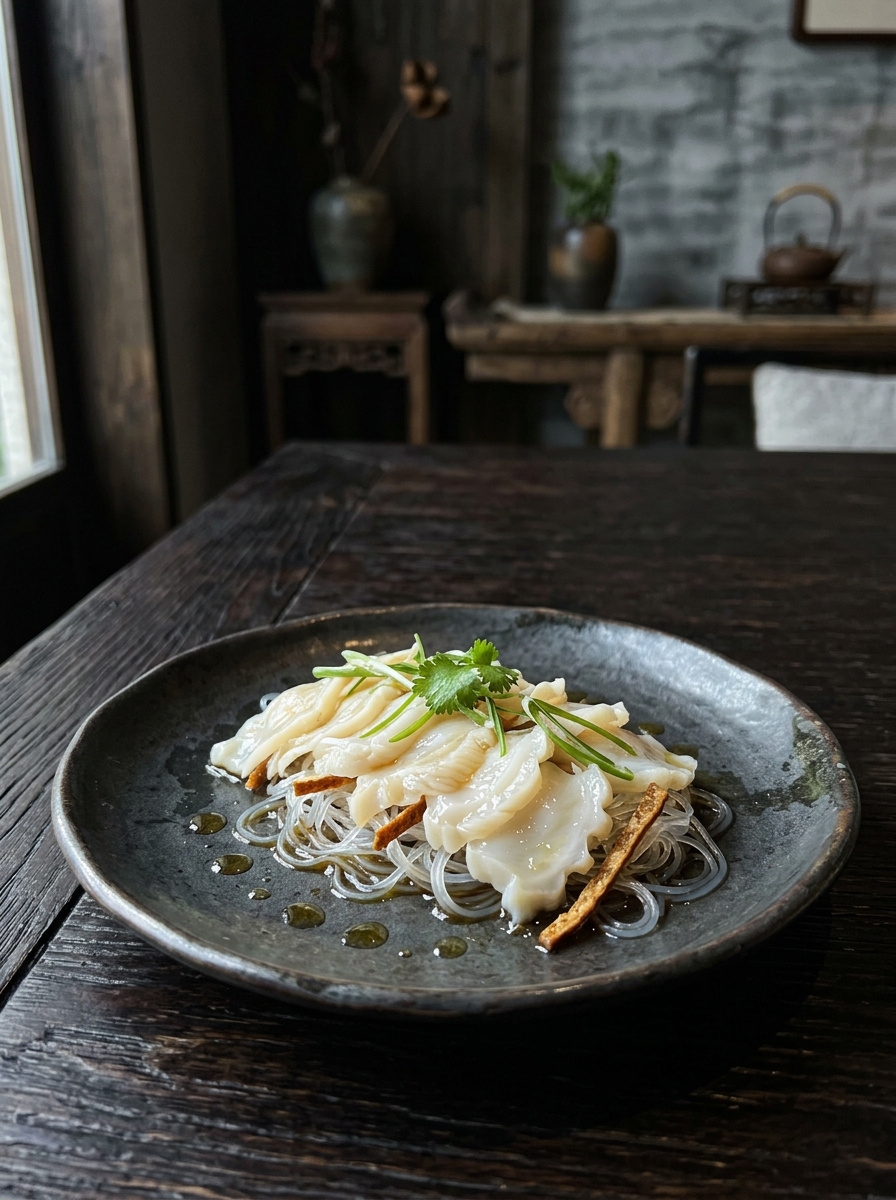
Geoduck is prized for a texture that exists in a window of seconds: slice it 2–3 mm thick, blanch it for exactly twenty seconds in a fragrant broth, and it curls into crisp, sweet ribbons; five seconds longer and it turns leathery, and there is no way back. The broth itself is seasoned but light — aged tangerine peel, ginger, scallion and wine in two litres of water — so it perfumes without masking, and the immediate ice bath stops the cooking dead and locks in the snap. Glass noodles underneath catch the juices and give the plate substance, while the remaining tangerine peel, blanched scallion and ginger threads on top repeat the broth's aromas in solid form. The soy and wasabi dip stays on the side, so each diner controls the salt and heat against a flavour that is, at its best, almost unseasoned sweetness. Serve it at once, while the slices are still cold and crisp against the warm noodles beneath them.
| Ingredient | US | Metric | Substitute / note |
|---|---|---|---|
| Live geoduck, in shell (1.5–2 jin) | About 10.6 oz meat | 300 g | Net meat from one clam. Specialist ingredient — a live geoduck from a Chinese seafood market; buy it alive and use it the same day. |
| Aged tangerine peel (chenpi), 3-year | 2 pieces | 2 pieces | Boiled 2 minutes, then shredded; half goes in the broth, half on top. |
| Dried glass noodles (longkou) | 1.8 oz | 50 g | Boiled until transparent, about 3 minutes, then cooled and cut into 15 cm lengths. |
| Scallions | 0.7 oz | 20 g | Cut into segments; half for the broth, half blanched 5 seconds for garnish. |
| Old ginger | 0.5 oz | 15 g | Sliced; half for the broth, half blanched 5 seconds for garnish. |
| Japanese soy sauce (koikuchi) | 2 tbsp | 30 ml | For the dip. |
| Wasabi paste | 1 tsp | 5 g | For the dip; the report's ratio is soy to wasabi 1:0.2 by weight, which is 30 g to 6 g — 5 g is the rounded home measure (adaptation). |
| Cooking wine | 2 tsp | 10 ml | Yellow wine, for the blanching broth. |
| Water, for the blanching broth | About 8 cups | 2000 ml | — |
| Ice water, for shocking | As needed | As needed | Drinking water with ice, 0–4 °C; replace every 2 hours if holding, per the report. |
The blanch is a kill step and a texture step at once, and both depend on the clock: twenty seconds in boiling broth is long enough for the centre to pass 70 °C but short enough that the proteins only just set, keeping the snap. The ice bath is not optional garnish — without it, residual heat keeps cooking the slices for another minute on the plate, and the dish is ruined before it reaches the table. Slice evenly, or the thin pieces overcook while the thick ones stay raw.
Live from a Chinese seafood market or a specialist fishmonger; it is sold by weight, alive, and must be used the same day. It is expensive — that is normal for this dish.
It was blanched longer than twenty seconds, sliced too thick, or not iced immediately. All three must be right.
This recipe deliberately blanches it; raw geoduck is a different preparation with its own sourcing and handling requirements, and this page does not cover it.
Best eaten within minutes of plating, on a chilled plate. Do not keep leftovers: blanched geoduck loses its snap within hours and should not be reheated. Buy and prepare it the day you serve it.
Twenty-second blanched geoduck over glass noodles with tangerine peel and a soy-wasabi dip.
Ingredients: 300 g geoduck meat; 50 g glass noodles; 2 pieces aged tangerine peel; 20 g scallions; 15 g ginger; 30 ml Japanese soy sauce; 5 g wasabi; 10 ml cooking wine; 2000 ml water.
Steps: 1) Clean geoduck, slice 2–3 mm; cook noodles and chenpi. 2) Blanch slices exactly 20 seconds, ice 10 seconds. 3) Assemble over noodles, garnish, serve dip separately.
Shrimp flash-fried in hot oil until the shells turn crisp and red, in a lightly sweet, savoury glaze.
Sichuan fish fillet in a tingly, chilli-topped broth — made with fillet, not a whole fish.
Shanghai-style noodles tossed in fragrant scallion oil and soy — fifteen minutes, pantry ingredients, big flavour.
Source note: ingredients, quantities and steps are adapted from the original ClouChef R&D report for 白灼象拔蚌 (data/reports/24.md). The report's pricing, margin and marketing sections are deliberately omitted here; no B2B cost is presented as a home-cook cost. The report's own cost tables are arithmetically wrong by an order of magnitude (a materials total of 759.62 against itemised lines that do not support it), so no cost figures are reproduced. The chilled-plate note, the wasabi rounding and the razor-clam variation are adaptations and are labelled as such. Original poster image: clouchef.com (白灼象拔蚌_24.jpeg).