White-Cut Chicken
Poached chicken served cool with a ginger-scallion dip.
← Home · Beijing duck roast banquet celebration
A whole Peking duck — inflated, glazed, air-dried for a day, then roasted in two stages — carved into 118 slices and eaten in pancakes with sweet bean sauce. Adapted for a home kitchen from the original ClouChef R&D report — 北京烤鸭, report 80.
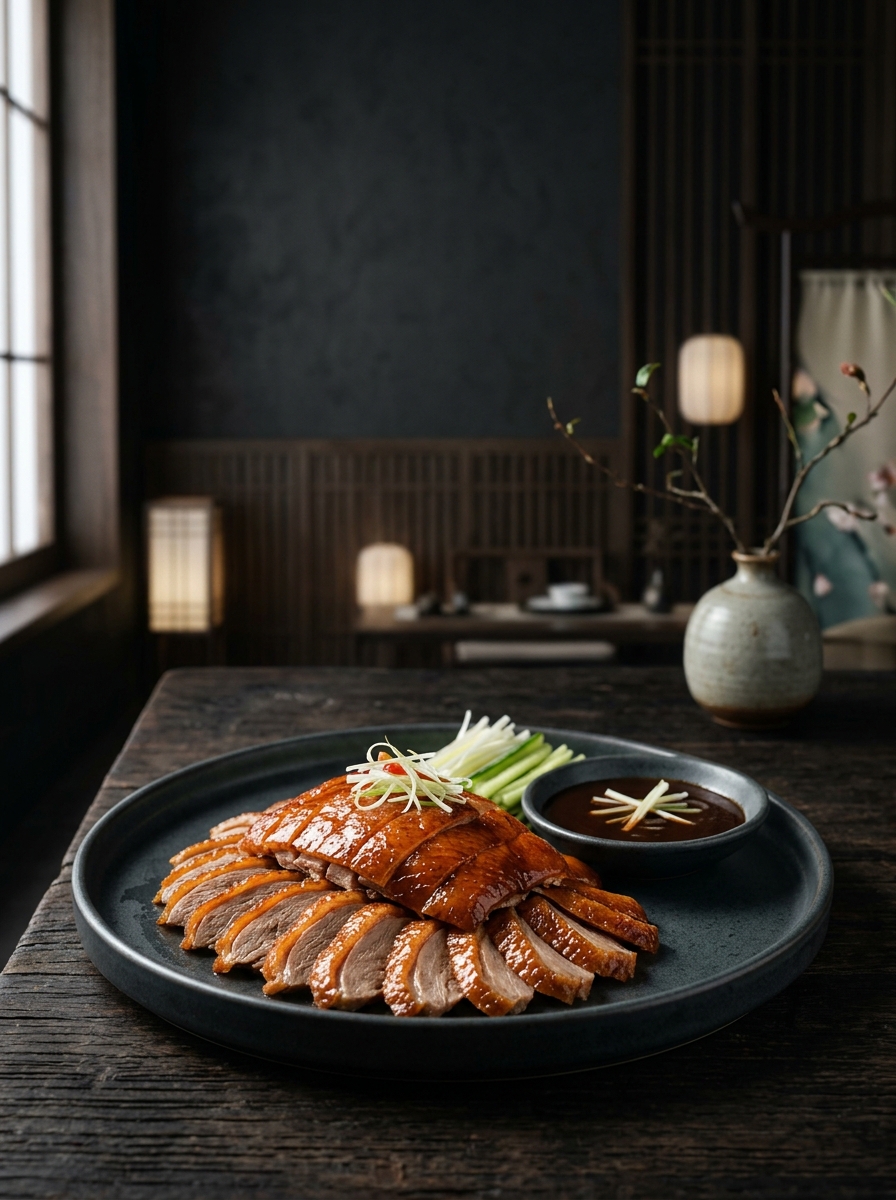
The report treats roast duck as a sequence of preparations, not a single roast. Inflating the bird separates skin from flesh so the skin can crisp; brushing the maltose glaze three times, five minutes apart, builds the deep jujube-red colour; and a full day of air-drying at 15–20 °C and 40% humidity is what makes the skin shatter instead of going soft — short drying is the commonest home failure, and there is no oven trick that replaces it. Roasting itself is two-stage: twenty minutes at 220 °C to colour and blister the skin, then twenty-five at 180 °C so the fat renders through without burning. The accompaniments are treated with the same care — scallion blanched five seconds, cucumber three, pancakes steamed two minutes — because a cold or raw garnish next to hot duck breaks the dish. Carving 118 slices is the report's standard, not a target to hit at home, but the order matters: breast first, then legs.
| Ingredient | US | Metric | Substitute / note |
|---|---|---|---|
| Peking duck, whole | 1 duck | 1 duck | About 3.5 jin (about 1.75 kg); a whole roasting duck from a butcher (adaptation for weight). |
| Maltose | 1.8 oz | 50 g | For the glaze; honey thinned with water is a substitute (adaptation). |
| White vinegar | 2.0 tbsp | 30 ml | For the glaze. |
| Cooking wine | 1.0 tbsp | 15 ml | For the glaze. |
| Salt | 0.2 oz | 5 g | For the glaze. |
| Sweet bean paste | 3.5 oz | 100 g | Tianmianjiang, served as-is. |
| Scallion segments | 1.8 oz | 50 g | Blanched 5 seconds, then iced. |
| Cucumber sticks | 2.8 oz | 80 g | Blanched 3 seconds, then iced. |
| Pancakes | 20 pieces | 20 pieces | Thin Mandarin pancakes, steamed 2 minutes. |
Crisp skin is made the day before, not in the oven: the duck must dry for 24 hours, and under-dried skin stays soft however hot the oven. In the oven, the two heats have separate jobs — 220 °C colours and blisters, 180 °C renders fat — and swapping their order or merging them into one temperature gives either pale, greasy skin or burnt skin over raw fat.
Drying removes moisture from the skin, which is what lets it crisp and blister in the oven. Short drying gives soft, leathery skin.
High heat first colours and blisters the skin; lower heat then renders the fat through without burning.
Yes, thinned with a little water — the glaze will be slightly sweeter and darker, so watch the colour during the high-heat stage.
Best eaten fresh from the oven; crisp skin softens within the hour. Leftovers keep 1–2 days refrigerated; reheat meat until steaming hot throughout — the skin will not fully re-crisp, though a hot oven helps.
A whole Peking duck — inflated, glazed, air-dried for a day, then roasted in two stages — carved into 118 slices and eaten in pancakes with sweet bean sauce. Ad
Ingredients: 1 whole Peking duck (about 1.75 kg); 50 g maltose; 30 ml white vinegar; 15 ml cooking wine; 5 g salt; 100 g sweet bean paste; 50 g scallion; 80 g cucumber; 20 pancakes.
Steps: 1) Inflate duck until skin separates; scald 3–4 times. 2) Brush maltose glaze 3 times, 5 minutes apart. 3) Air-dry 24 hours at 15–20 °C, 40% humidity. 4) Roast 20 minutes at 220 °C, then 25 minutes at 180 °C; rest 5 minutes. 5) Blanch scallion 5 seconds, cucumber 3 seconds; steam pancakes 2 minutes. 6) Carve breast then legs; serve skin-side up with accompaniments.
Poached chicken served cool with a ginger-scallion dip.
Cantonese barbecued pork with a sweet, caramelised edge.
Red-braised pork belly, sweet, savoury and meltingly tender.
Source note: ingredients, quantities and steps are adapted from the original ClouChef R&D report for 北京烤鸭 (data/reports/80.md). The report's pricing, margin and marketing sections are deliberately omitted here; no B2B cost is presented as a home-cook cost. Original poster image: clouchef.com (北京烤鸭_80.jpeg).