Lamb Noodle Soup
Warming lamb broth with noodles and tender lamb.
← Home · Beijing lamb hotpot winter banquet
Hand-cut lamb, sliced half a millimetre thin, swished in a clear broth for eight to ten seconds and eaten with sesame, fermented bean curd and chive-flower sauce. Adapted for a home kitchen from the original ClouChef R&D report — 涮羊肉, report 83.
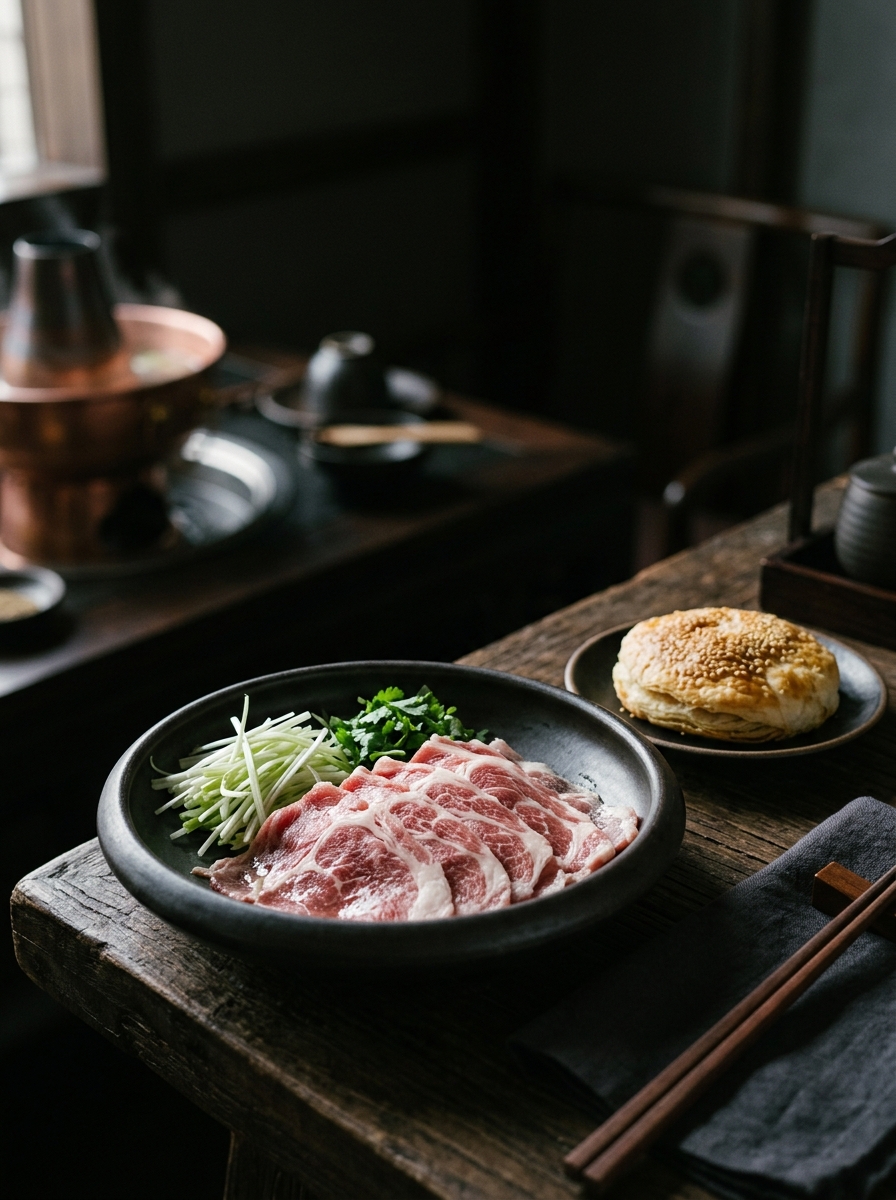
The report's version of hotpot is unusual: the lamb is cooked by the kitchen, not the diner, in a strainer lowered into boiling broth for eight to ten seconds, then served already cooked in a bowl preheated to 60 °C. That precision is the dish — eight seconds gives tender, just-set meat, and anything longer turns hand-cut lamb tough, which is why the report pairs the timer with a temperature check of at least 75 °C. The cutting matters just as much: lamb leg held at −2 to −4 °C, not frozen solid, slices against the grain into 0.5 mm sheets that curl the instant they hit the broth. And the dip is a formula, not a suggestion — sesame, fermented bean curd and chive flower in a 3:1:0.5 ratio, the sesame thinned 1:1.5 with 40 °C water — because the clear broth itself is deliberately plain, and all the flavour arrives in the dip.
| Ingredient | US | Metric | Substitute / note |
|---|---|---|---|
| Lamb leg, hand-cut | 14 oz | 400 g | Cut against the grain into 0.5 mm slices, 5–8 cm long, 8–10 g each, after chilling at −2 to −4 °C for 2 hours. |
| Water, for broth | 100 tbsp | 1500 ml | — |
| Scallion segments | 1.8 oz | 50 g | For the broth. |
| Ginger slices | 0.4 oz | 10 g | For the broth. |
| Goji berries | 0.2 oz | 5 g | For the broth. |
| Sesame paste | 2.8 oz | 80 g | Thinned with warm water at 1:1.5. |
| Fermented bean curd liquid | 1.1 oz | 30 g | Bean curd mashed with its liquid. |
| Chive flowers | 0.7 oz | 20 g | Drained; also called Chinese chive flowers. |
| Chilli oil | 0.5 oz | 15 g | — |
| Scallion greens | 0.4 oz | 10 g | Minced. |
| Coriander, minced | 0.4 oz | 10 g | — |
| Pickled garlic | 2.1 oz | 60 g | About 4 cloves, peeled whole. |
| Sesame flatbreads | 2 pieces | 2 pieces | About 120 g total; reheated in the oven until slightly crisp. |
Slicing temperature is the first control: at −2 to −4 °C the meat is firm enough to slice paper-thin; warmer and it tears, colder and it cannot be cut. The second control is the timer — eight to ten seconds in broth that never drops below a boil, with the broth replaced after an hour of continuous use. Thicker slices or cooler broth both break the timing, so check temperature, not just colour.
Hand-cut slices at 0.5 mm are thinner and more even than most frozen machine slices, and the report treats the knife work as the dish's signature.
Deliberately: clear water with scallion, ginger and goji lets the lamb flavour and the fermented dip do the work, instead of a spiced broth masking them.
Leg is specified for its firm texture and moderate fat. Shoulder is softer and fattier; it still works but slices less cleanly (adaptation).
Best eaten immediately. Leftover cooked lamb keeps 1 day refrigerated; reheat until steaming hot throughout. Uncooked sliced lamb keeps 1 day refrigerated, well wrapped, and must be cooked to at least 75 °C.
Hand-cut lamb, sliced half a millimetre thin, swished in a clear broth for eight to ten seconds and eaten with sesame, fermented bean curd and chive-flower sauc
Ingredients: 400 g lamb leg, hand-cut; 1500 ml water; 50 g scallion; 10 g ginger; 5 g goji berries; 80 g sesame paste; 30 g fermented bean curd liquid; 20 g chive flowers; 15 g chilli oil; 10 g scallion greens; 10 g coriander; 60 g pickled garlic; 2 flatbreads.
Steps: 1) Chill lamb at −2 to −4 °C for 2 hours; slice 0.5 mm against the grain. 2) Thin sesame paste 1:1.5 with 40 °C water; combine dip 3:1:0.5. 3) Boil broth with scallion, ginger, goji. 4) Swish 3–4 slices per batch for 8–10 seconds to at least 75 °C; serve in a 60 °C bowl. 5) Serve with dip, pickled garlic and reheated flatbreads.
Warming lamb broth with noodles and tender lamb.
Lamb stewed with radish in a warming Hunan style.
Cantonese barbecued pork with a sweet, caramelised edge.
Source note: ingredients, quantities and steps are adapted from the original ClouChef R&D report for 涮羊肉 (data/reports/83.md). The report's pricing, margin and marketing sections are deliberately omitted here; no B2B cost is presented as a home-cook cost. The report's ingredient cost table is arithmetically wrong — it prices a small quantity of pickled garlic at a sum far above its own stated unit price — so all cost figures are omitted. Original poster image: clouchef.com (涮羊肉_83.jpeg).